Mythology tattoo: choosing your myth, your god and your scale
A storm god hammering his drums down your shoulder, a one-eyed wanderer with two ravens on your forearm, or a small ankh on the wrist: a mythology tattoo can be a whole epic or a single sign, and the two need different plans. Choose the tradition and the figure, learn the story they really come from, then decide how much skin it deserves.
Three questions before you pick a god
Three things tend to go wrong here: a story the wearer learned too late, a symbol from a living religion, or an epic squeezed into a palm. So ask:
- Which tradition speaks to you? Heritage, a book you loved as a kid, a trip to Athens or Cairo, a fascination with storms. Any of these is a good reason.
- Figure, symbol or scene? A god's face is a portrait and needs room. A symbol (a trident, a raven, an eye) works small. A scene with gods, creatures and a landscape is a sleeve or a back.
- Which part of the story do you want to carry? Myths have dark corners. Read the figure's story first, and pick the moment that matches your meaning.
Greek mythology tattoo ideas: Zeus, Athena, Poseidon and Medusa
Greek gods come with clear attributes, which makes them easy to recognize on skin.
- Zeus is the sky and thunder god who rules as king of the gods on Mount Olympus; among his symbols are the thunderbolt and the eagle. A bearded head in realism, a hand gripping a thunderbolt or an eagle with lightning in its talons all read as Zeus.
- Athena, goddess of wisdom, warfare and handicraft and patron of Athens, has owls, olive trees, snakes and the gorgoneion among her symbols, and is shown with a helmet and spear. A helmeted profile suits the upper arm; a small owl on an olive sprig is the quiet version.
- Poseidon presides over the sea, storms, earthquakes and horses, and his symbol is the trident. Waves give him movement; our ocean tattoo guide covers water that flows around a limb.
Medusa, in more than one version
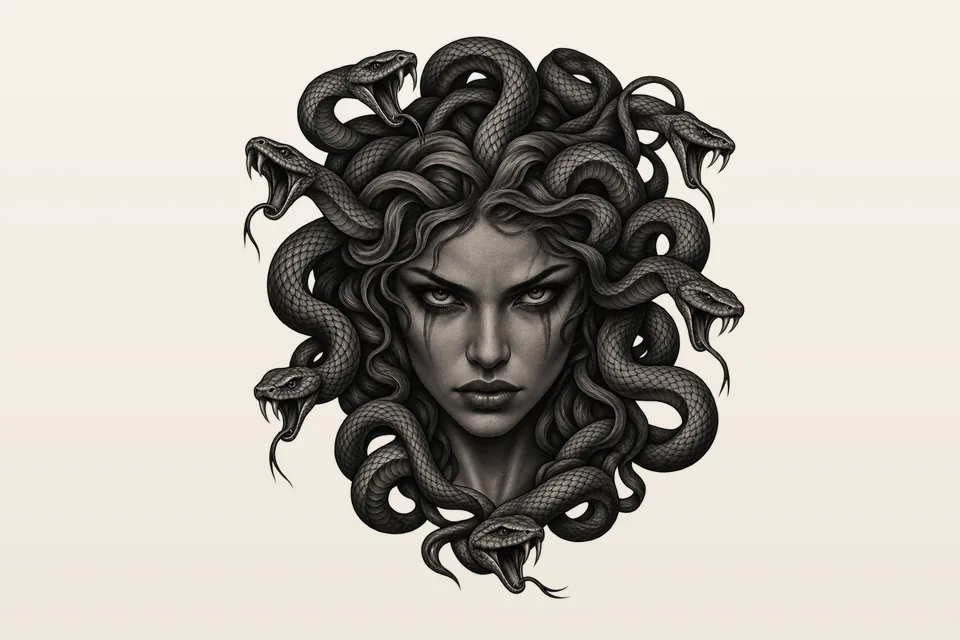
Wikipedia's Medusa article sums up the myth: she was one of three Gorgons and the only mortal one, and anyone who looked at her turned to stone. Perseus killed her with help from the gods, including a reflective shield from Athena, and Pegasus and Chrysaor sprang from her body. Athena placed the head on her shield, and the gorgoneion, Medusa's head, was used in antiquity to ward off evil.
In Ovid's later version she was a beautiful young woman whom Neptune lay with in Minerva's temple, and the goddess punished her by turning her hair into snakes; earlier texts don't mention this. Some people who wear her today mean that version. Decide which Medusa is yours, and tell your artist.
Norse gods: Odin, two ravens and the world tree
Odin is widely regarded as a god of the dead and of war, tied to poetry and wisdom. He has one eye, having sacrificed the other for wisdom, and in the poem Hávamál he hangs on a wind-rocked tree and takes up the runes. He carries the spear Gungnir and rides the eight-legged Sleipnir.
His ravens, Huginn and Muninn, fly across the world each day and tell him what they see and hear. Huginn's name is linked to thought and Muninn's to words that include memory, though the two overlap. Two birds make a strong small tattoo: one on each forearm, or a pair circling the back of the neck.
Yggdrasil is the immense sacred ash at the center of Norse cosmology, with the Nine Worlds around it, an eagle in its branches and the dragon Níðhöggr gnawing a root. A tree with roots and crown in a circle suits a shoulder blade; the full tree with its creatures is a back piece.
Egyptian symbols: Anubis, the Eye of Horus and the ankh
Egyptian imagery is graphic by nature: flat profiles, strong silhouettes and hieroglyph bands that wrap an arm like a border.
- Anubis, god of funerary rites and guardian of graves, is shown as a canine or a man with a canine head. His black color stood for regeneration and the rich soil of the Nile. At the weighing of the heart the heart was balanced against a feather, so a scale and a feather make natural companions.
- The Eye of Horus stands for protection, royal power and good health. Set damaged Horus's eye and it was restored, most often by Thoth, and wedjat-eye amulets were popular protective charms. Its bold lines hold up even at 3 to 4 cm.
- The ankh was the hieroglyph for "life," often held by gods or raised to the king's nose to give him the breath of life. A clean ankh is one of the simplest symbols to wear small.
Japan's storm gods, and myths to handle gently
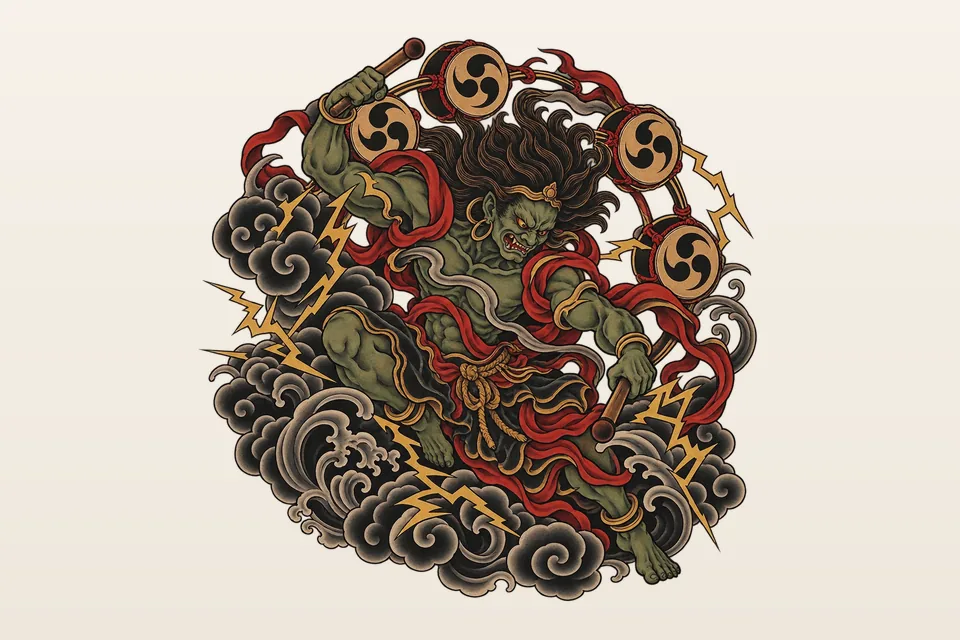
Raijin is a thunder god in Japanese mythology and in the Shinto and Buddhist religion, shown with a fierce face and wild hair, beating a ring of drums. His twin brother Fūjin, the wind god, carries a huge bag of winds on his shoulders, and the pair appear together on Tawaraya Sōtatsu's famous folding screen. On skin they work as a pair, one on each arm. Japanese tattooing has its own history and rules; our Japanese tattoo guide covers irezumi, and an artist from that tradition is the right person for a big piece.
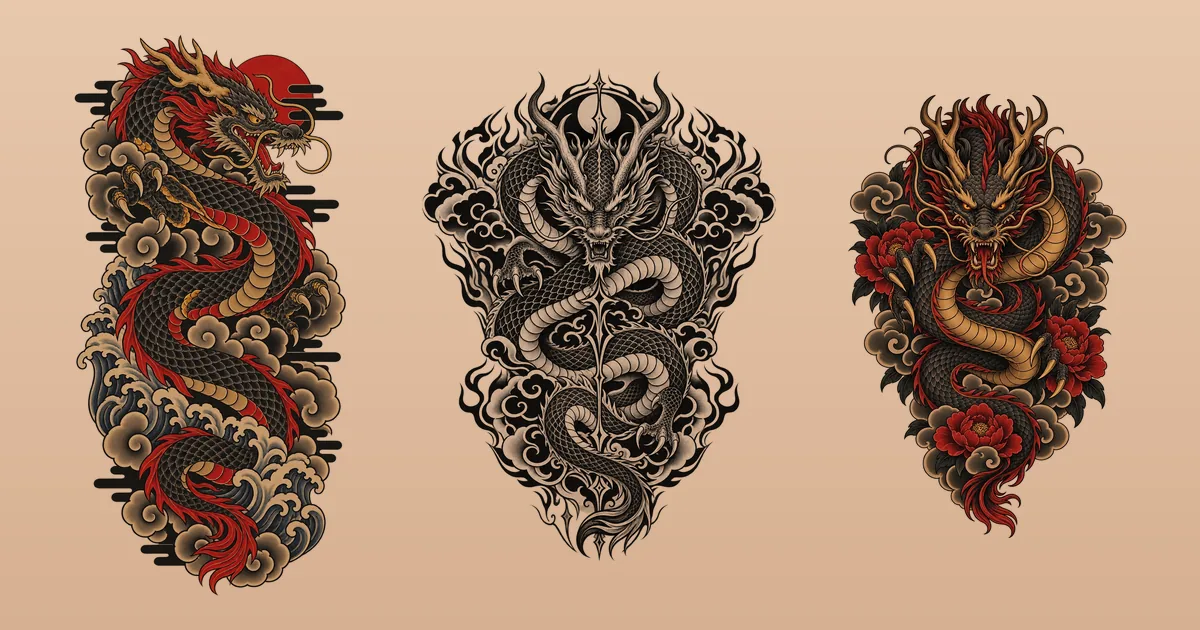
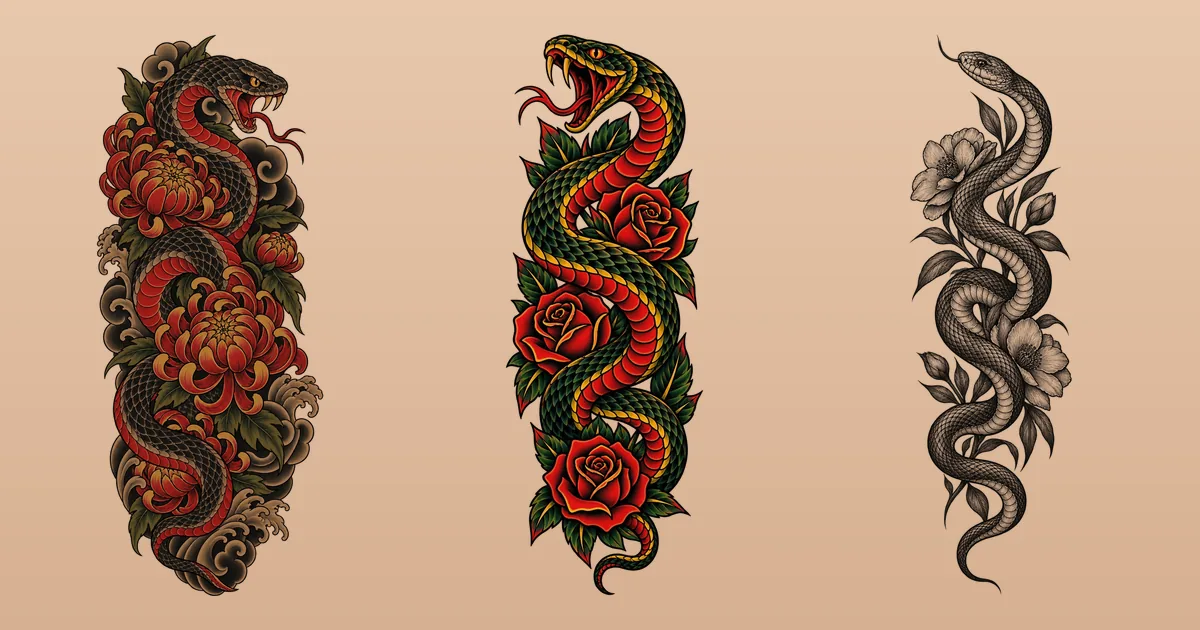
Two creatures cross every mythology: dragons have their own dragon tattoo guide, and serpents are in the snake tattoo guide.
Some gods are not mythology to everyone: Hindu deities, Buddhist figures and Shinto kami like Raijin are worshipped today. Learn the tradition and place them with care.
Scene or symbol: sizing and styling a mythology tattoo
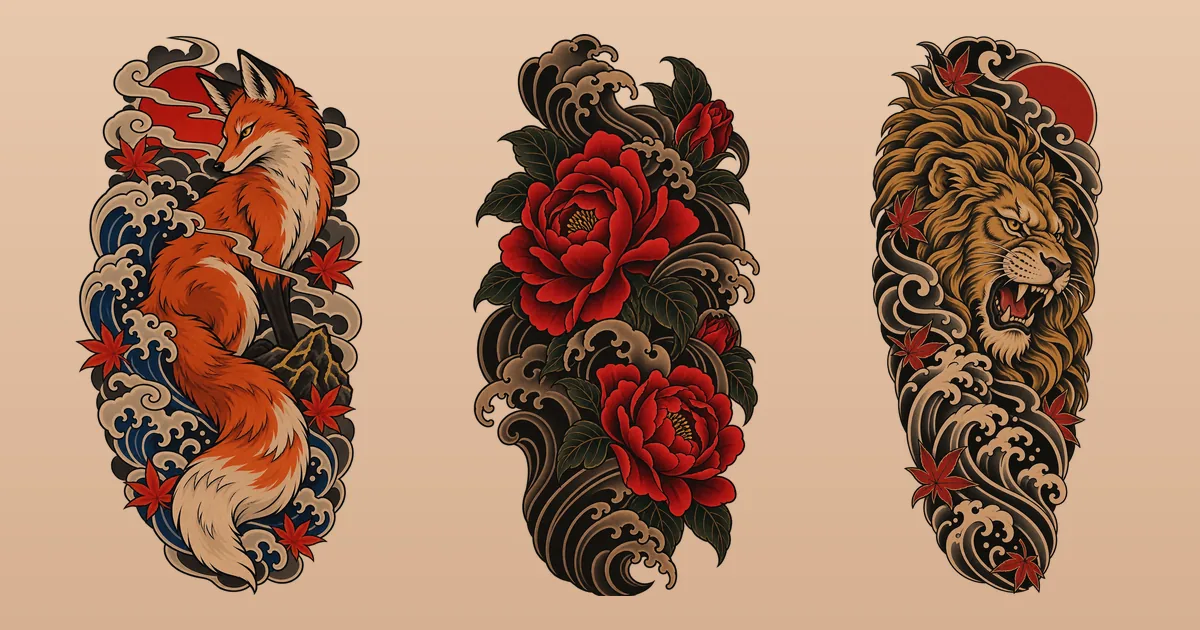
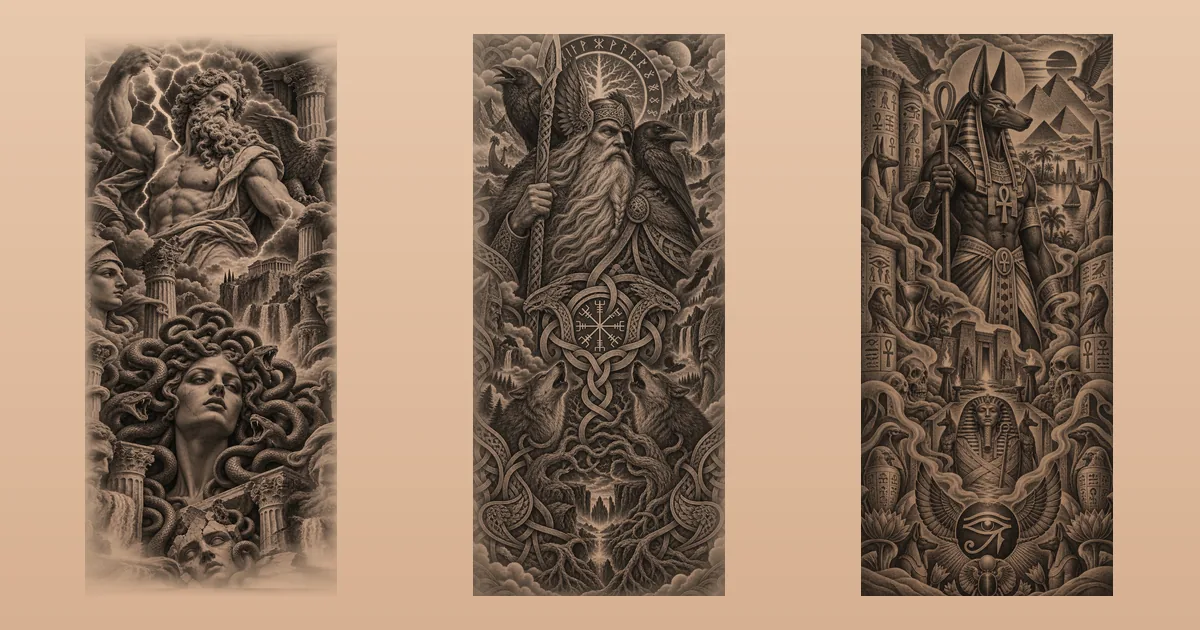
The three sleeves at the top of this page show the rule: a scene needs a limb or a back, with a god on the outer upper arm and a background (columns, knotwork, hieroglyph bands) wrapping around. Our sleeve tattoo guide covers the layout. A single symbol, by contrast, sits on a wrist, an ankle or behind the ear.
- Black and grey realism: marble-statue faces of Zeus or Medusa; faces need palm size or more.
- Illustrative etching: hatched lines like an old book plate, lovely for Norse trees and Greek scenes (see the etching tattoo guide).
- Japanese: bold outlines, wind bars and clouds, made for Raijin and Fūjin.
- Fine line: an owl, an ankh or two ravens; give thin lines a little more size than feels necessary.
Mixing mythologies works when it's deliberate: one style for the whole piece, each tradition in its own zone, a shared background between them. Don't blend gods into hybrids; Odin with a jackal's head will confuse anyone who knows either story.
Describing your myth to an AI or an artist
Name the figure, the moment, the style, and the size with the spot:
| Vague | Clear |
|---|---|
| Zeus tattoo | Zeus's bearded head in three-quarter view, thunderbolt raised, broken marble columns and clouds behind, black and grey realism, right upper arm half sleeve |
| Odin's ravens | two ravens circling each other, wings almost touching, illustrative etching, 8 cm, back of the neck |
| Egyptian tattoo | Anubis in profile holding an ankh, hieroglyph-style bands above and below, bold black lines, 16 cm, outer forearm |
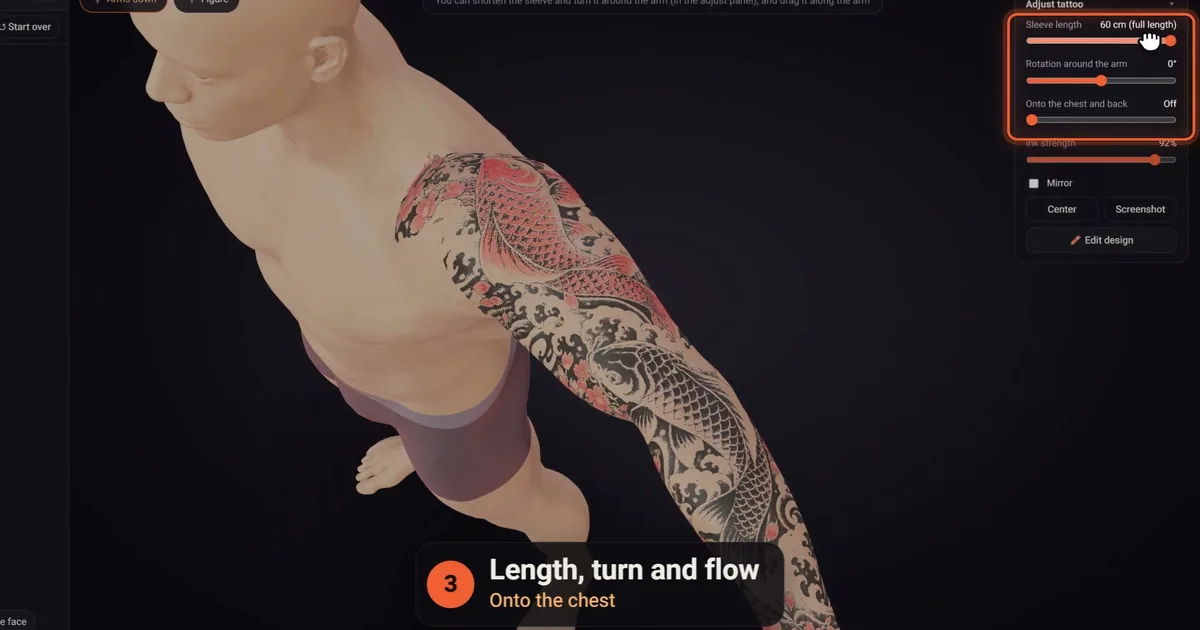
In click2ink, our own studio, you choose where it goes (a sleeve, the full back or a single spot) and a style, describe it, and can add a picture, such as a photo of a statue for the idea. The AI artist draws an original design that lands on a 3D figure sized to your height, so you see whether Poseidon fits the forearm or needs the whole arm. Then print a true-size stencil or share the 3D link with your artist. The how it works page shows each step.
Mythology tattoo questions
What does a Medusa tattoo mean?
It depends on the version. In the older myths she is a Gorgon whose gaze turns people to stone, and her head became a protective image meant to ward off evil. In Ovid's later version she is punished for what Neptune did to her, and some wearers read her as a survivor and a protector. Tell your artist which Medusa you mean.
Are Greek mythology tattoos for men or for women?
Both; the figures aren't tied to who wears them. Zeus and Poseidon heads in realism make strong half sleeves, Athena's helmeted profile and Medusa suit the forearm or thigh, and a small owl, olive sprig or trident works anywhere. Choose by the story and the size you want rather than by a list for men or women.
What is a good small mythology tattoo?
A single attribute rather than a full figure: Zeus's thunderbolt, Athena's owl, Poseidon's trident, one of Odin's ravens, an ankh or the Eye of Horus. Each reads from its outline alone, so it stays clear at 3 to 5 cm on the wrist, ankle or behind the ear. Faces, scenes and hieroglyph bands need far more room to keep their detail.
How do I plan a mythology sleeve?
Pick one tradition and one main figure for the outer upper arm, a second subject for the forearm, and a background that wraps around: clouds and columns for Greek, knotwork and branches for Norse, hieroglyph bands for Egyptian. Leave the inner arm lighter. Seeing it on a 3D figure first shows how the figures sit as the arm turns.
Is it disrespectful to get a Hindu god tattoo?
It can be, because Hindu deities are worshipped today. Many people object to sacred images on the feet or lower body, or in comic designs. If the faith matters to you, learn the deity's meaning, keep the image whole and dignified on the upper body, and talk to someone from the tradition or an artist who knows it before booking.
Are Norse runes a good idea for a tattoo?
They can be, if the text is right. Much of what is sold online as Viking runes is a modern mash-up, and spelling words in a rune row that never used them is a common mistake. Have the text checked by someone who reads Old Norse, and ask your artist where the symbols you like actually come from.
What do Odin's two ravens mean in a tattoo?
In the Norse sources Huginn and Muninn fly over the world each day and report back to Odin, and their names are linked to thought and memory. As a tattoo they usually stand for wisdom, curiosity or Odin himself. Two birds facing each other, or circling, make a balanced design for the forearms or the back of the neck.
Where can I get a mythology tattoo stencil?
Your tattoo artist makes the final stencil, fitted to your skin and placement. As a starting point, you can design the piece, check it on the body and print it at its real size with a 5 cm check ruler. Our tattoo stencil maker guide explains what artists need from a printed design.