Sleeve tattoos: how to plan one that flows all the way around
Hold your arm out and turn it slowly: outer forearm, soft inner arm, the point of the elbow, the round of the shoulder. Sleeve tattoos have to work on every one of those surfaces at once, and you'll never see the whole thing in one glance. That's why they reward planning more than any other tattoo.
Full, half, quarter: the kinds of sleeve tattoos
A sleeve tattoo is one big piece, or a group of smaller ones, covering most or all of an arm, and the word has spread to legs too. The lengths have names:
| Type | Covers | Good to know |
|---|---|---|
| Full sleeve | shoulder to wrist | one big story, or several pieces joined by a background |
| Half sleeve | usually shoulder to elbow | hidden by a T-shirt; a common starting point |
| Forearm sleeve | elbow to wrist | the most visible length; suits strong vertical designs |
| Quarter sleeve | shoulder to about halfway to the elbow | a big shoulder piece that can grow later |
| Three-quarter sleeve | shoulder to mid-forearm | a traditional Japanese length |
| Leg sleeve | thigh to ankle, or knee to ankle | a big canvas with room for large subjects |
Japanese tattooing has its own terms: in irezumi, a sleeve to the wrist is nagasode, and a three-quarter sleeve to the mid-forearm is shichibu.
One story, or a patchwork?
There are two ways to end up with a sleeve, and both are legitimate.
Planned as one piece
You and one artist design the whole arm from the start: a theme, two or three main subjects and a background that runs between them. It looks like a single work because it is one, and it asks for commitment up front.
Built over time
You collect separate tattoos, sometimes from different artists and different years, and later join them with a shared background. It reads more like a personal history than a single composition, and the joining takes a skilled artist.
If you're starting with single pieces but suspect a sleeve is coming, leave gaps between them and keep the styles compatible. The joining will be far easier.
How sleeve tattoos are built
Main subjects
Two or three anchors carry a sleeve, placed where they show best: usually the outer upper arm, the outer forearm and the shoulder cap. A koi on the forearm, a dragon over the shoulder, a peony near the elbow. More than three and they start to compete.
Background
The background, or filler, is what turns separate images into a sleeve. Traditional Japanese work uses clouds, waves and wind bars; other sleeves use smoke, foliage, dotwork or geometric patterns. A darker background makes lighter subjects stand out, and that contrast is what lets an arm read from across a room.
Flow
A sleeve should spiral with the arm, not stack in rows. Long diagonal shapes, like a koi swimming upward or a dragon's body coiling around the limb, lead the eye around. The elbow and the inner arm are the hard transitions, and designs there have to bend and stretch without breaking the picture.
Edges
Decide where it ends. A sleeve can stop at a clean line at the wrist, fade out, or carry over the shoulder onto the chest or back. Choose before the first session, because the edge shapes the whole layout.
Themes that carry all the way around
- Japanese. Koi, dragons, tigers, peonies, cherry blossoms and waves in a flowing background. Irezumi has its own long history and conventions, so look for an artist trained in it; our Japanese tattoo guide goes deeper.
- Black and grey realism. Forests, mountains, animals, statues or portraits, blended with smoke or clouds. It needs space, which a sleeve gives it.
- Polynesian and Māori-inspired. Patterns that wrap the arm naturally. Polynesian tatau has its own history, and Māori tā moko carries genealogy and identity; designs made in Māori style for others are known as kirituhi. Work with an artist from the culture, and see our guide to Polynesian and Māori tattoos.
- Botanical. Vines, roses, ferns and wildflowers climbing the arm, with plenty of open skin between them.
- Ocean. Waves, an octopus, a ship, a lighthouse or a whale, with the water itself as the background.
- Blackwork and ornamental. Bold bands, geometric panels and mandalas, which can also cover older pieces.
- Biomechanical. Machinery and muscle that seem to sit under the skin, a style that loves a big canvas.
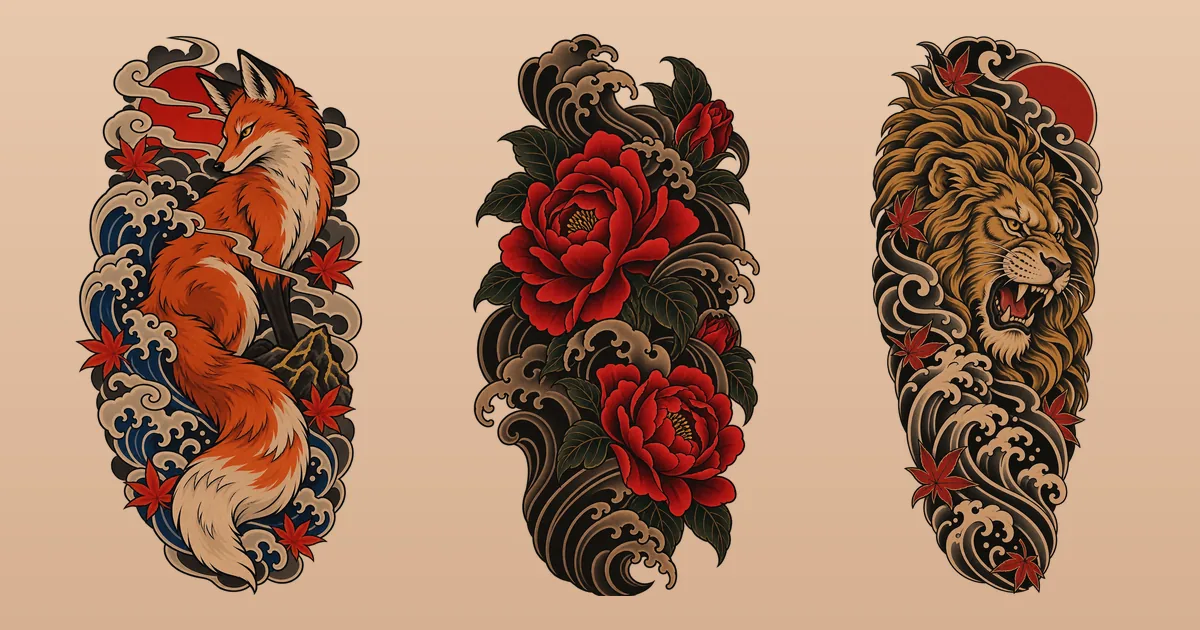
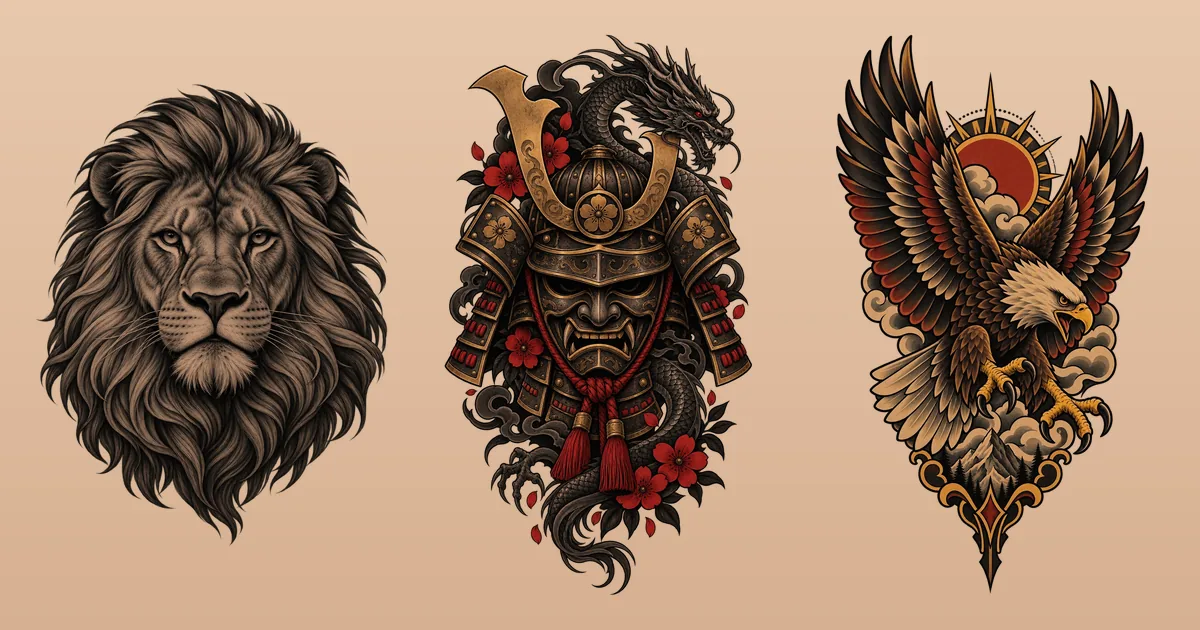
The click2ink library has 20 ready-made sleeves, free to put on the figure, which makes it quick to compare themes for sleeve tattoos before you describe your own.
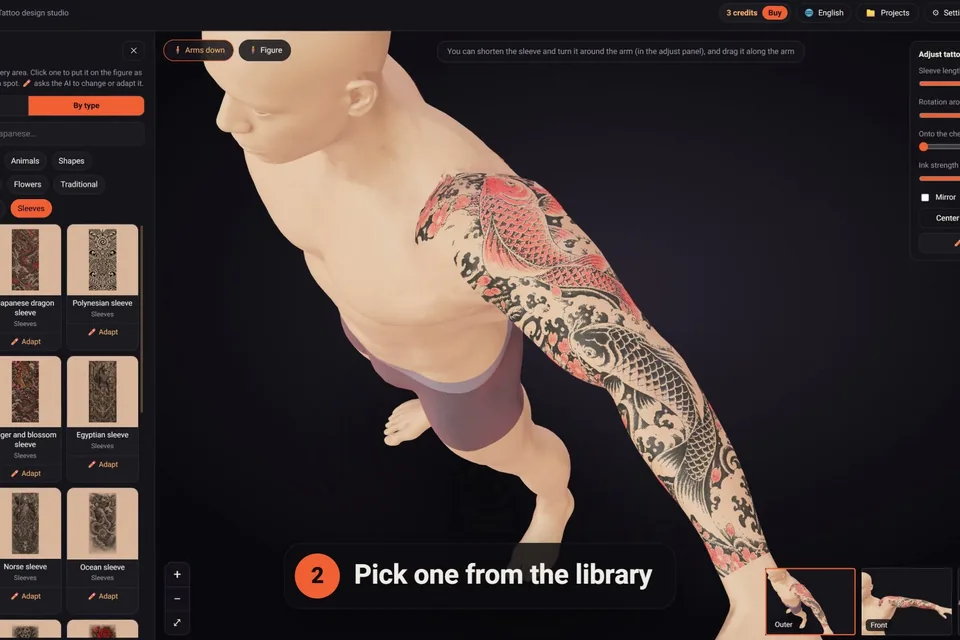
Plan your sleeve on a 3D arm
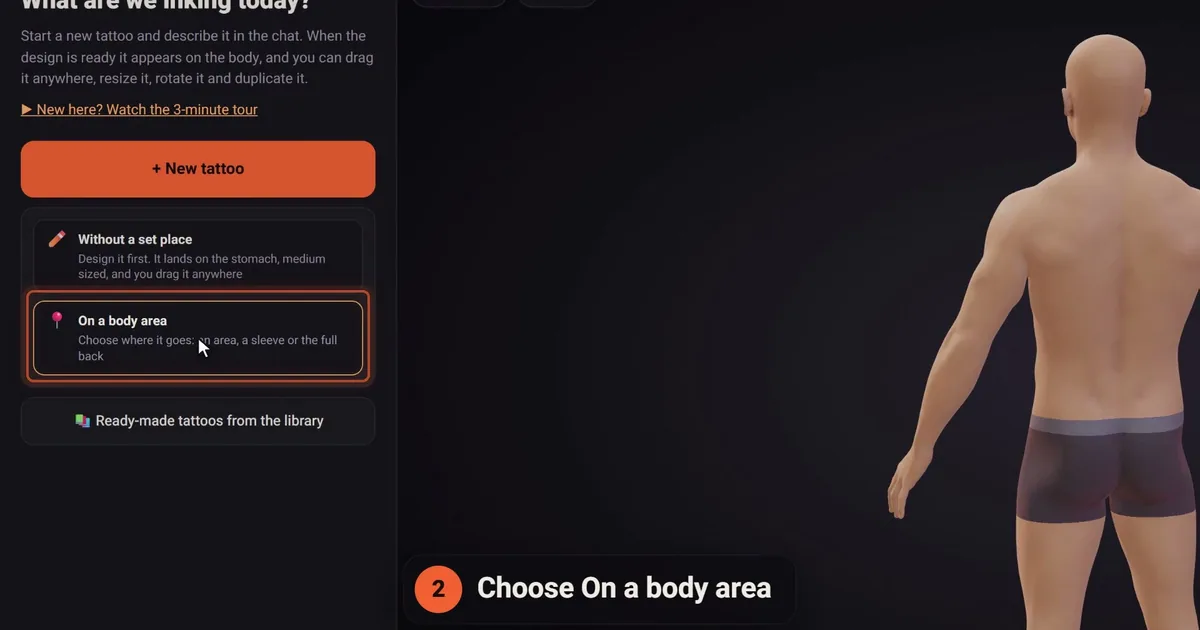
A flat drawing of a sleeve is always a little misleading, because the real thing wraps around. In click2ink, start a new tattoo and choose a full, half, forearm or leg sleeve, right or left. Describe the theme, the main subjects and the background, and the AI artist draws one continuous design all the way around the limb. A sleeve takes longer than a small piece, usually four to six minutes, and it keeps drawing on the server if you close the page.
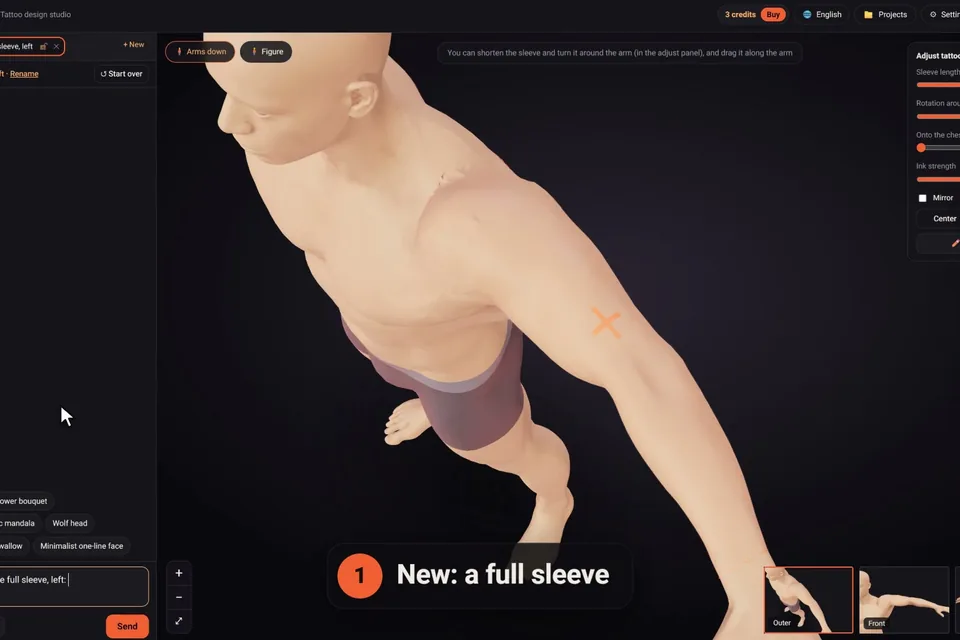
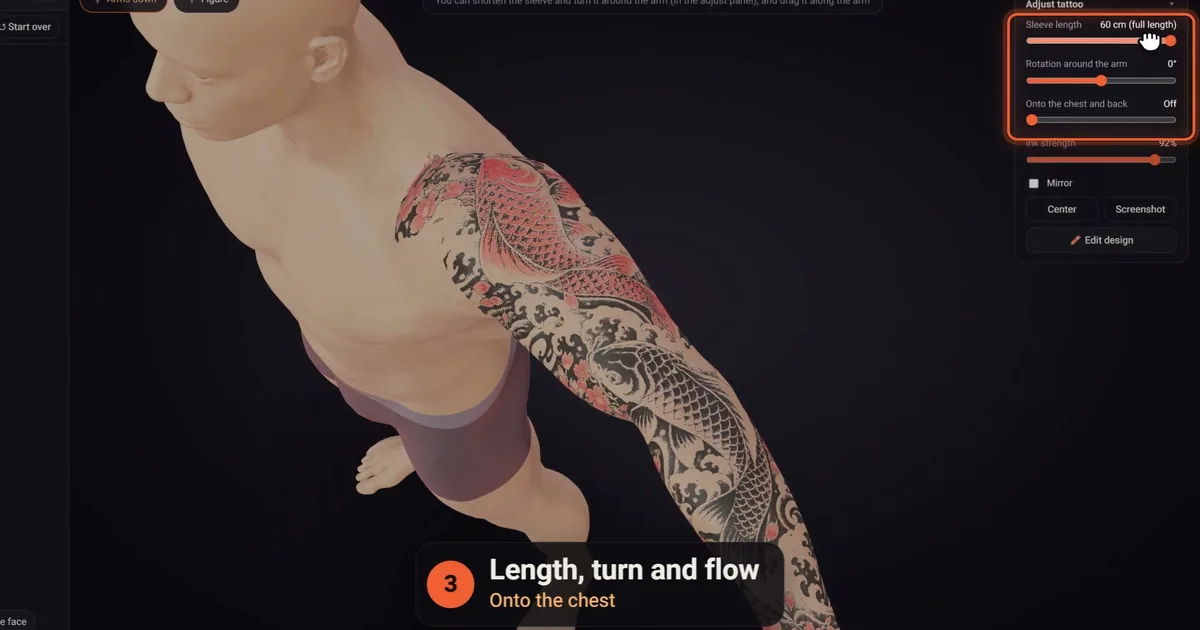
Then shape it on the body. Set the sleeve's length, slide it along the limb, turn it around the arm so the best part faces out, and let it carry on onto the chest and back, or onto the hip for a leg sleeve, fading out. Change one thing at a time in the chat, such as "make the koi swim upward" or "more waves around the elbow," and the AI keeps the rest. The features page shows each of the sleeve settings.
Time, sessions and one artist
Sleeve tattoos are a project, not an appointment. A planned sleeve can take weeks, months or years to finish, depending on the detail and how often you can sit, with healing time between sessions. Prices depend on the artist's rate and the hours involved, so ask for an estimate on your design rather than guessing from what someone else paid.
A sleeve usually looks most cohesive when one artist plans it. Bring them your plan: the design as a PNG, and a share link that shows the sleeve wrapping the 3D arm, which you can update as the plan changes. If you're torn between an arm and a leg, our tattoo placement guide helps you weigh them, and our tattoo designs for men guide, whose ideas suit anyone, covers forearm and upper-arm pieces that can grow into a sleeve.
Before you commit to a sleeve
How long does a sleeve tattoo take?
Longer than most people expect. A full sleeve is usually spread over several sessions with healing time in between, and depending on the detail and your schedule it can take weeks, months or even years. Realism and dense Japanese work tend to take longer. Ask your artist for an hour estimate on your specific design before you start.
What's the difference between a half sleeve and a quarter sleeve?
A half sleeve usually covers the upper arm from the shoulder to the elbow, though some people use the term for the forearm, elbow to wrist. A quarter sleeve covers only the top of the arm, from the shoulder to about halfway to the elbow. A quarter is a good start if you're unsure, because it can grow later.
Can I turn the tattoos I already have into a sleeve?
Often, yes. A skilled artist can link existing pieces with a shared background, such as smoke, clouds, waves or patterns, so they read as one sleeve. Bring clear photos of what you have. In click2ink you can attach a photo of a tattoo on your skin and the AI lifts it off as a clean design, ready to place and plan around.
Does a sleeve need one theme?
No, but it needs something that ties it together. That can be a theme, a style, a color palette or a background running through everything. Patchwork sleeves of unrelated pieces can look great when the styles are compatible and the gaps are filled with care. What rarely works is several clashing styles all at full volume.
Is the inner arm worth tattooing?
It depends on the look you want. A full sleeve with a bare inner arm can look unfinished when you raise your hand, while some designs leave it open on purpose. The inner arm is often described as one of the more sensitive parts of the arm, so some people leave it for a later session. Your artist can suggest what suits the design.
Can a sleeve continue onto the chest or back?
Yes, and it's a classic way to finish one. The design flows over the shoulder and fades into the chest or the shoulder blade, which also leaves a natural starting point for a chest or back piece later. In click2ink, the "Onto the chest and back" setting shows where the fade would end before anything is decided.
How much does a sleeve tattoo cost?
It depends on the artist's rate, your city and the hours your design needs, so any number without those facts is a guess. Ask for an estimate on your specific plan. Planning the design before you start helps: fewer surprises mid-project, and the hours go into tattooing rather than redrawing as you go.
Can a sleeve be done in fine line?
Yes. Fine line sleeves usually keep more open skin: botanicals, celestial pieces, small illustrations and script spread around the arm, sometimes linked by thin lines or dots. They read more delicately from a distance, so choose a few larger elements to anchor the arm. Look for an artist whose healed fine line work you like.
Should I start with the upper arm or the forearm?
Artists differ on where they like to begin, so ask yours. Starting on the upper arm keeps things easy to cover while the sleeve grows; starting on the forearm gives you the part you'll see most. Plan the whole layout first, and the order matters much less.