Snake tattoo: meanings across cultures and designs that coil with you
Look at the emblem of the World Health Organization and you'll find a snake coiled around a staff, a sign of medicine that goes back to Asclepius, the Greek god of healing. The same animal is the tempter in Eden, a ring of eternity biting its own tail and a companion of a Japanese goddess of fortune, so a snake tattoo can say almost anything.
Healer, tempter, guardian: one animal, many meanings
Few animals carry so many opposite meanings. Some of the traditions behind them:
- Healing (ancient Greece): the rod of Asclepius, a single snake around a staff, is still the main symbol of medicine, and the World Health Organization's emblem uses it. The caduceus, with two snakes and wings, belongs to Hermes, though it's often used for medicine too, especially in the United States.
- Temptation and cure (the Bible): in Genesis the serpent is a deceiver, cursed to crawl on its belly; later, Moses raises a bronze serpent on a pole to heal those who were bitten.
- Eternity (Egypt and Greece): the ouroboros, a snake eating its own tail, came into Western tradition through ancient Egyptian imagery and Greek magic, and is read as endless renewal: life, death and rebirth.
- Fortune (Japan): Benzaiten, a goddess of water, music and fortune and one of the Seven Lucky Gods, is linked with snakes and dragons, and may be shown with Ugajin, a white snake with a human head.
- Guardians (Hinduism and Buddhism): nāgas are half-human, half-serpent beings tied to water; the nāga king Mucalinda sheltered the Buddha from a storm with his seven heads.
- Renewal: snakes shed their skin, an obvious picture of a fresh start.
The snake is also the sixth sign of the Chinese zodiac; recent snake years were 2013 and 2025. Which reading is yours depends on what surrounds the snake, and on you; our guide to meaningful tattoos helps with the choosing.
Six shapes a snake tattoo can take
A snake has no fixed outline, which is why it fits places other subjects can't. The shapes artists come back to:
- The long S: straight down the spine, the back of the leg or the forearm, head at the top.
- The wrap: two or three coils around the forearm, the upper arm, the calf or the ankle, planned in the round so the body stays continuous.
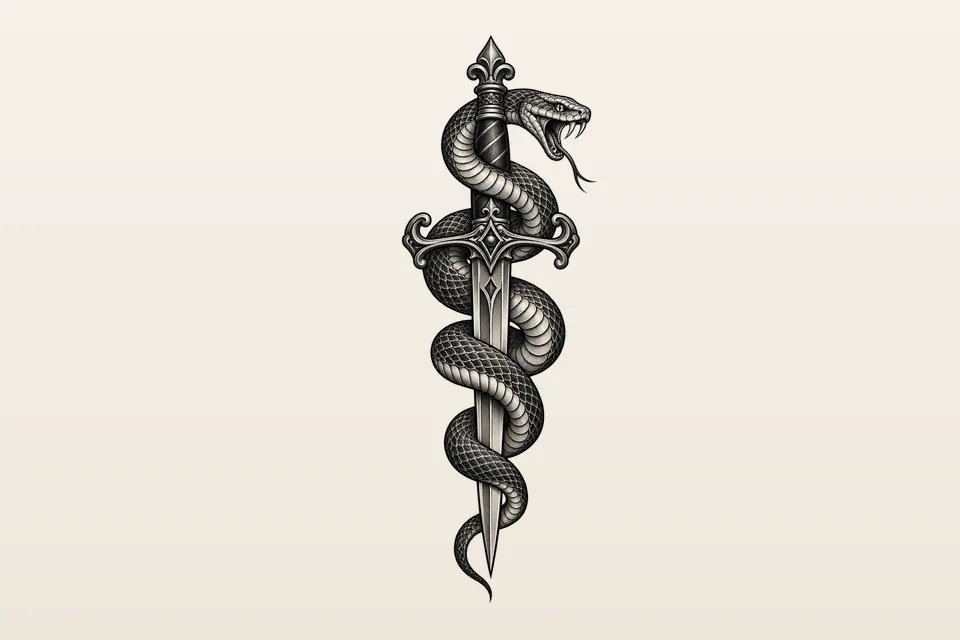
- Around an object: a dagger, a rose stem, a skull or a branch gives the coils something to grip, the classic flash format.
- The coil: a tight spiral with the head raised in the middle, for the shoulder cap or the thigh.
- The ring: an ouroboros around the wrist or the upper arm, or a closed circle on the back of the neck.
- The front view: a cobra with its hood spread, symmetrical, for the sternum or the upper back.
Daggers, roses, skulls: the snake's classic partners
- Snake and dagger: a staple of traditional flash, often read as danger faced head-on or betrayal survived. Our traditional tattoo guide covers the style it comes from.
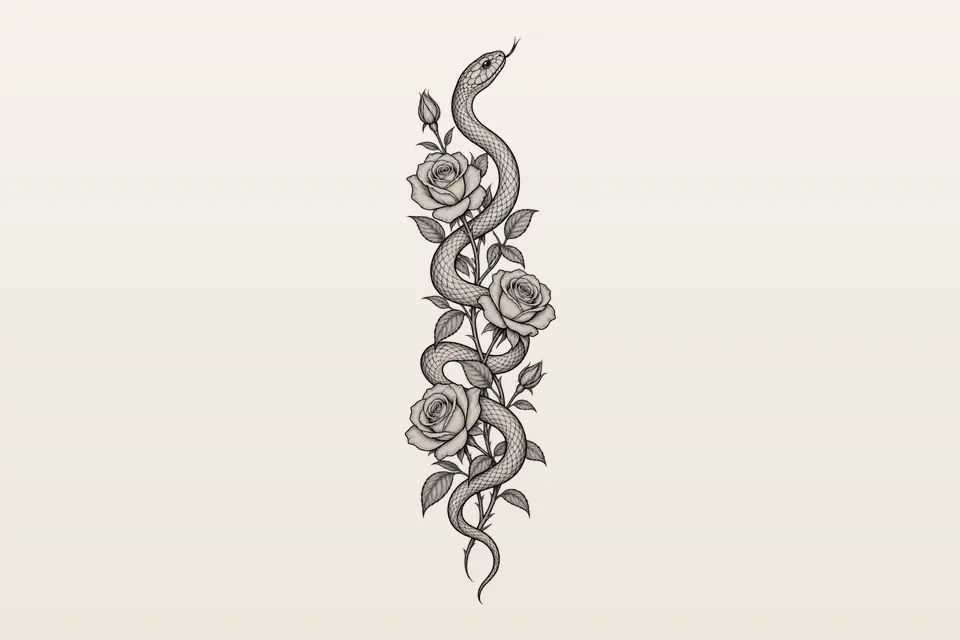
- Snake and rose: temptation and beauty together, the Eden story in one image; the rose tattoo guide covers what the flower adds.
- Snake and skull: death and renewal side by side.
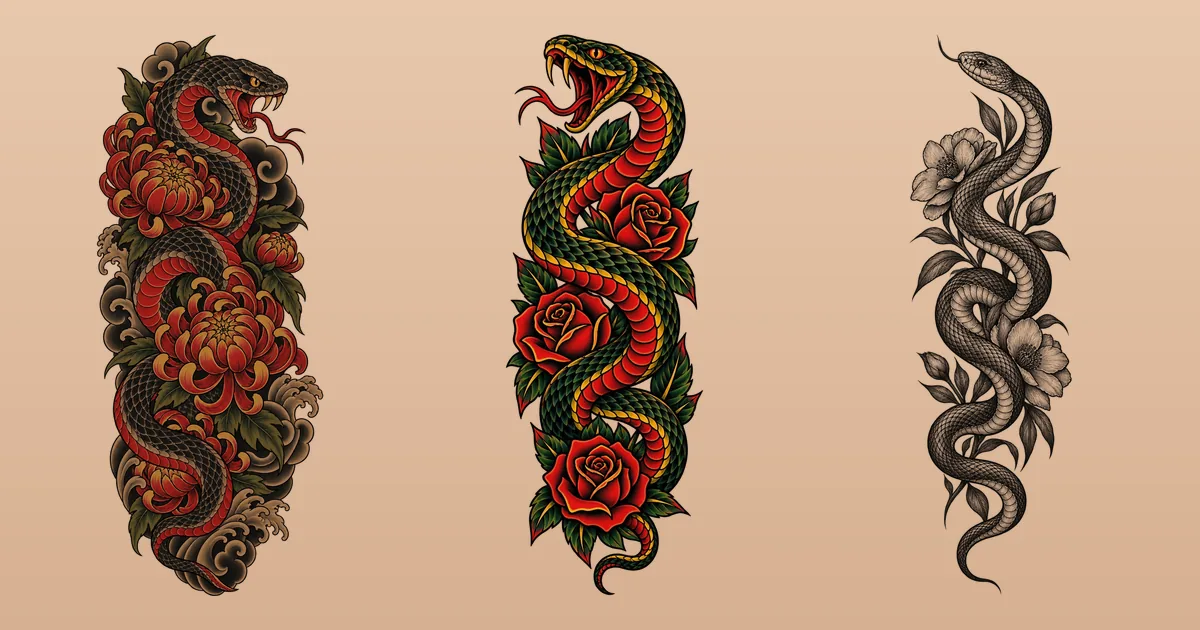
- Snake and flowers, Japanese style: chrysanthemums or peonies with waves, as in the first design at the top of this page; our Japanese tattoo guide explains how such pieces are built.
- Snake and apple: the Eden story at its plainest.
- Two snakes on a winged staff: that's the caduceus, Hermes' symbol. If you work in health care and want a medical emblem, the single-snake rod is the one the WHO uses.
Head, scales and tongue: the details that set the mood
Two snakes in the same pose can feel completely different. The details that decide it:
- The head: an open mouth with fangs reads aggressive; a closed mouth with the tongue flicking out reads calm and watchful.
- The twist: where the body turns, a stretch of the wide belly scales makes the coil read in 3D.
- The scales: full scales need size. On a small piece, a simple crosshatch or a few rows near the head suggest the rest.
- The species: a cobra's hood, a rattlesnake's rattle or the bold bands of a king snake make the design specific; on a small piece, keep one signature trait.
- The style: traditional snakes often come in green with a yellow or red belly and heavy outlines; the Japanese snake at the top of this page pairs dark scales with a red underside; fine line and illustrative etching keep it light and graphic; black and grey realism suits a big piece.
If you find yourself adding legs, claws and clouds, you're drifting toward a dragon; our dragon tattoo guide picks up there.
Plan the coils on a 3D figure
A snake that wraps a limb has to be judged in the round, which a flat drawing can't show. click2ink puts the design on a 3D figure you can turn to every side: you describe the tattoo in a chat, an AI artist draws an original design, and the Adjust panel can wrap it around the limb, resize it in real centimeters and rotate it. Arms out shows the inner arm, the part of a wrap that's easiest to forget. Descriptions that work:
- "A snake spiraling twice around the left forearm, head on the back of the hand, American traditional, green with a yellow belly"
- "An ouroboros in fine line, a closed ring on the back of the neck"
- "A black and grey cobra with its hood spread, centered on the upper back"
Ask for one change at a time ("close the mouth," "one fewer coil") and the AI keeps the rest; every version keeps its number, so going back is easy. New accounts start with 3 free credits, enough for 12 messages, and the free library holds 450+ ready-made designs, including the snakes on this page; pricing lists the packs. Then print the stencil at its real size and take it, with the 3D share link, to your tattoo artist.
Snake tattoo questions worth asking
What does a snake tattoo mean in Japan?
In Japan, snakes are tied to Benzaiten, a goddess of water, music and fortune and one of the Seven Lucky Gods, who may be shown with Ugajin, a white snake with a human head. In tattoos, a Japanese snake is often drawn with flowers such as chrysanthemums or peonies and a background of waves. If a specific meaning matters, ask an artist who works in the tradition.
What's the difference between the rod of Asclepius and the caduceus?
The rod of Asclepius has one snake around a plain staff and belongs to the Greek god of healing; it's the medical symbol used by bodies such as the World Health Organization. The caduceus has two snakes and a pair of wings and belongs to Hermes, a messenger god tied to commerce, though it's often used for medicine too, especially in the United States.
What does an ouroboros tattoo mean?
An ouroboros is a snake, or sometimes a dragon, eating its own tail. It reached Western tradition through ancient Egyptian imagery and Greek magic, and it's usually read as eternity, wholeness or the cycle of life, death and rebirth. As a closed ring it suits the wrist, the ankle, the upper arm or the back of the neck.
Should a snake tattoo's head point up or down?
Up, toward the shoulder or the neck, reads as rising and alert; down, toward the hand, reads as moving on or coming to rest. Many people decide by flow instead: on a forearm wrap, a head ending on the back of the hand is striking, while a spine piece usually has the head near the nape. Settle it before the stencil, since the layout follows the head.
Can a snake wrap all the way around my arm?
Yes. A wrap is one continuous design that circles the limb, so it has to be planned in the round rather than as a flat picture. Two or three coils around a forearm or a calf read well; more turns need a longer limb or a slimmer snake. Your artist may freehand part of it on your arm so the coils sit evenly on the muscle.
Can a snake link tattoos I already have?
Often, yes. A snake's body can wind between existing pieces and tie them into one composition, which makes it a handy way to turn scattered tattoos into a sleeve. Plan where the head and the tail land, match the line weight of the work around it, and bring photos of every existing tattoo to your artist so the path fits the gaps.
How big should a snake tattoo be?
Let the shape decide. A small ring or a short S-curve works at palm size; a snake wrapped around a dagger or a rose needs the length of a forearm or a calf; a full wrap or a cobra across the upper back needs room for scales and coils. If the scales matter to you, go bigger, or simplify them for a smaller piece.
Is a snake tattoo bad luck?
Not by any rule. The snake's readings run from healing and fortune to danger and deceit, depending on the tradition, and a design tilts it one way or the other: a snake on a staff, a closed ring, fangs bared over a skull. If someone in your family or community holds a strong view about snakes, it's worth hearing before you book.