Japanese tattoo: the motifs, meaning and flow of irezumi
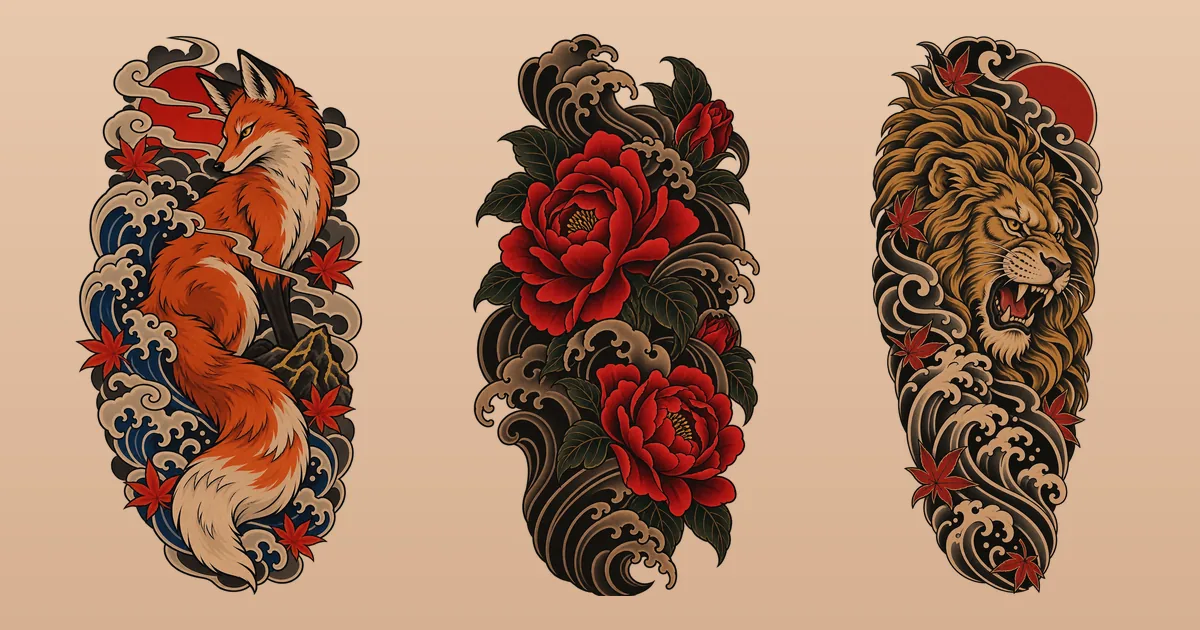
Ask a tattooer who specializes in Japanese work for "just a koi on my forearm" and you will often hear a question back: what's around it? A Japanese tattoo is a whole composition, not a single picture. One bold subject, a background of water, wind or clouds that moves with it, and a shape planned around the muscle underneath. Here is how that system works.
Where the Japanese tattoo comes from
The Japanese word for tattoo is irezumi, literally "inserting ink." You will also hear horimono for traditional pictorial work, horishi for the masters who make it, and tebori for tattooing by hand rather than by machine.
The style most people picture took shape in the Edo period. Tattoos were used then as a criminal punishment, while a decorative, pictorial kind grew up alongside the woodblock print. A Japanese edition of the Chinese novel Suikoden (Water Margin), published in 1757, created a demand for tattoos like the ones in its illustrations. Around 1827 to 1830, Utagawa Kuniyoshi's best-selling prints of the novel's 108 heroes showed them adorned with dragons, lions, snakes and peonies. The Museum of Fine Arts, Boston, explains in its Tattoos in Japanese Prints exhibition that tattoo artists' oral tradition credits that series with a new fashion for extensive pictorial tattoos.
The Meiji government outlawed tattooing, and it was legal again only from 1948. For many years the style was associated with the yakuza, and that stigma still shapes daily life in Japan: many public baths, gyms and hot springs turn away tattooed guests. In 2020, Japan's Supreme Court ruled that tattooists do not need a medical license.
Subject, background, edges: how a Japanese piece is built
Traditional work is built in layers. Know them and you can describe what you want far more clearly.
| Layer | What it does | Typical choices |
|---|---|---|
| Main subject | Carries the story and sits on the strongest part of the muscle | Koi, dragon, tiger, phoenix, hannya mask, a hero from folklore |
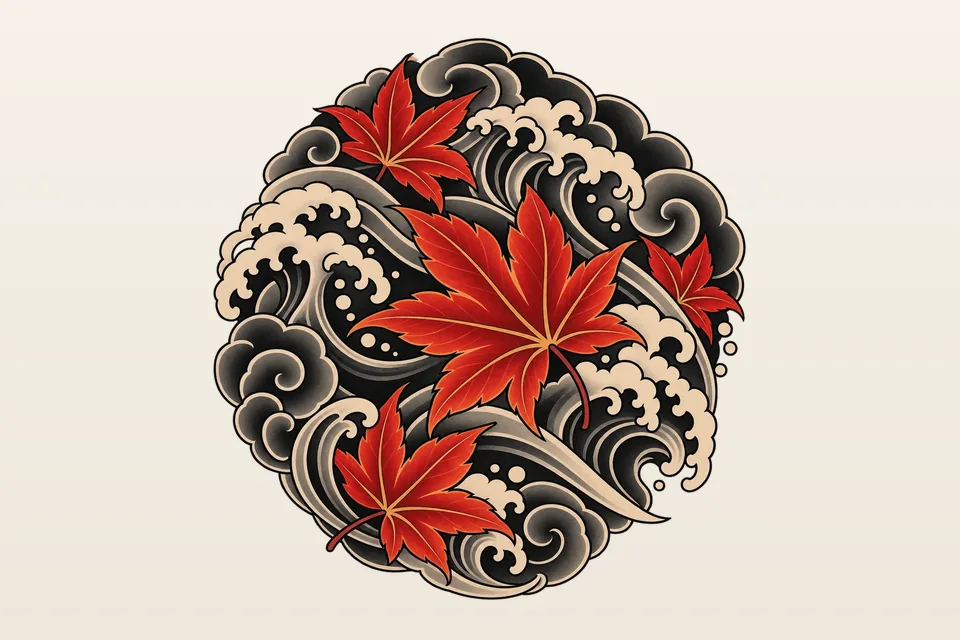
| Flowers and leaves | Add color, set the season, soften the transitions | Peony, cherry blossom, chrysanthemum, maple leaves, lotus |
| Background | Ties everything together and gives it movement | Wind bars, waves, clouds, rocks, flames |
The background is what separates real Japanese work from a picture with a Japanese subject. Wind bars, waves and clouds are shaded in black and grey, they fill the space between the main elements, and they run in one direction so the eye travels along the limb. Outlines are bold, blacks are solid, and the palette stays limited: reds, touches of yellow, green and blue, and plenty of grey.
The edges are planned too. A large piece ends in a deliberate line instead of fading out, and the classic chest layout, munewari, leaves an open strip of skin down the middle of the chest. The design is drawn for the whole arm or the whole back, not for a rectangle.
Classic subjects and what they carry
Meanings in Japanese tattooing come from folklore, theater and religion, and from combinations: a koi among peonies says something different from a koi turning into a dragon. These are the readings you will hear most often:
- Koi: perseverance, from the legend of the carp that climbs a waterfall at the Dragon Gate and becomes a dragon.
- Dragon: strength, wisdom and protection, usually coiled through clouds or water.
- Tiger: courage and protection, often shown with bamboo or wind.
- Hō-ō: the mythical bird often called the Japanese phoenix, a sign of good fortune.
- Hannya: a Noh theater mask of a woman consumed by jealousy and rage, worn for reasons from protection to a reminder of strong emotion.
- Foo dogs: curly-maned guardian lions, often paired with peonies.
- Flowers: peonies for wealth and good fortune, cherry blossoms for the beauty and shortness of life, chrysanthemums for long life (the chrysanthemum is also the imperial emblem).
- Maple leaves: autumn and the passing of time.
Many artists keep the seasons consistent, so spring cherry blossoms rarely share a scene with autumn maple leaves. Buddhist figures such as Fudō Myō-ō or Kannon carry real devotional meaning; if one speaks to you, ask your artist how they are traditionally treated before you commit.
Placement: sleeves, back pieces and single subjects
Japanese work was designed for big canvases, because the background needs room to move. The classic layouts:
- A full sleeve, shoulder to wrist, usually with the main subject on the outer upper arm and the background running down to the wrist.
- A half sleeve, shoulder to elbow, easy to extend later.
- A back piece, from the shoulders to the top of the thighs, the most traditional canvas of all.
- A chest panel, spreading from the shoulder across the pec and stopping short of the centerline.
- A thigh or calf piece, tall enough for a single koi or dragon.
A full traditional bodysuit is a project of years, not weeks. For something smaller, keep the rules: one subject, a bold outline and at least a little background. A coin-sized koi with no water around it loses most of what makes the style Japanese. Our guide to sleeve tattoos walks through planning an arm from shoulder to wrist.
Wearing irezumi with respect
Japanese tattooing is a living tradition, with masters who still train apprentices, some of them in tebori. Anyone can admire the style; wearing it well comes down to a few habits:
- Learn the stories. Know what a hannya or a Fudō Myō-ō is before it goes on your skin.
- Have any Japanese text checked by a fluent reader, ideally a calligrapher. Characters copied from the internet can be wrong, mirrored or meaningless.
- Choose an artist who works in the style, and look for healed sleeves and back pieces in their portfolio, not only fresh photos.
- Check a bath, gym or hot spring's tattoo policy before you travel; rules differ from place to place.
If you are still choosing between this and other bold styles, our overview of tattoo styles puts Japanese work next to neo-traditional, blackwork and tribal.
Sketching a Japanese tattoo before you book
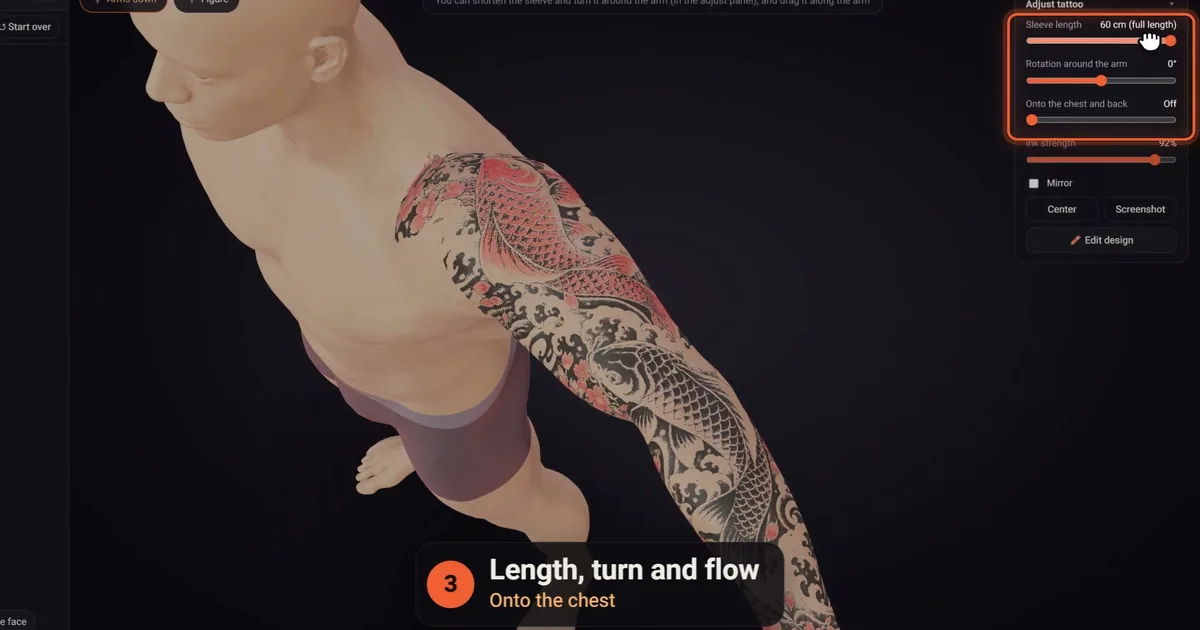
A consultation goes better when you arrive knowing the subject, the background and the placement, and that is where an AI design tool helps. In click2ink you pick Japanese among the 16 styles, choose where it goes (a single spot, a forearm, half or full sleeve, or the full back), and describe it in plain words:
- "A koi swimming up the outer forearm toward the elbow, black waves and wind bars behind it, red and gold scales, a few cherry blossoms"
- "A dragon wrapping the upper arm, head resting on the shoulder, clouds in black and grey, no flowers"
- "A tiger coming down a rock across the full back, bamboo on one side, muted colors"
The design lands on a 3D figure, and a sleeve wraps all the way around the limb, so you can see how the background flows from shoulder to wrist; you can turn it around the arm, shorten it or let it carry on onto the chest. Ask for one change at a time ("darker waves," "turn the koi so it swims upward") and the AI keeps everything else. The click2ink library also holds ready-made Japanese designs and 20 sleeves to try on the body for free, and how it works shows the whole flow.
Then bring it to your artist as a reference. A good Japanese-style tattooer will redraw it, especially the background, to fit your body, which is exactly how it should go.
Japanese tattoo questions, answered
Is irezumi the same thing as a Japanese-style tattoo?
Irezumi is simply the Japanese word for tattoo, but in English it usually means traditional Japanese work: large pictorial pieces with bold outlines and flowing backgrounds. "Japanese style" is broader and covers work made anywhere that follows that look, by hand or by machine. Neo-Japanese keeps the same structure but adds newer subjects and brighter color.
Can I get a Japanese tattoo if I'm not Japanese?
The style is practiced and taught around the world, and many artists trained in it tattoo clients of every background. What matters is how you approach it: learn what your subjects mean, avoid unchecked text, treat religious figures with care, and choose an artist who knows the tradition rather than one who only copies its surface.
Can I visit a hot spring in Japan with tattoos?
Sometimes. Many public baths, gyms and hot springs in Japan still refuse guests with tattoos, a habit linked to the old association between tattoos and organized crime. Policies differ from one place to the next and change over time, so check with each facility before you go. Some travelers book a private bath instead.
Which way should a koi swim in a Japanese tattoo?
There is no single rule. A popular modern reading says a koi swimming upstream shows a struggle still underway, while one swimming down shows a challenge already overcome. Many artists also choose the direction for how the piece flows along the limb. Decide what you want it to say, and tell your artist before the stencil is drawn.
How long does a Japanese sleeve take?
It depends on the size, the amount of color and how much your skin can take in one sitting, so only your artist can estimate it. A full sleeve is usually planned as a series of long sessions spread over months, with healing time in between, starting with the outline and moving on to shading and color.
Do Japanese tattoos have to be in color?
No. Black and grey Japanese work is common and very striking, because the style's strength lies in its bold outlines and the contrast between solid black and open skin. When color is used, it follows a limited palette, usually reds with touches of yellow, green and blue against grey backgrounds. Ask to see healed examples of both before you decide.
Can a Japanese tattoo be small?
It can, within limits. A small piece should hold one subject, a bold outline and a hint of background, such as a few waves or a single cloud. Very small koi or dragons lose their scales and whiskers, and without any background they stop reading as Japanese. The outer forearm, the calf and the shoulder suit a compact piece.
What is tebori?
Tebori is tattooing by hand, the traditional Japanese method. Instead of using a machine, the artist pushes needles fixed to a long handle into the skin with a steady rhythm. It is slower than machine work and takes many years to learn, and relatively few artists offer it, so finding one takes some research.
Should my Japanese tattoo include kanji?
Traditional pictorial work does not need any text. If you want a word or a name, have a fluent speaker check the characters and choose the writing style, because characters copied from the internet can be wrong or mirrored. Brushwork by a calligrapher, turned into a stencil, looks far better than a typed font.