Dragon tattoo: which dragon, what it means and where it coils
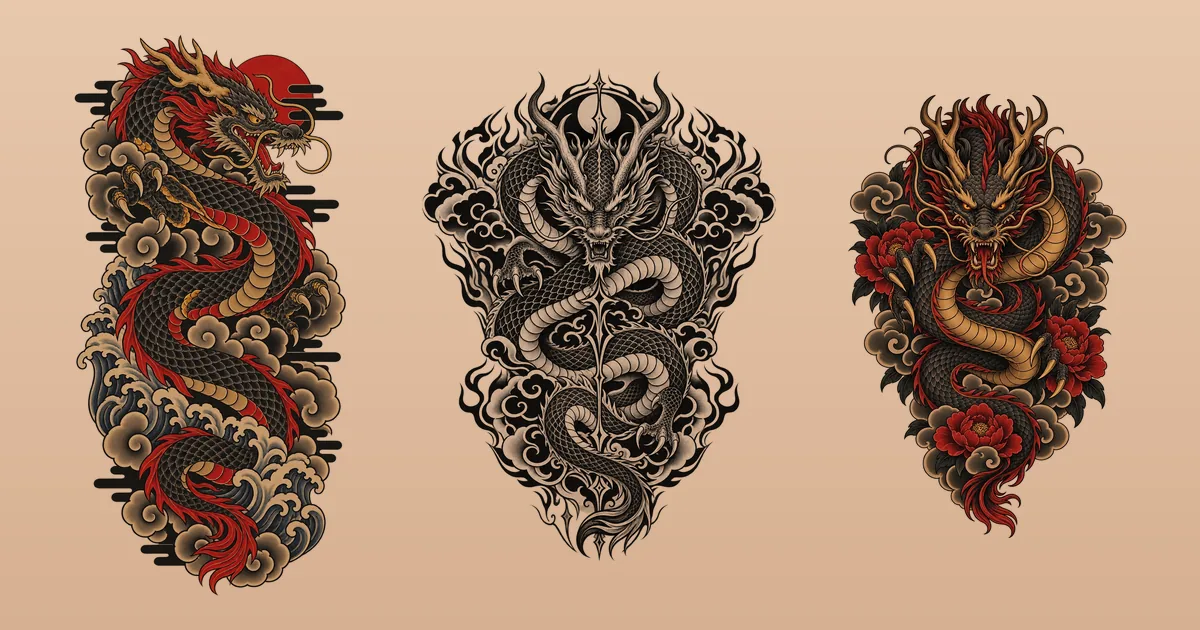
Which dragon do you mean? The long, wingless dragon of Chinese and Japanese art, coiling through clouds and bringing rain, and the winged, fire-breathing dragon of European legend share scales and claws and very little else. Settle that first, and every other choice in a dragon tattoo, from its meaning to the way it wraps your arm, gets easier.
Three dragons, three traditions
The three come from different stories, and the differences show up in the drawing:
| Chinese dragon | Japanese dragon | European dragon | |
|---|---|---|---|
| Body | Snake-like, with four legs; most have no wings | Large, wingless and serpentine, with clawed feet | Lizard-like and horned, with bat-like wings and two or four legs |
| Claws | Usually five on the emperor's dragon in many dynasties | Often drawn with three | Varies |
| Element | Water and weather; the dragon god dispenses rain | Water gods linked with rain, rivers and the sea | Fire, which it breathes |
| Usual role | Power, prosperity and good luck; a symbol of the emperor | Water deity; Ryūjin, the dragon god, rules the seas | Mostly a menace, guarding treasure until a hero slays it |
The Japanese dragon grew out of Chinese dragon mythology, blended with native legends, which is why the two look so alike; Wikipedia's articles on the Chinese dragon and the Japanese dragon trace the details. Many Chinese dragons are shown with a flaming pearl under the chin or in the claws. The European dragon isn't always a villain either: a red dragon is the emblem on the flag of Wales, and dragons fill medieval heraldry.
Rain, power, partnership, victory: reading a dragon
Because the traditions differ, so do the readings. The ones you'll meet most:
- Power and good fortune (China): the dragon traditionally stands for potent, auspicious powers, especially over water and weather, and for prosperity and luck. For centuries it was also the emperor's emblem.
- A balanced partnership (China): paired with the fenghuang, often called the Chinese phoenix, the dragon pictures a balanced, blissful relationship.
- Water and rain (Japan): most Japanese dragons are water deities, so in tattoos they coil through clouds and waves. Our Japanese tattoo guide tells the story of the koi that climbs a waterfall and becomes a dragon, a favorite image of perseverance.
- A battle won (Europe): in European legend the dragon is usually the enemy, from Saint George's dragon to the treasure-hoarding beasts of folk tales, so a western dragon can stand for a fight you won, raw power, or a guardian of what's precious.
- Your birth year: the dragon is the fifth animal of the Chinese zodiac; recent Years of the Dragon were 2000, 2012 and 2024, and the next is 2036.
- Modern fantasy: fiction has turned dragons into intelligent, noble companions, and that reading counts too.
Details steer the reading. A dragon chasing a pearl, rising out of waves, wrapped around a sword or asleep on a hoard tells four different stories.
Fitting a long body to your body
A dragon is mostly body: a head with horns and whiskers, four sets of claws and a long, scaled length that has to go somewhere. The classic solutions:
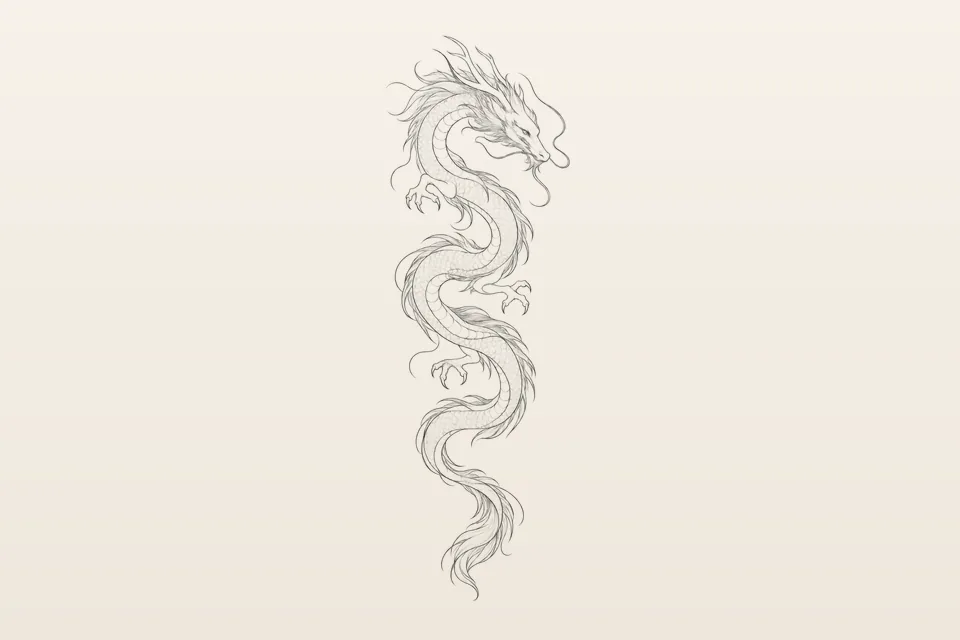
- The S-curve: head at one end, tail tapering at the other, for the forearm, the calf or the spine, like the fine line design below.
- The wrap: in a half or full sleeve the body coils around the arm, the head usually on the shoulder or the upper chest, with clouds or waves filling the gaps.
- The back piece: in traditional Japanese work a dragon can fill the back from the shoulders to the hips; our back tattoo guide covers that canvas.
- The chest panel: head on the pec, body sweeping over the shoulder and down the arm.
- The coil: the body knotted into a round shape with the head at its center, for the shoulder cap or the outer thigh.
Give the head the best spot and the most room, because that's where every eye goes; the scales can simplify toward the tail. Size is the honest limit: full scales, whiskers and claws need length, so a small dragon works best as a simplified fine line or silhouette version. If you want the coils without the legs, our snake tattoo guide is the dragon's cousin.
Dragon tattoo styles, from irezumi to fine line
The three dragons at the top of this page are Japanese, blackwork and neo-traditional. Each style changes the creature's temper:
- Japanese: bold outlines, solid blacks, wind bars, clouds and waves, and a limited palette; the dragon is one part of a whole composition.
- Neo-traditional: deep reds and golds, heavier ornament, often peonies.
- Blackwork: solid black flames and clouds around the body, graphic and striking from across a room.
- Black and grey realism: scales and smoke in soft shading, for large pieces.
- Fine line: thin, light lines, the gentlest way to wear a dragon.
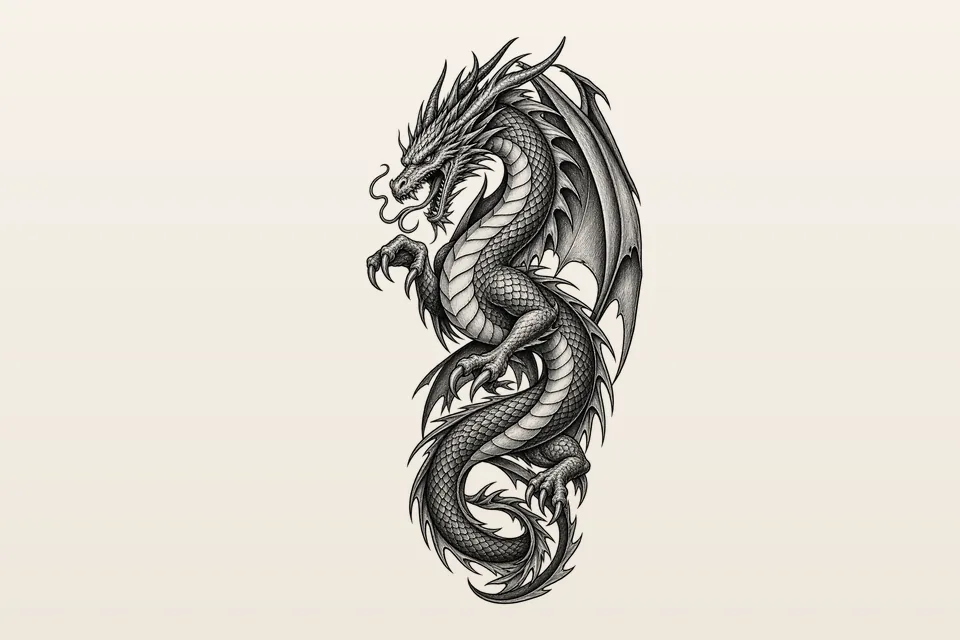
- Illustrative etching: hatched scales like an old engraving.
Our overview of tattoo styles compares these and the rest in more depth.
See the whole dragon on a 3D body
A dragon is hard to judge flat, because it lives on the curve of a limb or a back. In click2ink you describe the tattoo in a chat, an AI artist draws an original design, and it lands on a 3D figure you can turn to every angle. For a first tattoo, choose where it goes (a full or half sleeve, right or left, the full back, or a single spot) and a style, then describe it:
- "A Japanese dragon wrapping the left upper arm, head on the shoulder, black and grey clouds, red and gold accents"
- "A fine line dragon in one long S-curve down the spine, holding a pearl in its front claw"
- "A European dragon with wings spread across the upper back, illustrative etching"
A sleeve is one continuous design all the way around the limb: set its length, slide it along the arm, turn it, or let it carry on onto the chest and back. Big pieces take the AI four to six minutes, and the Detailed setting suits a final version. Ask for single changes ("close the mouth," "more clouds behind the tail"), compare the numbered versions, and try the 20 ready-made sleeves in the free library. When it's right, share the 3D link or print the stencil for your artist, who will redraw it to fit you; features lists the rest.
Borrowing a dragon from another culture, carefully
Chinese and Japanese dragons belong to living traditions, and their details carry meaning for the people who know them. A few habits help:
- Learn what the elements mean: the claw count, the pearl, the phoenix, and the seasons of the flowers in Japanese work.
- Have any Chinese or Japanese characters checked by a fluent reader, ideally a calligrapher; text copied from the internet can be wrong or mirrored.
- Look for an artist who specializes in the style, and ask to see healed work.
- Mix traditions on purpose, if at all: a winged dragon in Japanese waves will look odd to anyone who knows irezumi.
Dragon tattoo questions, from claws to zodiac years
Do Japanese dragons always have three claws?
Often, but not always. A nineteenth-century writer described the Japanese dragon as invariably three-clawed, and three-clawed dragons are common in Japan, while five claws marked the emperor's dragon in many Chinese dynasties and four appear in Korea and Mongolia. Treat the count as a convention that signals one tradition, not a law every artist obeys.
What's the difference between a Chinese and a Japanese dragon tattoo?
They're close relatives: Japanese dragon myths grew from Chinese ones blended with native legends, and both are long, wingless and tied to water. The differences in a tattoo come mostly from convention and style: the claw count, the flaming pearl that often goes with Chinese dragons, and the bold outlines, wind bars and waves of traditional Japanese tattooing. Tell your artist which one you want.
What does a dragon and phoenix tattoo mean?
In Chinese tradition the dragon is paired with the fenghuang, often called the Chinese phoenix, as a picture of a balanced and blissful relationship; the empress was often identified with the phoenix, while the dragon stood for the emperor. That makes the pair a natural choice for couples, in one design or split between two people.
What is the ball a dragon holds?
It's usually a flaming pearl, which many Chinese pictures show under the dragon's chin or in its claws. Its readings vary between sources, so if the symbolism matters to you, ask an artist or a reader who knows the tradition. In a design it also gives the composition a focal point close to the head, which helps the eye find the face.
Can a dragon tattoo be small?
Yes, if you simplify it. A small dragon works as a fine line S-curve or a bold silhouette, with the scales suggested by a few marks and only the head drawn in detail. Full scales, whiskers and four sets of claws need length, which is why traditional dragons are planned for sleeves, legs and backs. The inner forearm suits a compact one.
Is the Year of the Dragon a good reason for a dragon tattoo?
It's a lovely one. The dragon is the fifth animal of the Chinese zodiac, and recent dragon years were 2000, 2012 and 2024, with the next in 2036. Zodiac years follow the lunar calendar, so if your birthday is in January or early February, check which animal it actually falls under before you build a design around it.
Can a dragon tattoo look gentle instead of fierce?
Easily. Close the mouth, soften the eyes, give it a pearl or a flower to hold instead of prey, and let it rest in clouds rather than flames. A fine line or soft black and grey version reads gentler than bold blackwork, and an eastern dragon, linked with rain and good fortune, often feels calmer than a fire-breathing western one.
Which way should a dragon face?
Toward the center of your body, or along the direction you want the eye to travel. On a sleeve the head usually rests on the shoulder or the chest; on a back piece it often looks over one shoulder. Some people like an ascending dragon, head up, for rising fortunes. Decide before the stencil goes on, because the layout follows the head.