Ocean tattoo ideas: how to put the sea on skin so it still reads
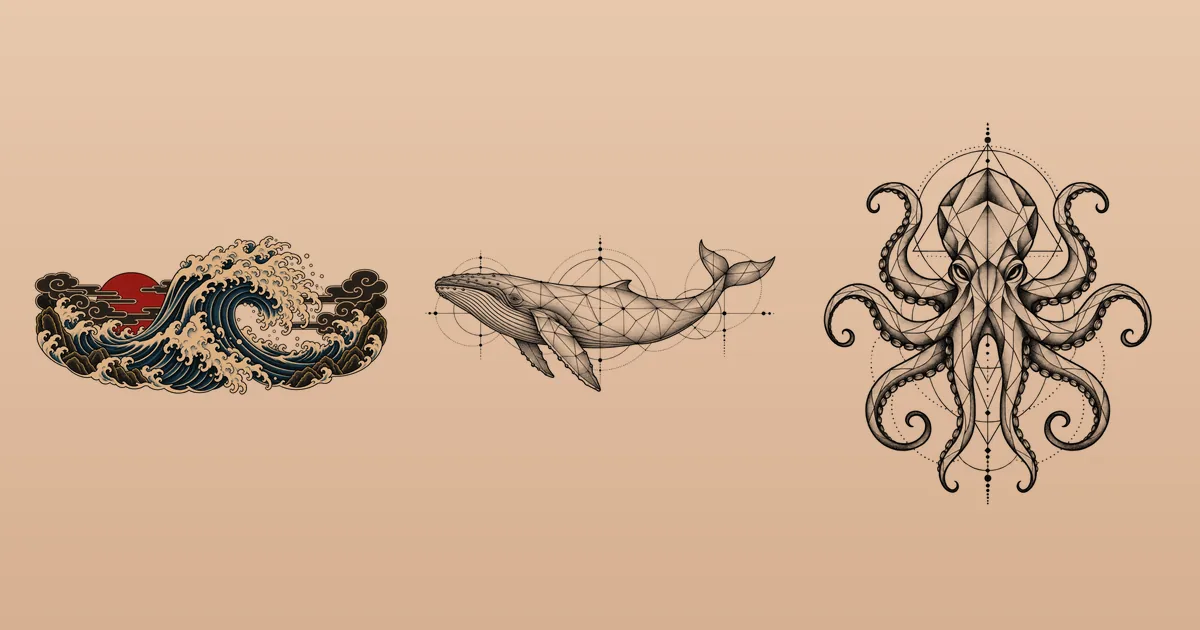
Water has no outline. That is the first problem with any ocean tattoo: the sea you love is light, movement and depth, and a tattoo is ink in skin that has to hold a shape for decades. The good news is that tattooers have solved it many ways, from three thin wave lines to a whale gliding around a whole leg. Here is how each one is built.
Four ways to build an ocean tattoo
"Ocean" is a theme, not a design, so the first decision is which part of it carries the piece. Almost every sea tattoo falls into one of four families:
| Approach | What carries it | Typical size |
|---|---|---|
| The wave | The water itself: a curl, a crest, a few lines | From 3 cm lines to a full back |
| The creature | One animal with a hint of water around it | 8–25 cm |
| The scene | A slice of the underwater world: reef, light, several animals | 20 cm and up |
| The sleeve | A current that runs around a limb and links everything | A full arm or leg |
Pick the family first and the rest follows: the size, the placement, the style and how much detail survives. The picture at the top of this page shows how far apart they can be, all from the click2ink library: a Japanese wave whose foam breaks into claws under a red sun, a geometric whale floating over fine-line circles, and an octopus built from geometric shapes.
Waves: from three lines to a breaking giant
Minimal line waves
The simplest wave tattoo is a single curl or a row of two or three parallel lines that rise and fall. It works at 3 to 6 cm on the inner wrist, the ankle bone, behind the ear or along a finger's side. Keep the gaps between lines at least as wide as the lines themselves, so they don't close up as the ink settles. A tiny sun or moon above the wave is the classic add-on; more than that and a small piece gets crowded. Our guide to small tattoos covers the sizing rules in more detail.
The Japanese wave
The other end of the scale is the wave of Japanese tattooing: thick, rolling crests with foam that breaks into finger-like curls, drawn with bold outlines and solid black or deep blue. It is rarely a subject on its own. It is the background that carries koi, dragons and tigers across a back or a sleeve, and our Japanese tattoo guide explains how it fits into irezumi as a whole.
Many people bring in one particular picture: Katsushika Hokusai's print, held by the Met as Under the Wave off Kanagawa, also known as The Great Wave, a woodblock print from about 1830–32 in the series Thirty-six Views of Mount Fuji. If you want that exact print on your skin, it is a reproduction of an artwork; if you want your own wave, say so, and ask for the foam claws, the curl and perhaps a small mountain or sun rather than a copy.
Sea creatures and the body parts that suit them
An animal gives an ocean piece a face and a focal point. The trick is matching its silhouette to the shape of the spot:
- Whales: long and heavy at one end. A humpback or a sperm whale swimming along the forearm or the outer calf, tail toward the wrist or the ankle. A whale tail alone, rising from a line of water, is a good small version.
- Octopus: a round head with arms that can go anywhere, which makes it one of the most adaptable sea animals in tattooing. The head sits on the shoulder cap, the knee or the elbow, and the arms wrap around the limb.
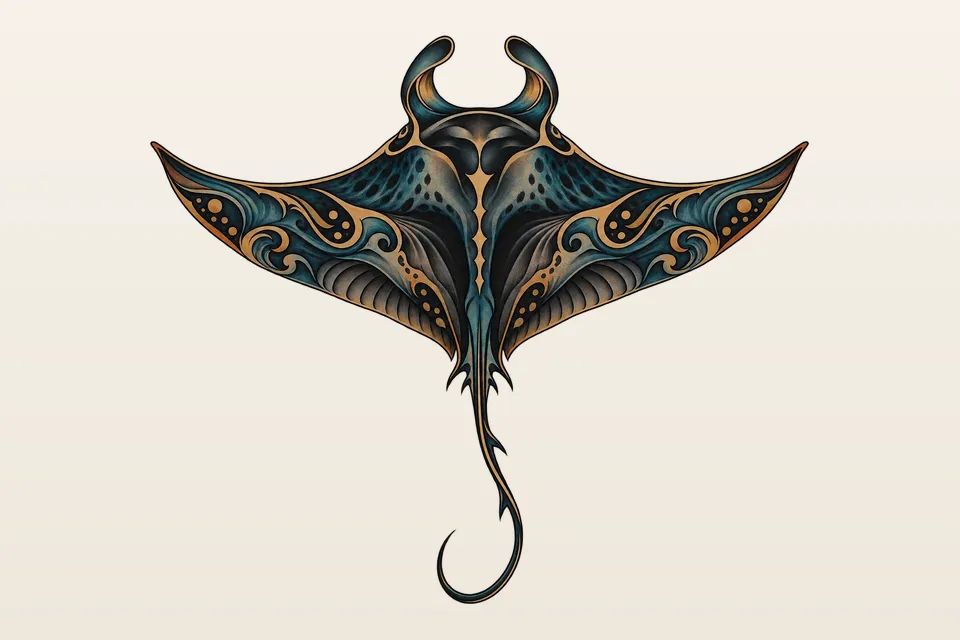
- Manta rays: broad triangular wings and a short tail, with horn-shaped fins at the mouth, as the manta ray entry describes. That wide shape suits the upper back, the chest, the sternum or the back of the thigh.
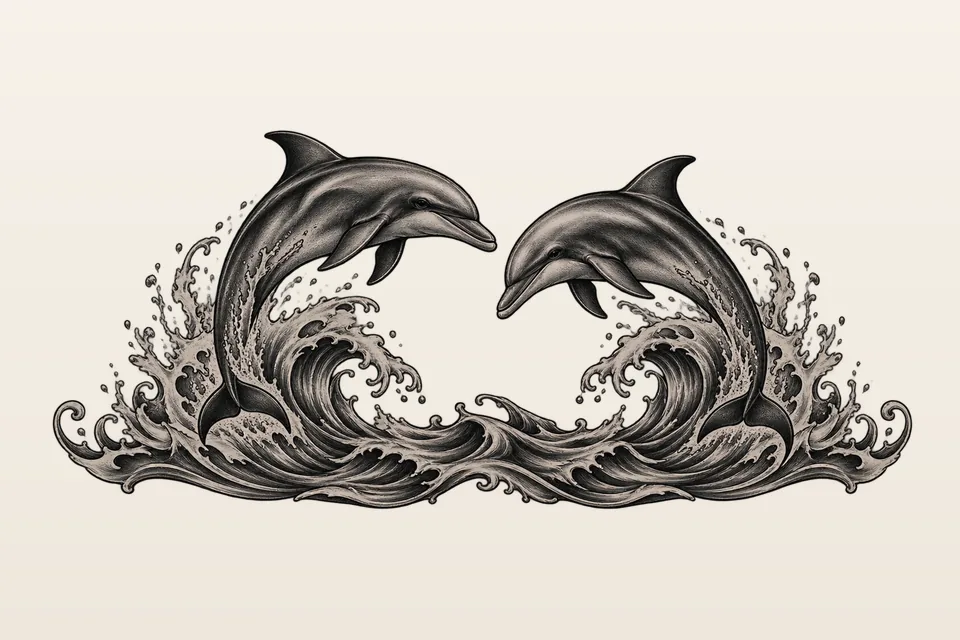
- Dolphins: curved and natural in pairs; an arc out of the water fits the shoulder blade, ribs or hip.
- Sea turtles: a compact oval for the ankle, the top of the foot or the shoulder; the shell can hold a pattern.
- Jellyfish: a small bell with trailing tentacles that run down the ribs, the spine or the back of the arm.
- Sharks: a lean torpedo, side-on along the forearm or the shin.
Koi live in ponds, not the sea, and have their own story; see the koi fish tattoo guide if that's where you're heading.
Underwater scenes: how much detail survives
An underwater scene is where ambition and skin most often collide. Light rays through the water, a reef, a diver, three species of fish and bubbles all look wonderful in a 30 cm drawing and turn grey and muddy at 10 cm. A rough guide:
- Under 8 cm: one animal or one wave, no background.
- 10–18 cm: one main animal plus a simple element: a few waves, a strand of kelp, a ring of bubbles.
- 20–30 cm: a main animal, one or two smaller ones, and water with depth.
- Back, thigh or sleeve: a real scene with layers, light falling from the surface and darker water below.
Depth comes from contrast: dark water at the bottom, more open skin toward the top, so the surface reads as light. A circle or frame, like the fine-line rings behind the whale at the top of this page, contains a scene so it doesn't fade into the skin around it.
The ocean sleeve and leg sleeve: built around flow
In an ocean sleeve the background is the subject: waves and currents run around the limb and tie everything together. Three plans that work:
- Surface to deep: waves and sky at the shoulder, mid-water animals on the upper arm, darker depths and the seabed toward the wrist.
- One big animal: an octopus with its head on the shoulder and arms reaching down to the forearm, or a whale whose body spirals around a leg sleeve from thigh to calf.
- A current: one continuous stream of water winding around the arm, with a turtle, a manta and a school of small fish riding it.
Keep the strongest animal on the outer arm or the outer thigh, where it is seen first, and use the water to bridge the elbow and the inner arm. Our sleeve tattoos guide covers sessions, edges and how sleeves are built in general. Ships, anchors, lighthouses and compasses fit naturally into a sea sleeve; the compass tattoo and traditional tattoo guides cover those sailor motifs.
Colour or black and grey?
Both suit the sea. Colour brings the obvious palette: deep navy for the depths, teal and turquoise for shallow water, with an accent such as a red sun or gold on a manta to give the eye somewhere to land. Black and grey turns the ocean into light and shadow, which suits realism, dolphins and whales, and the drama of a storm wave.
Many blues side by side can blur into one, so plan where the darkest and lightest water sit before adding shades. Foam and highlights are usually bare skin rather than white ink (click2ink draws no white unless you ask). How a colour looks on your skin tone over the years is a question for your tattoo artist and their healed work.
What an ocean tattoo can mean
People read the sea in very personal ways, and none of these is a rule. Some choose an ocean tattoo for a place: a home coast, a surf break, the beach where they grew up or where someone's ashes were scattered. Others choose a feeling: calm, freedom, the size of the world. Waves are often read as change and resilience, since they keep coming back; a turtle as patience and long journeys, an octopus as cleverness, dolphins as play. Divers, sailors and surfers often simply wear what they love. The meaning that matters is the one you can explain in a sentence.
How to describe your ocean tattoo to an AI or an artist
A clear brief names the family, the main subject, the style, the size and the spot. Compare:
- "A minimal wave, three fine lines with a small sun above, 4 cm, inner wrist"
- "A humpback whale swimming along the outer forearm, black and grey realism, light rays from above, tail toward the wrist"
- "An octopus wrapping the calf, neo-traditional, deep red with teal water, its head just below the knee"
- "A Japanese-style wave as the background of a full left sleeve, dark blue and black, with a sea turtle and a manta riding the current"
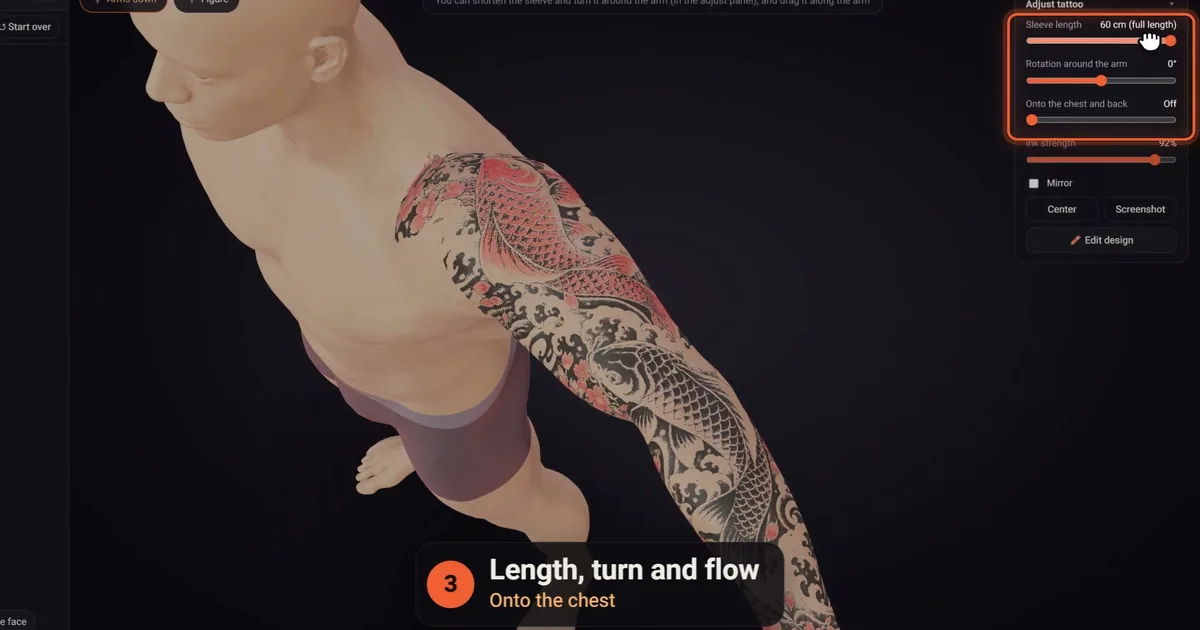
In click2ink you pick the spot or sleeve and the style, then describe it; the design appears on a 3D figure sized to your height in real centimetres, and a sleeve wraps all the way around the limb. Change one thing at a time ("fewer bubbles") and the AI keeps the rest. New accounts get 3 free credits, enough for 12 messages; how it works shows the flow. Then take the design and a true-size stencil to your tattoo artist.
Ocean tattoo questions
What is the best ocean tattoo for a first tattoo?
A small, simple piece: a single line wave, a whale tail rising from the water, or a sea turtle outline, around 4 to 8 cm. They are quick to tattoo, easy to place on the wrist, ankle or shoulder, and they can become part of something bigger later. Choose a spot you can cover if you want to, and see a few healed examples of your artist's fine work first.
Which ocean animals work best for a sleeve?
Animals with long or flexible bodies: an octopus, whose arms can wrap the whole limb; a whale or a shark, which can spiral around it; and a manta or turtle as a secondary subject riding the water. Pick one main animal and one or two smaller ones, and let the waves and currents connect them instead of adding more species.
Can I get Hokusai's Great Wave as a tattoo?
Many people do, from a small version on the forearm to a large back piece. A faithful copy of the print needs size, because the foam, the boats and Mount Fuji are full of small details. Many people prefer a wave in the same spirit but drawn for their body, which also lets an artist fit the curl to the shoulder or the calf.
Are ocean tattoos good for men or for women?
Both, and the theme doesn't decide it. A bold shark or a storm wave across the chest and a fine-line jellyfish on the ribs are both ocean pieces, and anyone can wear either. What changes the look is the style, line weight and size you choose, so think about those rather than about who usually gets which animal.
Where should a small wave tattoo go?
The inner wrist, the side of the wrist, the ankle bone, the side of a finger, behind the ear and the collarbone are the usual places, since a short horizontal shape suits them. Hands and fingers tend to need touch-ups more often because the skin there gets a lot of use; ask your artist what to expect before choosing them.
What is the difference between a sea tattoo and a nautical tattoo?
A sea or ocean piece is about the water and what lives in it: waves, whales, reefs. Nautical tattoos are about the sailor's world on top of it: ships, anchors, compasses, rope and swallows, usually in the American traditional style. They mix well, such as a compass over a wave, but they come from different traditions.
Can I add coordinates or a place name to a wave tattoo?
Yes, it's a common way to tie a wave or an animal to a real coast. Make the numbers or letters big enough to stay readable as the ink settles (ask your artist for their minimum letter height), and run them under the wave or the animal. In the click2ink editor you can add text by hand, at no credit, and check the spelling before you print.
Should an ocean tattoo be in colour?
It's a matter of taste. Blues and teals make the sea obvious at a glance and suit neo-traditional and illustrative work. Black and grey turns it into light and shadow, which suits realism and storm scenes. Ask your artist how specific colours look on your skin tone, and look at their healed colour work before deciding.