Eye tattoo: designs that look back at the world
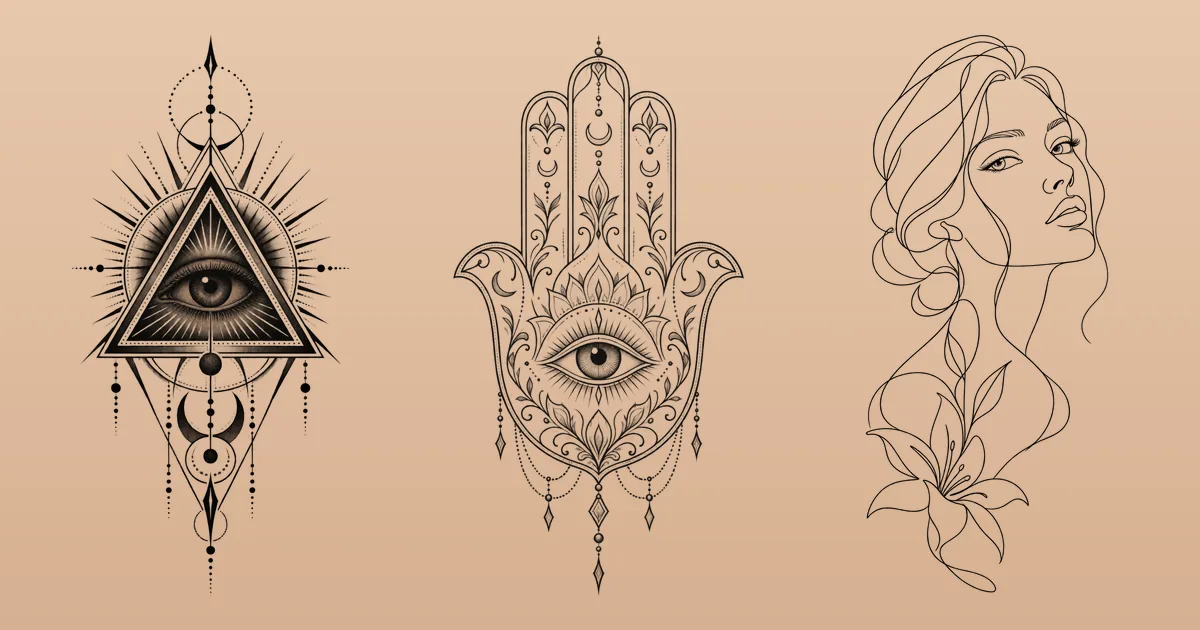
Most tattoos are looked at. An eye tattoo looks back. That is its whole power, and the reason it fails when it's drawn flat: a dead stare reads as a sticker, a living one seems to follow people. Whether you want an all-seeing eye in a triangle, an evil eye charm, a hamsa or a realistic eye, the same few parts decide which one you get.
What makes a tattooed eye look alive
Every eye design, from a 3 cm evil eye to a portrait on the thigh, is built from the same parts:
| Part | What it does | What to decide |
|---|---|---|
| Pupil | The darkest point, and where the eye "looks" | Centered for a stare, off-center for a glance |
| Iris | Texture, and the one spot of color if you want it | Radiating lines, dotwork, solid color, or a pattern inside |
| Highlight | The reflection that makes the eye look wet and alive | A small patch of bare skin at the edge of the pupil |
| Lids and lashes | The shape and the expression | Almond or round; a few bold lashes or many fine ones |
| Frame | What turns an eye into a symbol | A triangle, a palm, rays, a crescent, a face, or nothing |
Check the highlight first: an eye without one looks blind. Then the lids: a slightly lowered upper lid looks calm, a fully open one startled, a straight lower lid stern.
One note on terms: "eye tattooing" in the medical sense, ink placed into the white of the eyeball, is a different thing altogether, and this page doesn't cover it.
The all-seeing eye: triangle, rays and the Eye of Providence
The design most people picture first is the eye in a triangle. Wikipedia's Eye of Providence article describes an eye "often enclosed in a triangle and surrounded by rays of light or a halo," meant to represent divine providence watching over humankind, with the triangle as an explicit symbol of the Christian Holy Trinity. It adds that the eye appears on the reverse of the Great Seal of the United States and the one-dollar bill, is often associated with Freemasonry, and that some conspiracy theorists read the eye on the Great Seal as a sign of Masonic influence on the founding of the United States. As a tattoo it's often read as watchfulness, awareness or faith; some simply like the shape.
- The triangle: point up, the eye filling its middle third. Thin double lines for fine line, one bold line for traditional.
- The rays: sharp spikes, straight lines or a dotted halo, with gaps wide enough not to merge into grey as the tattoo ages.
- The extras: crescents, a sun circle, dotted lines, as in the first design at the top. The moon tattoo guide covers crescents.
- Minimal: an outline triangle and a three-line eye at 3 to 5 cm; drop the rays at that size.
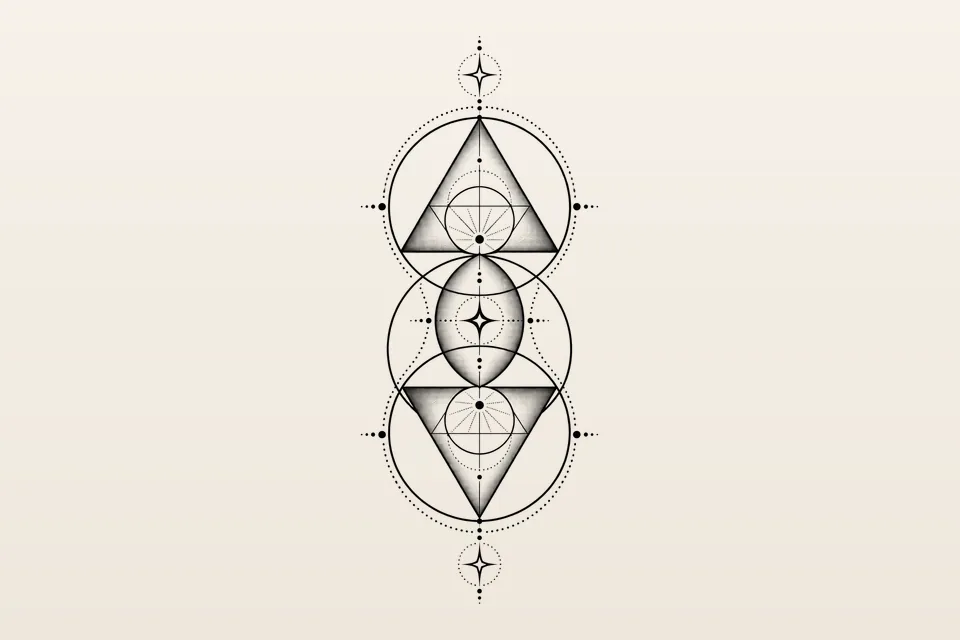
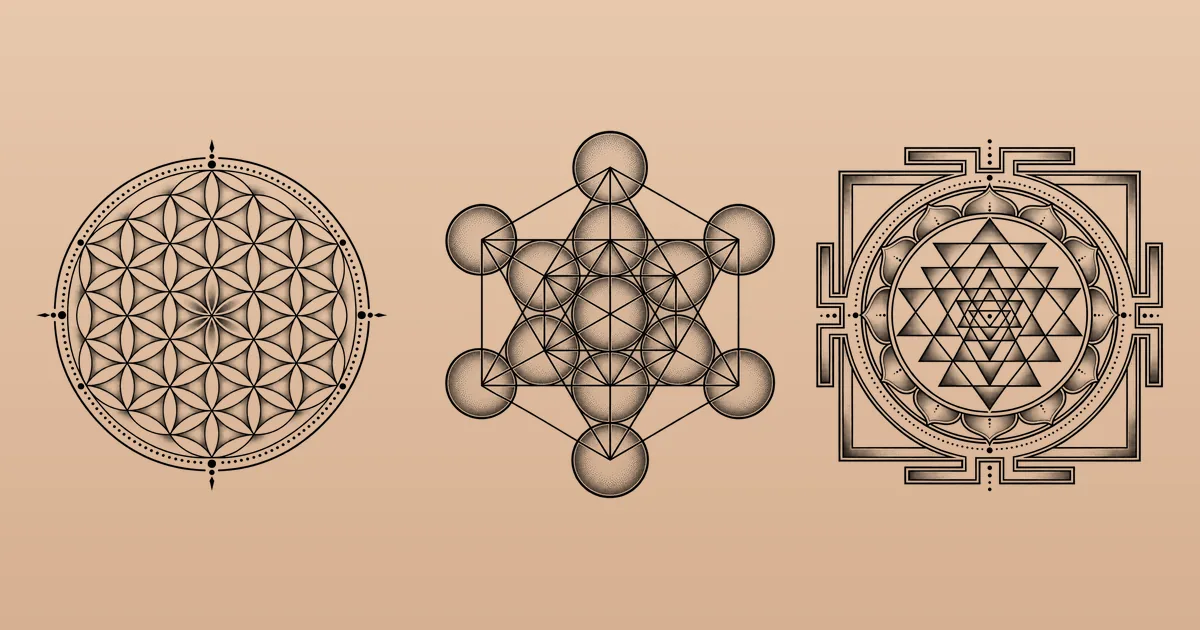
The sacred geometry tattoo guide covers figures like this one.
Protective eyes: the evil eye and the hamsa
Evil eye (nazar)
The evil eye is, in Wikipedia's words, a supernatural belief in a curse "brought about by a malevolent glare, usually inspired by envy," found in many cultures around the Mediterranean and beyond. The charm against it is the nazar, an eye-shaped amulet believed to protect against it, typically glass with "concentric circles or teardrop shapes in dark blue, white, light blue and black." So an evil eye tattoo pictures the protection, not the curse.
Design it as rings: dark blue outside, a white band left as skin, light blue, then a black pupil. That flat build stays clear at 2 to 4 cm on a finger, wrist or behind the ear. Bigger versions add lashes, beads or a realistic eye in the middle.
Hamsa with an eye
Wikipedia calls the hamsa "a palm-shaped amulet popular throughout North Africa and in the Middle East," believed to defend against the evil eye, and notes that hamsas often contain an eye symbol. It's known as the hand of Fatima, the hand of Miriam and the hand of Mary, so it carries religious meaning for many people; wear it with that in mind. The meaningful tattoos guide lists it among other protective symbols.
As a design it's a symmetrical hand, thumb and little finger curling out alike, the eye in the center of the palm, with filigree, a lotus or beaded drops around it, like the fine line hamsa at the top. It suits the back of the hand, the sternum and between the shoulder blades.
The Eye of Horus and the third eye
Eye of Horus
The Egyptian eye with its long cosmetic line and spiral is its own symbol; our mythology tattoo guide tells its story with sources. The design note: its bold, flat lines hold up small, and it pairs naturally with other Egyptian signs.
Third eye
Wikipedia's third eye article describes an intangible eye, usually shown on the forehead, "supposed to provide perception beyond ordinary sight." In Hinduism it refers to the ajna, or brow, chakra, and Shiva's third eye, the article says, symbolizes the power of knowledge and the detection of evil. As a tattoo it's often read as intuition: a belief, not a claim about the body. A vertical eye above a lotus is a common layout. Treat images of Shiva or other deities with the respect due to a living faith.
Realistic, portrait and old school eyes
Realistic eyes
A black and grey realistic eye lives on contrast: deep black in the pupil and lash line, smooth grey in the iris, bare skin for the highlight. It needs room, usually 8 cm wide or more, so the iris texture doesn't close up. Variations fill the iris with a landscape, a clock or a galaxy, or add a single colored iris. The realism tattoo guide explains what holds up.
Eyes in a face
Sometimes the eyes belong to a face, like the one-line woman with a lily at the top: a continuous fine line where two short strokes still carry the expression. A real portrait of a person is a job for a portrait specialist; the memorial tattoo guide says why.
Old school eyes
American traditional eyes are bold: a heavy outline, a solid black pupil, often a teardrop, flames, or an eye set in a heart or a hand, in a few flat colors. They read across a room. The traditional tattoo guide covers the style.
Where an eye tattoo sits, and how big
These are general starting sizes; your artist sets the real limits for your skin and detail.
| Spot | What fits | General starting size |
|---|---|---|
| Back of the hand | A hamsa with an eye, an all-seeing eye, a traditional eye | 5 to 9 cm |
| Finger | A simple evil eye in rings | 1.5 to 3 cm |
| Back of the neck | An all-seeing eye or a small third eye on the spine line | 4 to 8 cm |
| Forearm or upper arm | A realistic eye, an eye with rays, an Egyptian pair | 8 to 18 cm |
| Sternum | A tall all-seeing eye, a hamsa, an eye over a lotus | 10 to 18 cm tall |
See the hand, neck and forearm guides, and tattoo placement to compare every area.
Designing your eye tattoo in click2ink
A good brief names the eye, the frame, the iris, the style, the size and the spot:
- An all-seeing eye in an upward triangle, fine double lines, short rays, two crescent moons, black only, 7 cm, back of the neck.
- An evil eye in dark blue, light blue and black rings with a few lashes, 2.5 cm, side of the right index finger.
- A hamsa with a realistic eye in the palm, a lotus at the wrist and three beaded drops, fine line, 14 cm, sternum.
In click2ink, our own studio, a first tattoo starts with four questions: where it goes (tap a spot on a small figure), the style (16 of them, from fine line to black and grey realism and American traditional), your description and an optional picture. The AI artist draws an original design on a 3D figure sized in real centimeters to your height, and leaves highlights as skin, since it uses no white ink unless you ask. Ask for one change at a time ("lighter iris, keep the rays"), then print a true-size stencil or share a link with your artist. How it works shows each step, and pricing explains the free credits.
Eye tattoo questions
What does an eye tattoo mean?
It depends on the eye. An eye in a triangle is often read as watchfulness or faith, an evil eye charm as protection, a hamsa as protection and blessing, a third eye as intuition, and a realistic eye as awareness or simply love of the drawing. These are popular readings, not rules; your own meaning is the one that counts.
What is the difference between an evil eye and an all-seeing eye tattoo?
An evil eye tattoo shows the nazar, a ring-shaped charm believed to guard against an envious glare, usually in blues, white and black. The all-seeing eye, or Eye of Providence, is an eye in a triangle with rays, from Christian art and later the Great Seal of the United States. They come from different traditions and look different.
Is an all-seeing eye tattoo religious?
It began in Christian art as an image of God watching over people, the triangle standing for the Trinity, and it's also linked with Freemasonry and the dollar bill. Some people wear it without any of those associations, but others will read them into it, so know the history before you commit.
Can a man wear a hamsa or evil eye tattoo?
Yes. Neither symbol belongs to one gender; both are worn as amulets by all kinds of people across many cultures. Style sets the mood more than the subject: a bold blackwork hamsa on the back of the hand feels very different from a fine line one behind the ear.
How small can an eye tattoo be?
A flat evil eye in rings can be very small, around 1.5 to 3 cm. A detailed eye with lashes and iris texture needs more room, and a realistic eye usually 8 cm or more, so the highlight and iris don't blur as lines soften over the years. Ask your artist what size your design needs.
Should an eye tattoo have white highlights?
Some artists leave the highlight as bare skin rather than inking it white, so the skin itself becomes the shine. Ask your artist how they handle highlights on your skin tone. In the click2ink studio, designs leave highlights as skin unless you specifically ask for white.
Where is the best place for an all-seeing eye tattoo?
The back of the neck, the back of the hand, the forearm and the sternum are the usual spots, because the triangle sits well on a center line or a flat surface. Check the stencil in a mirror while standing naturally, so the triangle doesn't tilt with the curve of the body.
Can I combine several eye symbols in one tattoo?
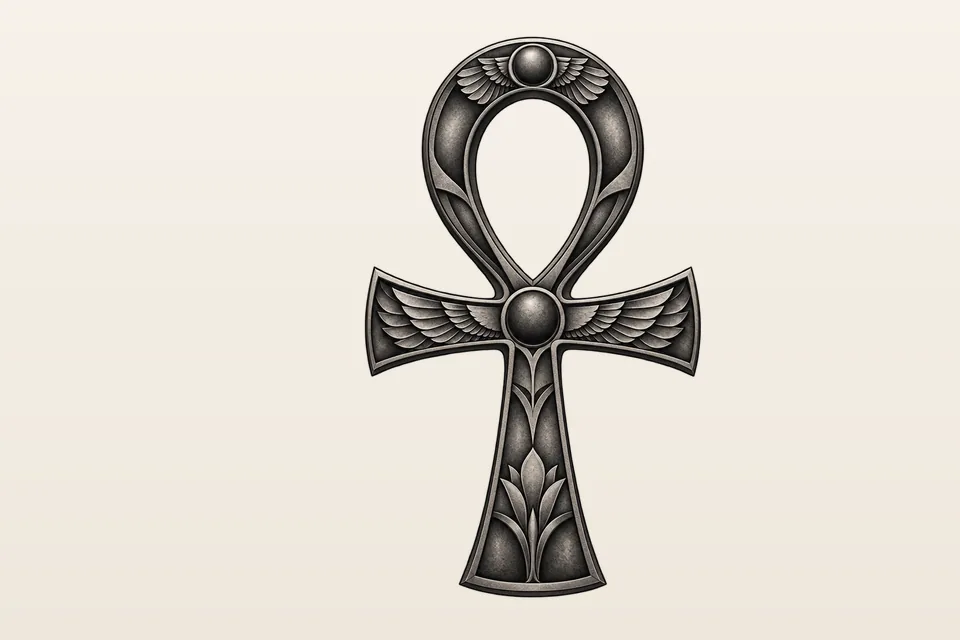
Yes, with a plan. A hamsa with an eye in its palm is already a pairing, as the hamsa article notes, and an Eye of Horus with an ankh makes an Egyptian set. Give one eye the lead and keep the others smaller or simpler, so the design has one point that looks back rather than several competing stares.