Realism tattoo: how to plan one that still looks real in ten years
Why do some realism tattoos still look like photographs years later, while others soften into a blur? Most of the answer is decided before the first session: the size, the contrast, the reference photo and the artist's hand. This guide covers black and grey and color realism, portraits, and what actually holds up in skin over time.
What counts as a realism tattoo
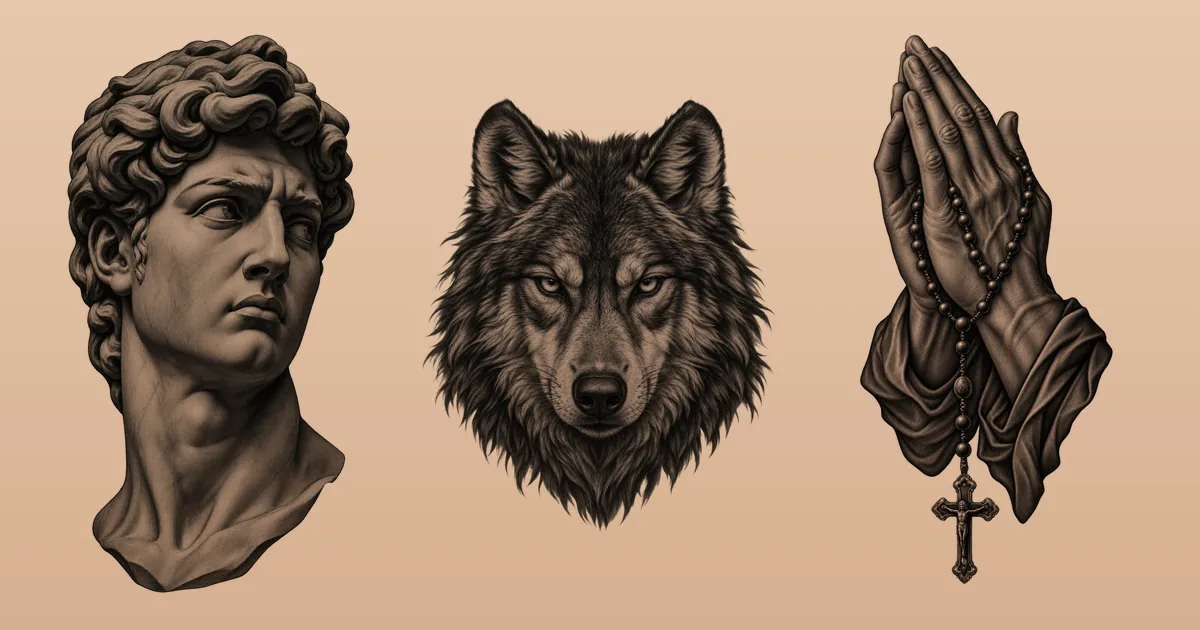
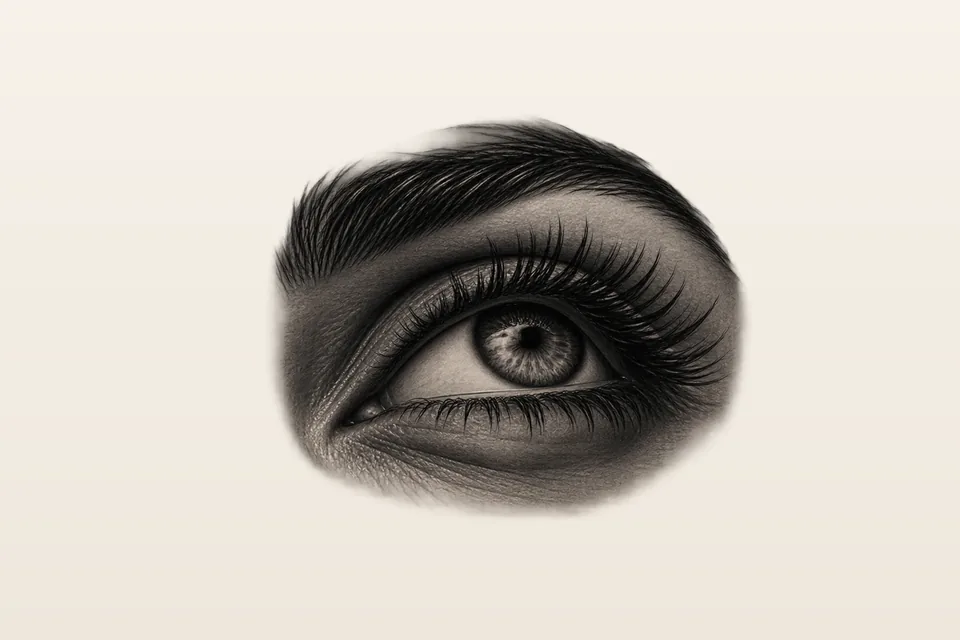
A realism tattoo imitates what a camera or a classical draftsman sees: light falling across a form, smooth gradients, the texture of skin, fur, stone or metal, and usually no hard outlines at all. The family is wide:
- Black and grey realism: diluted black ink in many shades, from deep shadow to bare skin.
- Color realism: full color built up in layers, often with dramatic lighting.
- Portraits: people and pets, the hardest subject of all, because everyone knows what a face should look like.
- Statues and still life: marble busts, roses, clocks and skulls, popular because they come with strong light and shadow.
- Micro-realism: small realistic pieces with simplified detail.
- Surrealism: realistic rendering of scenes that could never exist.
What unites them is that the eye judges them against reality. A stylized rose can be a little off and still charm you; a realistic one that is slightly wrong looks wrong.
Black and grey: from prison-style to fine art
Black and grey has roots in prisons and in Chicano street culture in Los Angeles. As a 2018 report by NPR's Code Switch team explains (republished by WNYC), it used to be called joint-style or prison-style: homemade machines had a single needle, there was no colored ink, and diluting black made the greys. In the mid-1970s a shop in East Los Angeles, Good Time Charlie's Tattooland, took up that look for clients who asked for it and switched its machines to a single needle.
One of the artists there, Jack Rudy, became known for developing the black and grey style, realistic portraits included. Single-needle work allowed far more detail than tattooing had managed before, and a softer, more realistic look. Today's realism artists use many needle groupings and carefully mixed grey washes, but the idea is the same: build form out of light and shadow.
Black and grey or color realism?
Neither is better. They suit different subjects, and the right choice depends on the mood you want and on your skin.
| Black and grey | Color realism | |
|---|---|---|
| Strength | Contrast, mood, a timeless photographic feel | Lifelike color and vivid subjects |
| Classic subjects | Portraits, statues, religious pieces, wildlife | Flowers, birds, eyes, pets, nature scenes |
| Skin tone | Works on every skin tone when the contrast is planned for it | Pale colors show less on deeper skin, so the palette needs adjusting |
| Over the years | Strong blacks keep the structure while greys soften gradually | Pale tints tend to soften first; dark accents keep the shape |
Many collectors mix both on one body, keeping black and grey for portraits and statues and using color where nature calls for it. If you are still weighing realism against other approaches, our overview of tattoo styles compares them side by side, and black and grey Japanese work shows how realistic shading can live inside a traditional structure.
Size is the first decision
Realism lives on small things: the glint in an eye, a single hair, the grain of marble. Each one needs room on the skin, and the skin needs room for them to soften over the years without merging into their neighbors. If in doubt, go bigger.
- A face needs enough width for the eyes, nose and mouth to each get real space. For a portrait, roughly palm-sized or larger is a common starting point; your artist will tell you their minimum.
- A single eye, a rose or a small animal can work smaller, as long as there is one clear focal point.
- Full scenes, such as a portrait with background, need a forearm, a thigh, a calf or the back.
Placement matters as much. Flat, stable areas like the outer forearm, upper arm, calf, thigh, chest and back hold realism best. Fingers and the sides of the hands and feet are poor homes for fine detail, and a face over the elbow or knee bends whenever you move. Our tattoo size guide has more on matching detail to size.
Portraits: the photo is half the tattoo
An artist can only tattoo the information the photo contains. Before you book, find a picture that is:
- Sharp, high resolution and with the eyes in focus. A screenshot of a screenshot won't do.
- Lit from one side. Directional light shapes the face; flat flash photos leave very little to shade.
- True to the person, with an expression you recognize, at an angle that suits the placement.
- Yours to use, taken by you or by someone who agrees to it being tattooed.
Bring several photos if you have them; artists sometimes combine the best features of more than one. For pets, shoot at eye level, in daylight, with the fur direction clearly visible.
Testing a realism design on your own body
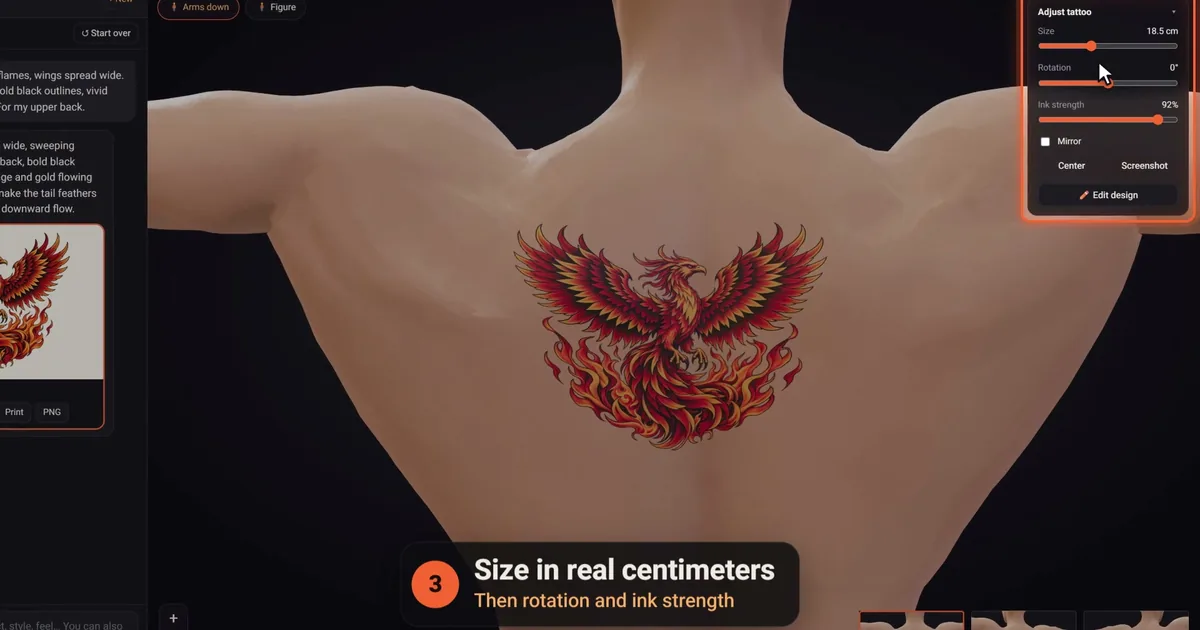
In click2ink you can pick black & grey realism or colour realism among the 16 styles, choose the body area, and describe the subject and the lighting: "a lion's face in three-quarter view, black and grey, light from the upper left, deep shadows under the mane, on the outer forearm." Set the speed to Detailed for a final design, and use the one-tap More detail or Simpler changes to push it either way.
Working from a photo, attach it with 📎 as inspiration and the AI draws a new design from it; see our guide to turning a photo into a tattoo design. For a portrait you can also put the photo itself on the body exactly as it is, background removed, to check its size in real centimeters before anyone draws a line. Turn the figure to see whether a face sits flat or wraps out of view, then bring both the design and the original photo to your artist. New accounts start with 3 free credits; the pricing page explains the rest.
What holds up in skin
Every tattoo softens as the years pass, and realism shows it most because it depends on fine transitions. The pieces that age well share a few traits:
- Real contrast: true blacks next to open skin. A piece built only from mid-greys can flatten out.
- Highlights made of skin. Many artists leave the brightest points as untouched skin rather than relying on white ink, and click2ink draws its designs without white ink unless you ask for it, for the same reason.
- Fewer, larger details, and a strong overall silhouette that still reads when the fine texture has softened.
- An artist whose healed work, photographed a year or more after the session, still looks crisp.
Aftercare and sun protection matter for any tattoo; follow your artist's instructions, and ask a doctor if you have concerns about your skin.
Realism tattoo: what people ask before booking
How big should a realism tattoo be?
Big enough for its smallest detail to have room. A portrait usually starts around the size of a palm, while a single eye, a flower or a small animal can be smaller if it has one clear focal point. Scenes with backgrounds need a forearm, a thigh or the back. Your artist knows the minimum size their technique needs, so ask before you settle on a spot.
Do realism tattoos age well?
They can, if they are planned for it. Strong contrast, highlights left as bare skin, enough size and a skilled artist all help the piece keep its form as fine detail softens. Very small, low-contrast realism ages least gracefully. Ask to see healed work, not just fresh photos, before you choose an artist.
Is black and grey or color realism better on darker skin?
Both can look excellent. Black and grey relies on contrast, which an experienced artist plans around your skin tone. In color work, very pale tints show less on deeper skin, so artists lean on richer, more saturated colors and strong darks. Look for an artist whose portfolio includes healed work on skin like yours.
What makes a good photo for a portrait tattoo?
A sharp, high-resolution image with the eyes in focus, lit from one side so the face has shadows, and showing an expression you recognize. Avoid heavy filters, flat flash and blurry crops. If you have several good photos, bring them all, because artists sometimes combine the best parts of more than one.
How long does a realistic portrait take to tattoo?
It depends on the size, the detail and the artist's pace, so only your artist can say. A small portrait may fit in one long session, while larger pieces with backgrounds are usually split into several, with healing time in between. Realism is slow work by nature, because every tone has to be built gradually.
Can a realism tattoo be small?
Yes, within limits. Micro-realism works best with simple subjects, one focal point and fewer details than a large piece would carry. A tiny face or a crowded scene tends to lose its features as the skin ages. If you want something small, choose a subject that reads at a glance, like a single eye, a flower or an animal's head.
Why don't realism tattoos have outlines?
Because real objects don't. Realism defines edges through contrast, a dark shadow meeting a lighter surface, the way a photograph does. Some artists hide a faint line inside the shading for structure, but a visible black outline pushes a piece toward illustrative or neo-traditional styles. That's a valid choice, just a different one.
Can I add color to a black and grey realism tattoo later?
Often, yes. Artists can add a color accent, like red roses next to a grey portrait, or color an element that was left open. Turning a finished black and grey piece fully into color is harder, because dark tones limit what can go on top. Ask your artist, ideally the one who did the original.
How do I choose a realism tattoo artist?
Look for healed work, smooth gradients without patchy spots, believable eyes and consistent proportions across several pieces. Portrait specialists show many faces; if yours is a pet or a statue, look for that too. At the first consultation, bring your references and your size ideas, and ask how they would adapt them.