Sacred geometry tattoo: a practical guide to the figures, the lines and the body
Every sacred geometry tattoo starts with a compass, a straightedge and a few simple rules: circles of equal radius, centers placed where other circles cross, lines joining points that already exist. Knowing those rules is what separates a design that stays crisp for decades from one that blurs into a grey disc. Here is how each figure is built, what it really comes from, and how to get it onto a curved body.
A modern name for very old shapes
"Sacred geometry" is not one tradition. It is a loose, modern umbrella name for geometric shapes and proportions that people have given symbolic or spiritual meaning. Wikipedia's article on sacred geometry traces those meanings through very different settings, from Plato and Kepler to medieval church builders and Tibetan Buddhist art, and quotes the writer Stephen Skinner's criticism of diagrams laid over buildings or natural objects without meeting any real points on them.
So the figures come from very different places: Greek mathematics, ancient decorative patterns renamed in the late twentieth century, and one, the Sri Yantra, a devotional diagram still used in Hindu worship. Many people wear these shapes for balance or a sense of connection, and some believe they carry energy or healing power. Those are beliefs, not established facts; the geometry is the part everyone can check.
The figures, and how each one is drawn
Vesica piscis
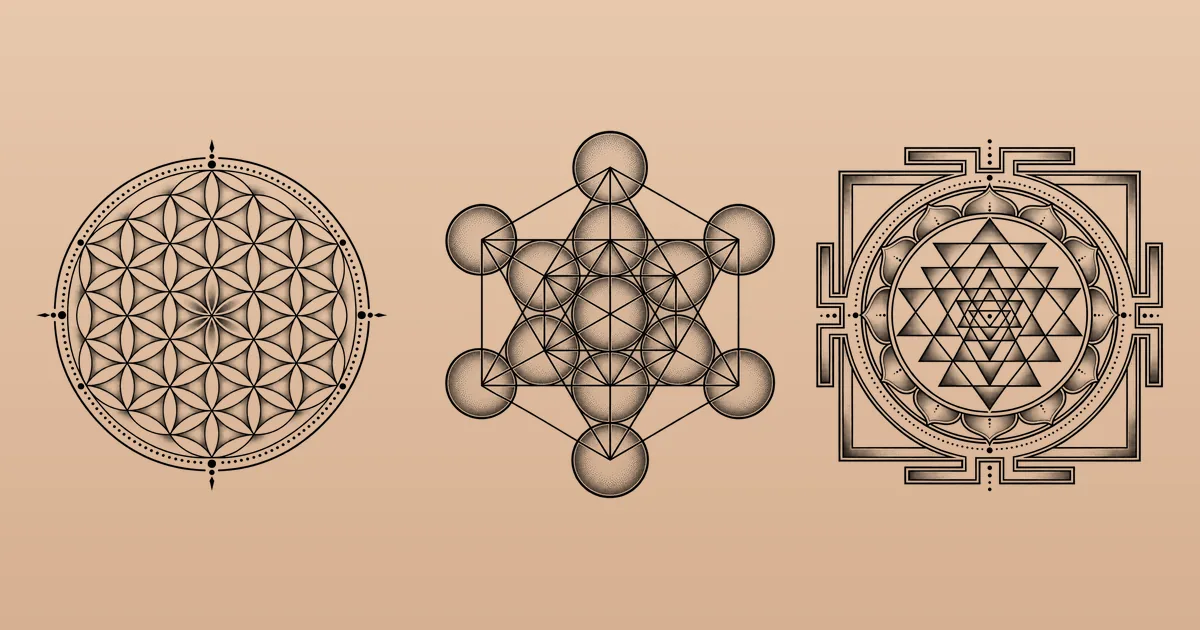
The simplest of all: two circles of equal radius, each centered on the other's edge. The almond-shaped overlap is the vesica piscis, Latin for "fish bladder." Joining the two centers and the two crossing points gives two equilateral triangles, which is why Euclid starts his first proposition with it. Upright, the same almond is the mandorla around Christ in medieval art. As a tattoo it works small, or as the first cell of a bigger piece.
Seed of Life and Flower of Life
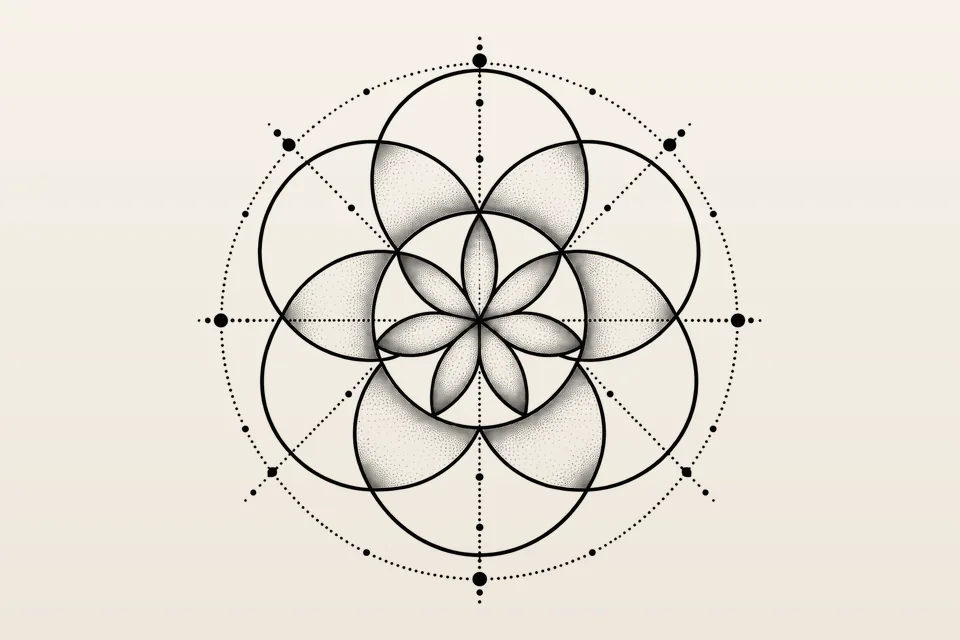
Keep adding circles of the same radius, each centered where two earlier circles cross. Seven circles (six around one) make the Seed of Life, a six-petaled rosette. Carry on to nineteen circles, usually inside a larger bounding ring, and you have the Flower of Life. Wikipedia's page on the overlapping circles grid notes that the pattern is ancient, with examples from an Assyrian palace threshold of the 7th or 6th century BCE and red-ochre drawings on columns of the Temple of Osiris at Abydos, but that the name "Flower of Life" is modern and tied to the New Age movement.
Metatron's Cube
Take thirteen equal circles (one in the center, six around it, six more further out) and join every center to every other center with straight lines. The web of lines is Metatron's Cube, named after Metatron, an angel of Jewish tradition and later Kabbalistic texts. Fans often say it holds all five Platonic solids; what you can trace are flat outlines resembling some of them. With 78 lines crossing, it is dense, which matters for size.
Platonic solids
The five Platonic solids are the only solids whose faces are identical regular polygons with the same number meeting at every corner: the tetrahedron (4 triangles), cube (6 squares), octahedron (8 triangles), dodecahedron (12 pentagons) and icosahedron (20 triangles). In the Timaeus, Plato paired four with the elements and the dodecahedron with the heavens. In tattoos they appear as wireframes, alone or in a row of five, often with dotwork on one face for depth.
Sri Yantra
The Sri Yantra is built from nine interlocking triangles, four pointing up and five pointing down, which cross to form 43 smaller triangles around a central dot, the bindu. Two rings of lotus petals (8 and 16) surround them, inside a square with four gates. It is the central object of devotion in the Shri Vidya school of Hinduism, worshipped as the form of the goddess Tripurasundari. A yantra in general is a diagram used for worship and meditation, not a decoration.
If the Sri Yantra speaks to you, learn about it first: read about Shri Vidya, ask someone who practices it how they would feel about it on skin and where, and avoid casual placements such as the feet. Its triangles must meet at exact points, so a sloppy copy is both disrespectful and wrong.
Golden spiral
A golden spiral widens by the golden ratio (about 1.618) every quarter turn. Tattoos usually draw the approximation: a golden rectangle split into ever-smaller squares, a quarter circle in each. Nautilus shells and galaxies are often said to follow it; the same article explains that they generally don't. It still makes a flowing counterpoint to straight-edged figures.
What makes the geometry hold up in skin
A wobble in a straight line or a dent in a circle shows at once. Three things decide how the figure ages.
Space between lines
Ink spreads a little in the skin over the years, so close lines slowly merge. The trouble spots are the narrow petal tips of a Flower of Life, the crossings at the heart of Metatron's Cube and the tiny inner triangles of a Sri Yantra. If those gaps look like hairlines at the real size, they will close up on skin. Your artist judges the exact minimum.
Size for the density
| Figure | How dense | Rough guidance |
|---|---|---|
| Vesica piscis, single Platonic solid | a few lines | works small: wrist, ankle, behind the ear |
| Seed of Life | 7 circles | palm-sized pieces and up |
| Flower of Life (19 circles) | many narrow petals | needs a broad, flat area such as the upper back, chest or outer thigh; avoid shrinking it to coin size |
| Metatron's Cube, Sri Yantra | dozens of crossing lines | the largest of the group; sternum, upper back or outer upper arm |
These are general tendencies, not hard numbers. Our tattoo size guide explains how detail and size trade off in general. If you want something tiny, choose a simpler figure rather than shrinking a complex one; the minimalist tattoo guide has ideas.
Line weight and shading
A bolder outer ring with finer inner lines keeps the figure readable. Shading is usually dotwork: stippled gradients in alternate petals or on one face of each solid, adding depth without a black mass that swallows the lines. Fill cells solid and you move toward blackwork tattoo territory, which can look striking but leaves less room for error.
Circles on a curved body
A perfect circle drawn on paper is only perfect on the body where the skin is roughly flat. Anywhere it wraps, it turns into an oval or bends out of true:
- Spine and upper back. The flattest large area there is, with a clear center line. Ideal for a big Flower of Life or a vertical stack of figures, as long as the center sits exactly on the spine.
- Sternum. A natural axis for symmetrical figures like the Sri Yantra or Metatron's Cube, but the chest curves away on each side, so wide designs need checking from an angle.
- Forearm. A circle on the flat inner or outer face works; a wide one wraps over the edges and foreshortens. Tall arrangements, like a column of Platonic solids, suit it better.
- Upper arm. Rounder still: a flat figure curves away at its sides, bending straight lines visibly.
That is why a flat placement helps: the figure stays true without the artist bending it. Our mandala tattoo guide covers radial symmetry and placements in more depth.
Building a sacred geometry sleeve
A common plan puts the largest figure (a Flower of Life or Metatron's Cube) on the outer upper arm or shoulder cap, then runs smaller figures, such as stacked Platonic solids or vesica chains, down the forearm. Dotwork bands and nested polygons tie them together, and a golden spiral can sweep around the arm to break up the straight lines.
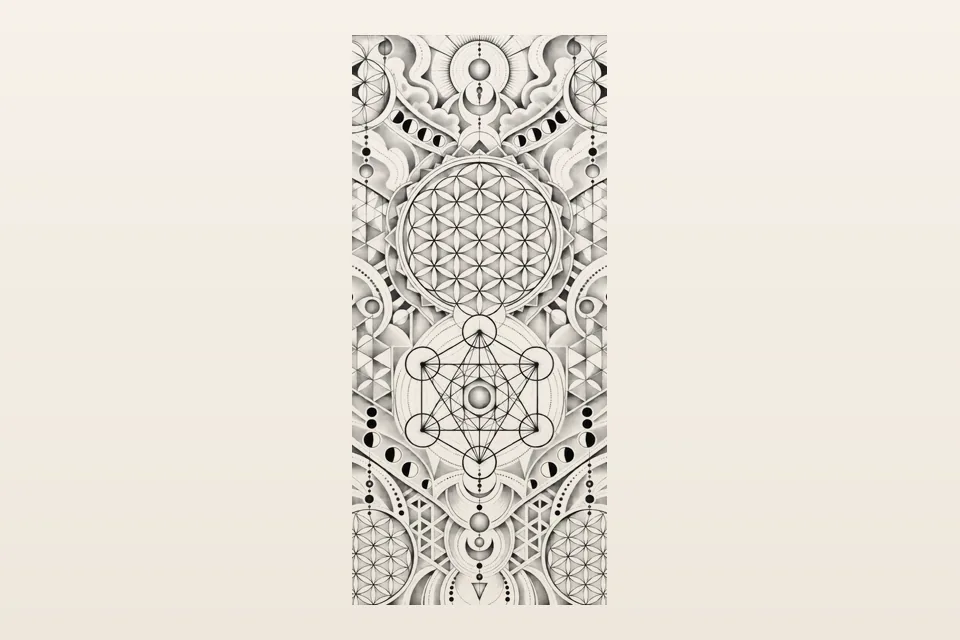
Leave bare skin between dense figures so each reads on its own. For flow and sessions, see our sleeve tattoos guide; for jewelry-like framing around the figures, the ornamental tattoo guide.
Describing it to an AI or an artist
Name the figure, how it is built, its size and its spot. "Spiritual" or "cosmic" gives nobody anything to draw. Examples:
- "The Seed of Life, seven equal circles, a bolder outer ring, dotwork shading in alternate petals, about 7 cm, inner forearm."
- "A Flower of Life of 19 circles inside a double ring, fine even lines, no shading, centered on the upper back between the shoulder blades, about 18 cm across."
- "The five Platonic solids as wireframes in a vertical column, tetrahedron at the top, one face of each shaded with stippling, for the outer forearm."
- "Metatron's Cube with the 13 circles visible, a thin golden spiral sweeping behind it, black only, sternum."
In click2ink, our own design studio, pick geometric among the 16 styles (or dotwork & mandala for a stippled look), tap the spot or choose a sleeve, and write a description like these. The design lands on a 3D figure sized in real centimeters to your height, so you can turn it and see where the circles stretch. If it looks crowded, ask for fewer circles or tap Simpler. How it works shows the whole flow, and new accounts start with free credits (see pricing).
Then print the stencil: it comes out at its real size on the body, with a 5 cm check ruler, so your artist can measure the gaps between lines and check the circles are equal. Expect them to redraw the geometry with their own tools; our tattoo stencil maker guide explains how a true-size print helps.
Sacred geometry tattoo questions
What is the difference between the Seed of Life and the Flower of Life?
Both are built from circles of the same radius, each centered where two others cross. The Seed of Life stops at seven circles, six around a central one, forming a six-petaled rosette. The Flower of Life continues outward, usually to nineteen circles inside a bounding ring. The Seed is far simpler, so it can be tattooed much smaller and still stay clear.
Is a Sri Yantra tattoo disrespectful?
It can be, depending on how it is done and worn. The Sri Yantra is the central object of devotion in Shri Vidya, a living Hindu tradition, not a decorative pattern. Learn what it represents, ask practitioners how they view it on skin, choose a respectful placement, and make sure it is drawn correctly. Some people decide on a different figure after learning more, and that is a valid choice too.
Do sacred geometry tattoos have healing powers?
Some people believe these shapes carry energy or healing properties, and that belief is meaningful to them. There is no scientific evidence that a tattooed shape affects health. Choose a figure because you love how it looks or what it means to you, and see a doctor, not a design, for anything medical.
Can a Flower of Life tattoo be small?
A full nineteen-circle Flower of Life has many narrow petal tips where lines nearly touch, and those close up as a tattoo ages. Small versions risk becoming a grey blur. If you want something small, the Seed of Life or a single vesica piscis keeps the same look with far fewer lines. Check the design at its real size before deciding.
Which sacred geometry symbol suits a first tattoo?
Simple figures make good first pieces: a vesica piscis, the Seed of Life, a single Platonic solid or a small golden spiral. They work at modest sizes, take less time and show you how your skin holds fine lines, and they can grow later into a bigger composition.
Should a sacred geometry tattoo be perfectly symmetrical?
The geometry itself should be precise, because unequal circles or lines that miss their crossing points are easy to spot. On the body, though, the aim is that it looks symmetrical when you stand naturally. Artists sometimes adjust lines slightly for the curve of a limb or chest so that the figure reads as even to the eye.
What does Metatron's Cube mean?
The name refers to Metatron, an angel in Jewish tradition and Kabbalistic texts, but the figure itself is mostly a modern spiritual symbol. Many people see it as an image of order, creation or the structure of the universe, and some link it to the Platonic solids. Those are interpretations rather than one fixed meaning, so it means what you choose.
Is sacred geometry the same as a geometric tattoo?
Not quite. Geometric tattoos are any designs built from lines, circles and polygons, such as an animal inside a frame of triangles. Sacred geometry tattoos use specific named figures with symbolic associations. Every sacred geometry piece is geometric, but most geometric tattoos are not sacred geometry. The two mix easily, for instance a wolf set inside a Seed of Life.