Mandala tattoo: meaning, geometry and dotwork, planned for a curved body
On paper, a mandala tattoo is perfect symmetry: rings of petals and dots around a single center. On skin, that perfection meets a body that curves, twists and stretches. The best mandala, geometric and dotwork pieces are planned for that from the start. Here is where the mandala comes from, how the three styles differ, and where symmetry sits best.
Where the mandala comes from
Mandala is the Sanskrit word for "circle." In Hindu, Buddhist and Jain traditions it is a sacred diagram, a map of a divine realm or of the universe itself. The Rubin Museum of Himalayan Art's glossary describes the mandala in Vajrayana Buddhism and Bon as the cosmic dwelling of a deity, usually drawn as a circle with a square inside it, the deity at the center of its palace. Mandalas are used in initiations and meditation, and the sand mandalas of Tibetan Buddhism are built grain by grain, then swept away once finished, as a lesson in impermanence.
Most mandala tattoos are decorative descendants of these: rings of petals, scallops, dots and lines with no deity at the center. Wearing one is generally a matter of taste. Sacred content is another matter. If a design includes a specific deity, a sacred syllable or a temple mandala copied from a painting, learn what it is first, and ask someone from that tradition whether it belongs on the body and where.
Mandala, geometric, dotwork: telling them apart
Studios often list the three together, because they overlap all the time. They are still different things:
- Mandala: radial symmetry, drawn from a center outward in rings of petals, scallops, beads and lines.
- Geometric: circles, straight lines, triangles and polygons, symmetrical or not, often framing an animal or a flower.
- Dotwork: a way of shading rather than a subject. Tone is built from dots instead of smooth grey.
- Ornamental: the jewelry-like cousin, with lace, chains and hanging drops, often seen in henna-style pieces.
A typical mandala tattoo combines them: clean linework for the structure, dotwork for the shading, and maybe an ornamental drop beneath it. Knowing the words helps you ask for exactly that mix.
Where a mandala tattoo sits best
A mandala only reads as a mandala when its center sits where the eye expects it and its rings stay round. That makes placement the biggest decision you will make:
- The sternum or under the bust, centered on the breastbone, often with a drop or a half mandala hanging below.
- The upper back between the shoulder blades, where the spine gives a true center line.
- The back of the neck, small, sometimes with a tail of dots running down the spine.
- The shoulder cap, whose round shape suits a full mandala, often as the start of a sleeve.
- The elbow or the knee, where the joint becomes the center and the design bends with it, which some people love and others don't.
- The thigh or the forearm, where a half mandala or a vertical chain of small ones follows the limb better than one big circle.
Curved surfaces stretch circles into ovals. Good artists place the stencil while you stand naturally, check it from the side, and sometimes adjust lines freehand so the circle looks round to the eye even when it isn't perfectly round on paper.
Dotwork: shading one dot at a time
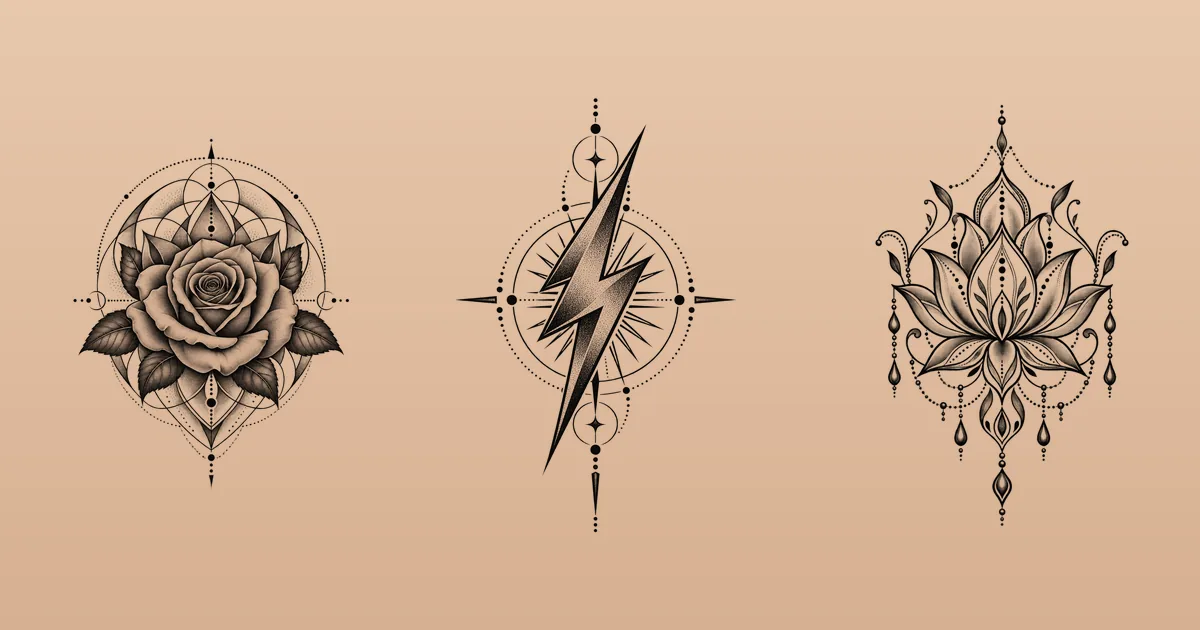
In drawing, stippling creates shade with small dots: the denser the dots, the darker the tone. Dotwork tattooing does the same in skin. The result has a grainy, almost printed texture that smooth shading can't match, and it pairs beautifully with crisp geometric lines, as in the stippled rose and lightning bolt at the top of this page.
It is slow work, because the artist builds every gradient dot by dot. It also ages softly: over the years dots spread a little and gradients smooth out. Leaving clear space between dense fields and open skin keeps the design readable, and a strong line structure keeps it from turning vague.
Geometric tattoos: lines, sacred geometry and hybrids
Geometric work forgives nothing. A straight line that wobbles or a circle that isn't round shows immediately, so artists draw the geometry with care and stencil it precisely. Three directions are popular:
- Sacred geometry, patterns such as the Flower of Life, made of overlapping circles, and other diagrams built from circles and polygons.
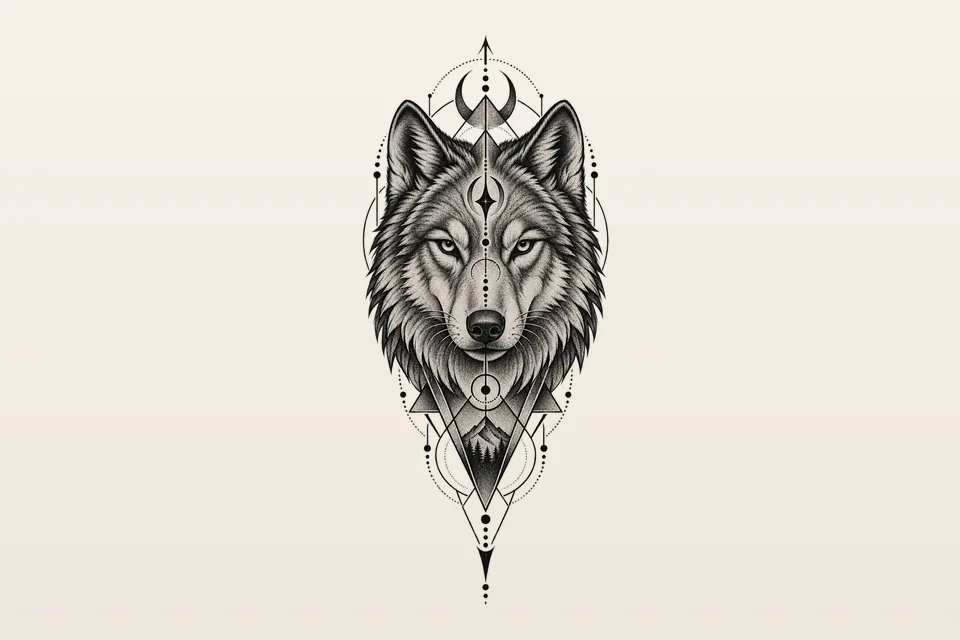
- Hybrids, where an animal, a flower or a face sits inside a geometric frame, often shaded in dotwork or black and grey.
- Fragmenting designs, where a shape breaks apart into triangles or dots along one side.
Line weight does a lot of the work. A bold outer line and finer inner lines keep the piece readable from across a room; very thin lines laid close together need size to stay separate. For delicate linework in general, see our guide to fine line tattoos, and for small, clean shapes, the minimalist tattoo guide.
Planning the rings before you book
Mandalas are easiest to describe from the center outward. In click2ink, choose the dotwork & mandala style (or geometric, or ornamental for a henna-like look), pick the spot, and list the layers: "a mandala centered on the sternum, a small lotus in the middle, three rings of petals, a ring of fine dots, a short chain of beads hanging below, dotwork shading, no color."
The design lands on a 3D figure, so you can see the circle on a real curve and turn the body to check it from the side. Resize it in centimeters, wrap it around the limb for a forearm or shoulder piece, or use the arms-out view for the inner arm. If it is too busy, ask for fewer rings or tap Simpler. The click2ink design editor's outline tool shows how it would look as a stencil, and the print page puts it at its true size, with a 5 cm ruler to check the print; our tattoo stencil maker guide explains why that matters. Expect your artist to redraw the geometry with their own tools; the features page shows every step.
Mandala tattoo questions
What does a mandala tattoo mean?
In its traditions the mandala is a sacred diagram of a divine realm or of the universe, and a support for meditation. As a tattoo, people often wear it for balance, wholeness or a sense of calm, or simply because they love its symmetry. A decorative mandala carries whatever meaning you give it, while a copied religious mandala carries its tradition's meaning too.
Is a mandala tattoo cultural appropriation?
A decorative mandala of petals, dots and lines is widely worn and is generally treated as an ornamental design. The care point is sacred content: specific deities, sacred syllables or temple mandalas from Hindu or Buddhist art. If your design includes any of those, learn what they mean and ask someone from the tradition whether and where it is appropriate to wear them.
Where is the best place for a mandala tattoo?
Places with a natural center line or a round shape: the sternum, the upper back between the shoulder blades, the back of the neck, the shoulder cap, the elbow and the knee. Long limbs suit half mandalas or a vertical chain of small ones better than a single large circle. Check any placement from the side, because curves distort circles.
What is the difference between dotwork and stippling?
They are the same idea with different names. Stippling is the drawing term for building tone out of small dots; dotwork is what tattooers call that technique, and the style built around it, on skin. Both rely on density: more dots close together read as darker, fewer dots further apart read as lighter.
Do dotwork tattoos fade or blur?
Every tattoo softens with time, and dotwork is no exception: the dots spread slightly and gradients become smoother. Well-planned dotwork still ages gracefully, especially when it has clear open spaces and a solid line structure. Very fine dot gradients in a tiny design are the most likely to lose their texture, so size the piece generously.
Can a mandala tattoo be small?
Yes, but it needs fewer rings and bolder details. A small mandala on the wrist, ankle or behind the ear works best as a simple flower of petals with a ring or two of dots, rather than a full, complex wheel. If it looks crowded on screen at its real size, it will look more crowded on skin.
Does a mandala have to be perfectly symmetrical?
It should look symmetrical, which is not quite the same thing. Bodies aren't symmetrical, so an artist may adjust lines by eye so the design reads as even when you stand naturally. Some modern pieces break the symmetry on purpose, dissolving one side into dots or fragments, which can look striking if it is clearly intended.
What is sacred geometry in tattooing?
It is a loose name for designs built from geometric patterns with spiritual associations, such as the Flower of Life made of overlapping circles, and other diagrams of circles and polygons. Some come from specific religious traditions and some are modern, so if a pattern has a name, it's worth reading up on where it comes from before it goes on your skin.
Can a mandala be part of a sleeve?
Easily. A mandala on the shoulder cap or the elbow often anchors a geometric or ornamental sleeve, with patterns, dotwork gradients and smaller mandalas flowing between them. Plan the large circles first, since they need the round parts of the arm, and fill the straighter areas of the forearm and upper arm with linear patterns.