Tattoo size: how big your tattoo should be, area by area
A classic tattoo size mistake is shrinking a detailed design to fit a small spot. On screen it looks sharp; on skin, fine lines and tight gaps close up as the years pass. The right tattoo size starts with the design's detail and the body area, and gets tested at real scale before the stencil goes on. Here's how to find it.
How tattoo size is measured
Artists usually talk about the longest side: a design that's 12 cm tall and 7 cm wide is a "12 cm piece." Some quote both numbers, width by height, which is more useful for wide designs like chest pieces. In the US you'll hear inches, and the inch is defined as exactly 2.54 cm, so 4 inches is about 10 cm.
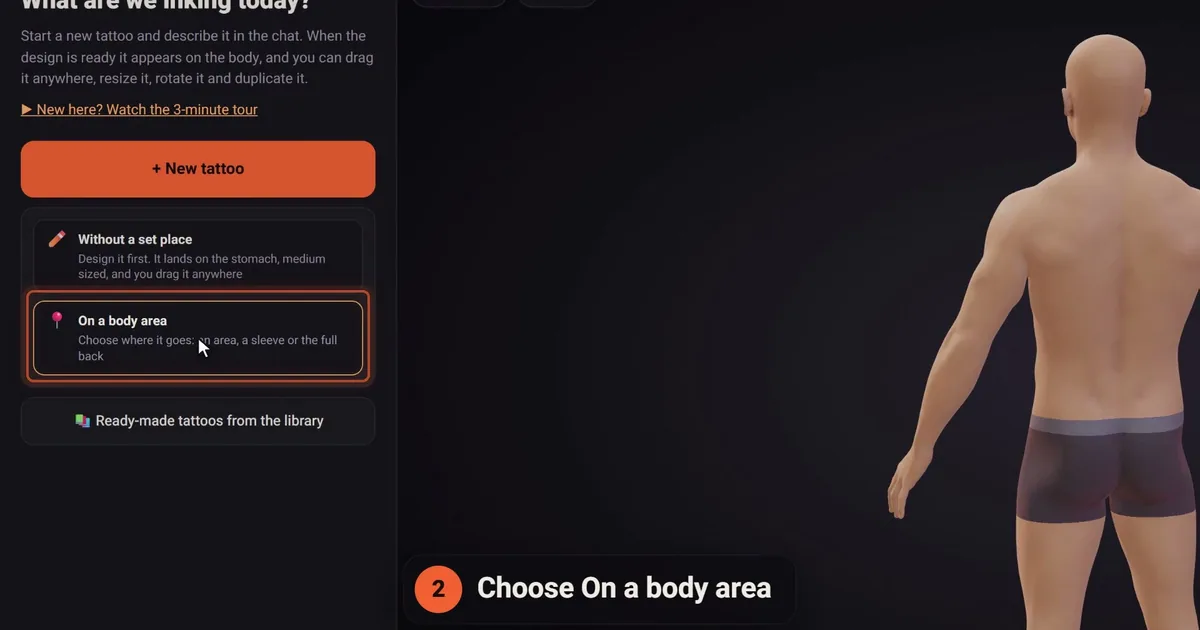
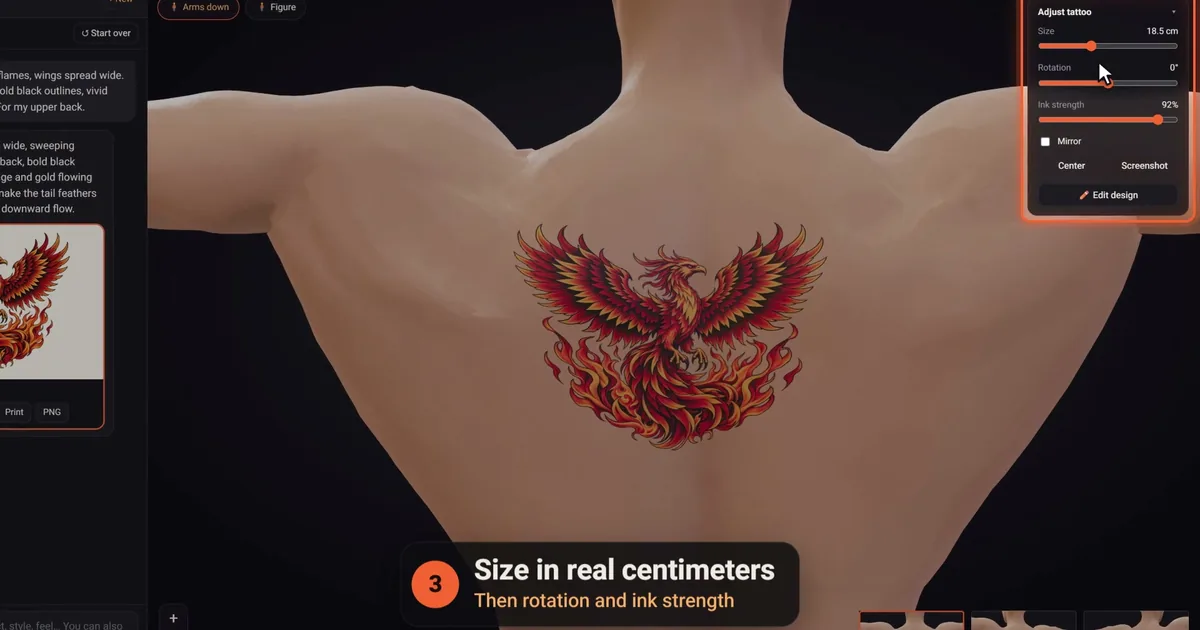
Measure the design flat, the way it's printed on the stencil. A forearm piece that wraps partway around the arm is longer on the stencil than it looks from the front. In click2ink, the adjust panel shows the size in centimeters as you drag the slider, on a figure sized to your height.
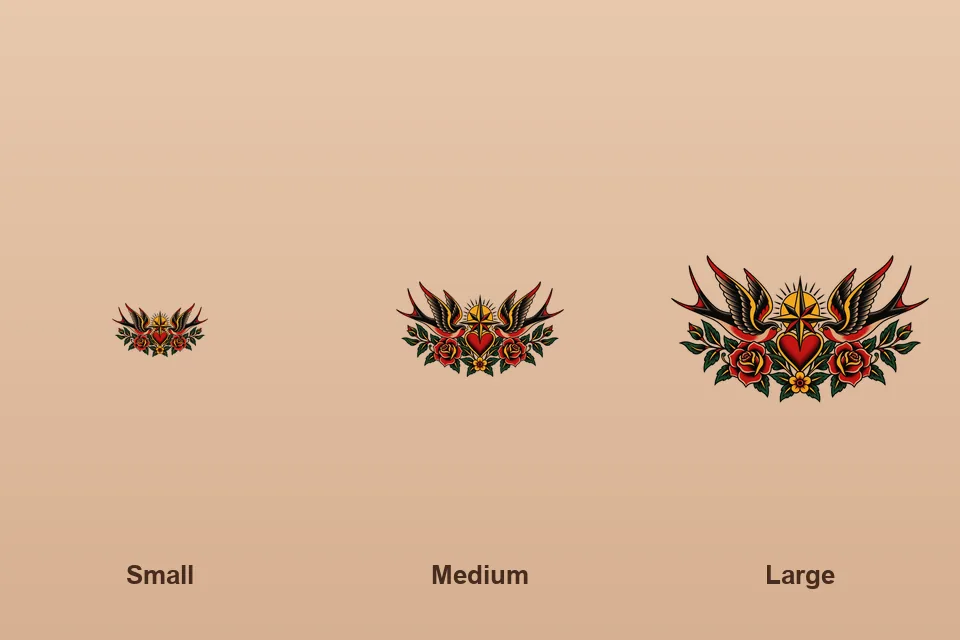
Small, medium and large: what people usually mean
There are no official categories, but these are the words you'll hear in studios, roughly:
- Small: up to about 5 cm (2 in). A symbol, a word, a tiny animal, a minimalist line drawing.
- Medium: about 5 to 15 cm (2 to 6 in). Most forearm, shoulder and calf pieces.
- Large: over about 15 cm (6 in). Thigh, back and rib pieces, and anything with a scene or a portrait.
- Big projects: sleeves and full backs, planned as one design and usually tattooed over several sessions.
"Palm-sized" is another common shorthand: about the size of your palm without the fingers, which on most adults means around 8 to 10 cm (3 to 4 in). Measure your own to be sure.
Tattoo size by body area
Bodies vary, so treat these tattoo sizes as starting points for an average adult, measured along the longest side. Then measure your own.
| Area | Comfortable range | What fits |
|---|---|---|
| Wrist, ankle, back of the neck | 2–8 cm (1–3 in) | One simple subject, a short word |
| Hand | 3–10 cm (1–4 in) | Bold, simple designs |
| Forearm, one side | 8–20 cm (3–8 in) | An animal, a flower stem, a line of script |
| Upper arm and shoulder | 8–18 cm (3–7 in) | A rose, a medallion, an animal head |
| Chest, one side | 10–20 cm (4–8 in) | A bird, a heart, an ornament |
| Chest, across | 25–35 cm (10–14 in) | Wings, symmetrical pieces |
| Ribs and side | 10–30 cm (4–12 in) | Tall flowers, script, a long animal |
| Upper back | 15–30 cm (6–12 in) | Wings, a mandala, a scene |
| Thigh | 15–30 cm (6–12 in) | Portraits, big animals, florals |
| Calf | 10–25 cm (4–10 in) | Tall subjects, figures |
For sleeves and full backs, measure the canvas itself: shoulder to wrist for a sleeve, shoulders to waist for a back. If you're torn between two spots, our tattoo placement guide compares them.
Detail sets the minimum tattoo size
Tattoo ink doesn't stay perfectly put. Pigment sits in the dermis, and over decades it tends to migrate deeper, which accounts for the softer detail of old tattoos. Lines thicken a little and small gaps fill in. That's why the amount of detail, not the size of the spot, should decide how big a design has to be.
- Keep gaps at least as wide as the lines. At small sizes, that means fewer lines, not thinner ones.
- Give faces room. A realistic portrait needs enough size for the eyes and mouth to carry shading, often palm-sized or bigger; our realism tattoo guide goes further.
- Allow more size for fine line than you'd expect. Thin lines leave little margin for softening, and our fine line tattoo guide covers what holds up.
- Give letters height. As a starting point, keep lowercase letters around 1 cm (3/8 in) tall or more for fine script; bold block letters can go a little smaller. Ask your artist where their limit is.
- Count the elements. Each extra subject needs space, and shrinking a scene doesn't simplify it; redrawing it does.
Size, time and price
Tattoo size and time go together: bigger usually means longer in the chair, and time is what most artists price. Many charge by the hour for larger work and by the piece for smaller designs, and shops often set a minimum charge, so a tiny tattoo can cost about as much as a slightly bigger one. Large pieces are split into sessions, with healing time in between.
Detail matters as much as size: a 10 cm dotwork mandala can take longer than a 15 cm bold traditional panther. When you ask for a quote, give the size in centimeters or inches, the placement and a reference, and let the artist estimate from there.
Proof the size at real scale
- See it on a body at real scale. On click2ink's 3D figure, the size you set is in real centimeters on a body of your height, and "Make it look like me" adds your weight and build. Drag the size slider until the design fills the spot without crowding its edges.
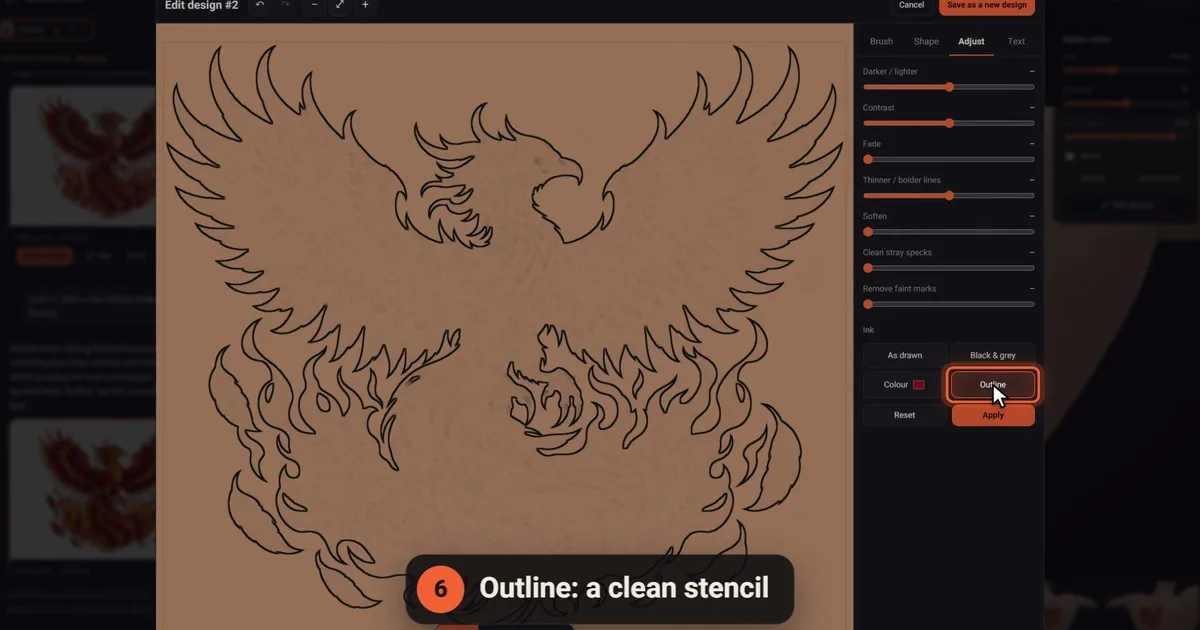
- Print it at actual size. The print page makes a stencil at the size the design has on the body, with a 5 cm check ruler.
- Tape it on and step back. Look from a few steps away, then up close. If the main shape only reads up close, the design is too small or too busy.
- Try one size up. Print a version 2 or 3 cm bigger and compare. If the bigger one looks better, trust it: that extra room is what keeps detail readable for decades.
Our tattoo stencil maker guide goes deeper into printing, and the features page shows the adjust panel and the print page.
When small is right, and when to go bigger
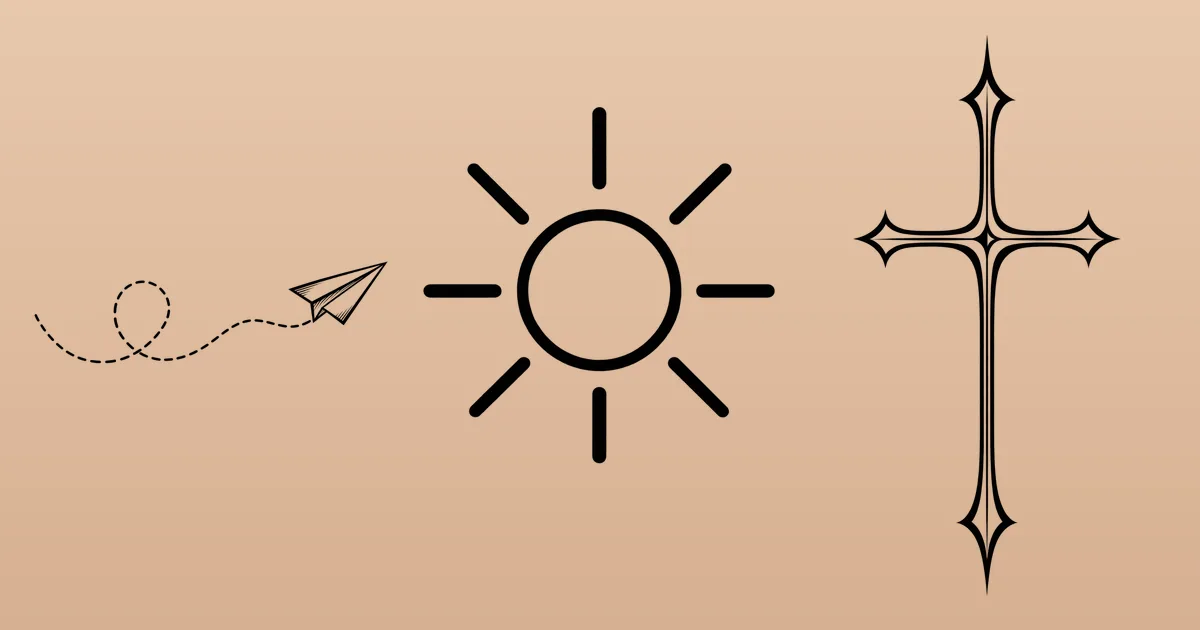
Small tattoos aren't a compromise when the design is simple: a single symbol, a short word, a minimalist line drawing. Those can stay crisp at 2 to 5 cm, and our small tattoos guide is full of ideas built for that scale.
Go bigger when the design has a face, a scene, layered shading, more than one subject or a whole sentence of text. And if you can't decide between two sizes, the right tattoo size is the one that leaves the design room around its edges. It's much easier to add to a tattoo later than to make one smaller.
Tattoo size: quick answers
What size is a small tattoo?
Usually anything up to about 5 cm (2 inches) on its longest side: a symbol, a word or a tiny animal. There's no official definition, and some artists call 7 or 8 cm small. What matters more than the label is whether the design is simple enough for its size, with open gaps and few elements.
How small can a tattoo be?
A simple, bold symbol can work at around 1 to 2 cm, but the smaller it is, the simpler it must be and the sooner it may need a touch-up. Fine detail, tiny text and faces at that size tend to blur. Ask your artist for their smallest size for your exact design; many will suggest going up a little.
How big should my first tattoo be?
Big enough for the design to read clearly, in a spot with room for it. For many first tattoos that's somewhere between 5 and 12 cm (2 and 5 inches) on a forgiving area such as the outer forearm, the upper arm or the calf. Choose by the design's detail, not by nerves alone.
How tall should letters be in a script tattoo?
As a starting point, aim for lowercase letters around 1 cm (3/8 inch) tall or more, especially in thin, looping scripts whose loops can fill in. Bold, simple lettering can go a little smaller. Long quotes need a long spot, such as the ribs or the forearm, rather than smaller letters. Your artist will know their own limit.
Does a bigger tattoo always cost more?
Usually, but not strictly by size. Price follows time, and time follows detail as much as area: a dense dotwork piece can take longer than a bigger, bolder one. Many shops also have a minimum charge, so the smallest tattoos don't save as much as you'd expect. Ask for a quote with the size and a reference.
How big is a palm-sized tattoo?
About the size of your palm without the fingers, which on most adults is roughly 8 to 10 cm (3 to 4 inches) long. Hands differ, so measure yours. It's a useful size for a first piece with some detail, such as an animal head, a rose with leaves or a compass, on the forearm, upper arm or calf.
Can a tattoo be made smaller after it's done?
No. Ink can't be shrunk. An artist can add to a tattoo, rework it or build it into a bigger piece, and a laser clinic can lighten or remove it, but none of that makes the original smaller. That's one more reason to test the size at real scale before the stencil goes on.
Should my tattoo be the same size as the reference picture?
Not necessarily. A picture on a screen has no real size; what matters is the size on your body. Decide it from the placement and the detail, then check it with a true-size print or a 3D figure. If the reference was a tattoo on someone else, their arm may be bigger or smaller than yours.
How do I print a tattoo design at its real size?
Set the design to the size you want on the body, then print with scaling turned off, usually labeled "actual size" rather than "fit to page." Check the result with a ruler. click2ink's print page includes a 5 cm check ruler for exactly this, so you can confirm the scale before you tape it on.