Ornamental tattoo: filigree, lace and jewelry drawn for the body
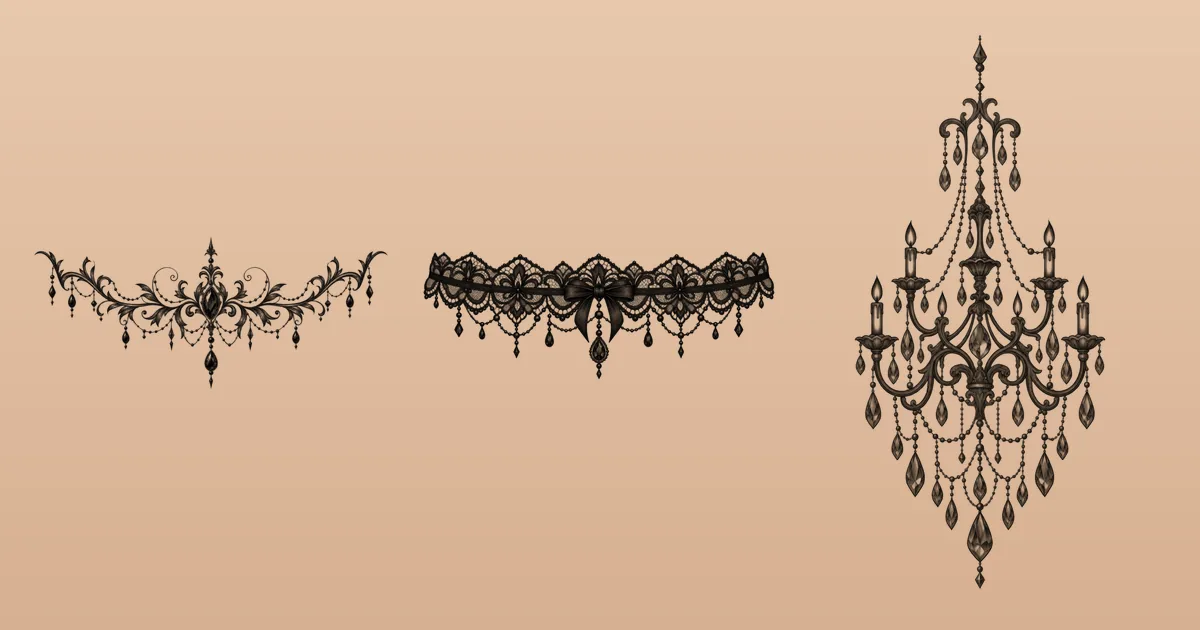
The most common mistake with an ornamental tattoo is choosing the pattern before the body part. A filigree piece that looks perfect on a screenshot of someone's sternum turns lopsided on a forearm, because ornament is drawn around a center line, a curve or a joint. Start from the spot, then the lace, beads and scrolls that frame it, and the design almost plans itself.
What makes a tattoo "ornamental"
An ornamental tattoo is decoration first: it frames and adorns the body the way a necklace does. Art historians use the word the same way: ornament is the decoration used to embellish parts of a building or object, as Wikipedia's article on ornament in art puts it, from acanthus leaves on Greek capitals to the arabesques and scrolls spread by European pattern books.
Tattooers borrow from several sources:
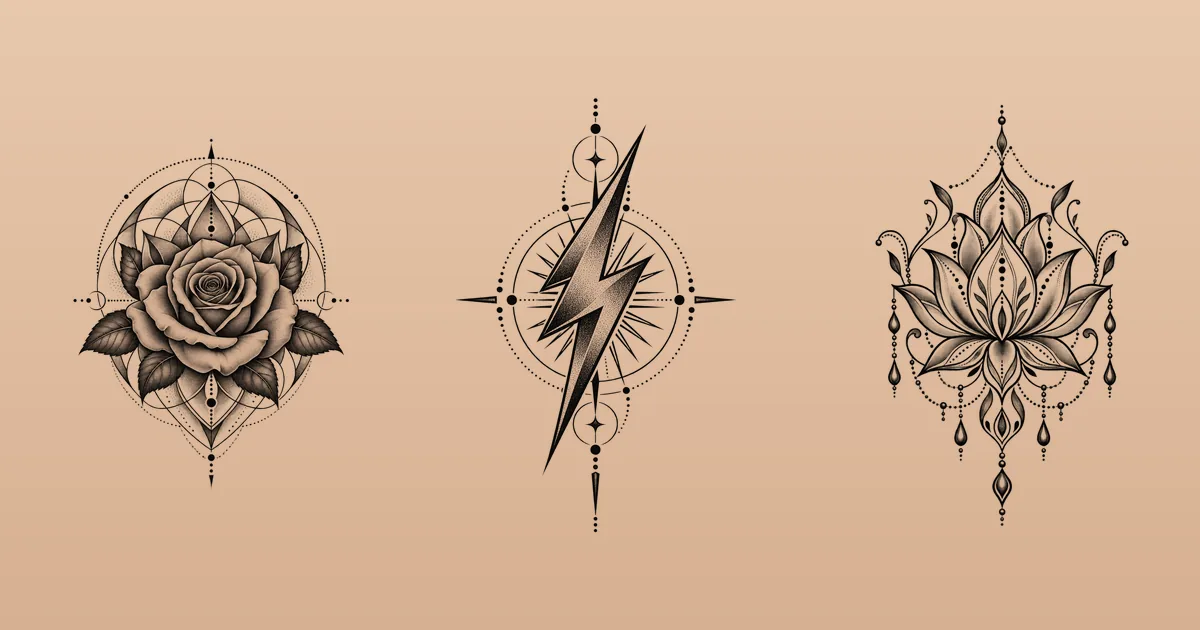
- Jewelry. Pendants, chokers, chains and drops, and above all filigree, intricate metalwork of curled and twisted gold or silver wire with tiny beads, which translates beautifully into fine looping lines.
- Lace and textiles. Scalloped edges, mesh and repeating borders, often worn as garters, cuffs or epaulettes.
- Architecture. Wrought-iron scrolls, stained-glass tracery, baroque flourishes and chandeliers.
- Henna. The flowing vines, paisleys and fingertip patterns of mehndi.
That last one deserves care. Mehndi is a living tradition: in South Asia it is applied for weddings, religious festivals such as Diwali and Eid, and family ceremonies, and regional styles differ, from intricate South Asian patterns to floral Middle Eastern designs and simpler, geometric African ones. A henna-inspired tattoo makes permanent something temporary, and often ceremonial, in its home cultures. Learn what you are borrowing, and for a design that truly follows the tradition, look for an artist who knows it well.
The building blocks of ornamental work
Most ornamental designs are assembled from a short list of parts:
- Filigree and scrollwork: curling C- and S-shaped lines that branch and loop, usually in mirrored pairs.
- Lace: scalloped borders, little arches and mesh, good for bands and edges.
- Beads and drops: dotted strands and teardrop pendants that hang below the main shape and lead the eye downward.
- A focal jewel: a gem, a small rosette or a lotus in the center that everything else grows from.
- Symmetry: usually mirror symmetry along a vertical line, not the radial symmetry of a mandala.
- Dotwork shading: stippled gradients that give the pattern depth without heavy black.
- Negative space: bare skin left open between lines, which keeps the pattern airy and readable as it ages.
Ornamental, mandala or blackwork?
The three overlap constantly. The difference is mainly how a design is organized and how much black it carries:
| Ornamental | Mandala & geometric | Blackwork | |
|---|---|---|---|
| Organized around | a center line, an edge or a curve of the body | a single center point, or clean geometric shapes | contrast between solid black and skin |
| Typical parts | filigree, lace, drops, beads, jewels | rings of petals, circles, polygons, sacred geometry | silhouettes, fills, bands, heavy patterns |
| Amount of black | light to medium | light to medium | heavy |
A mandala often sits inside an ornamental piece, with lace and drops hanging below it; our mandala tattoo guide covers the radial side and its meanings. When ornament is packed with solid black, it moves into blackwork tattoo territory. For the wider family, see the tattoo styles overview.
Where an ornamental tattoo sits best
Ornament loves a body part with a natural axis or edge:
Sternum and under the bust
The breastbone is the body's clearest center line, so a mirrored filigree piece with a jewel in the middle and drops hanging down looks like a necklace that belongs there. Wider designs can follow the curve under the bust. The sternum is bony with thin skin, and spots like that are generally described as more sensitive; your artist can tell you what to expect.
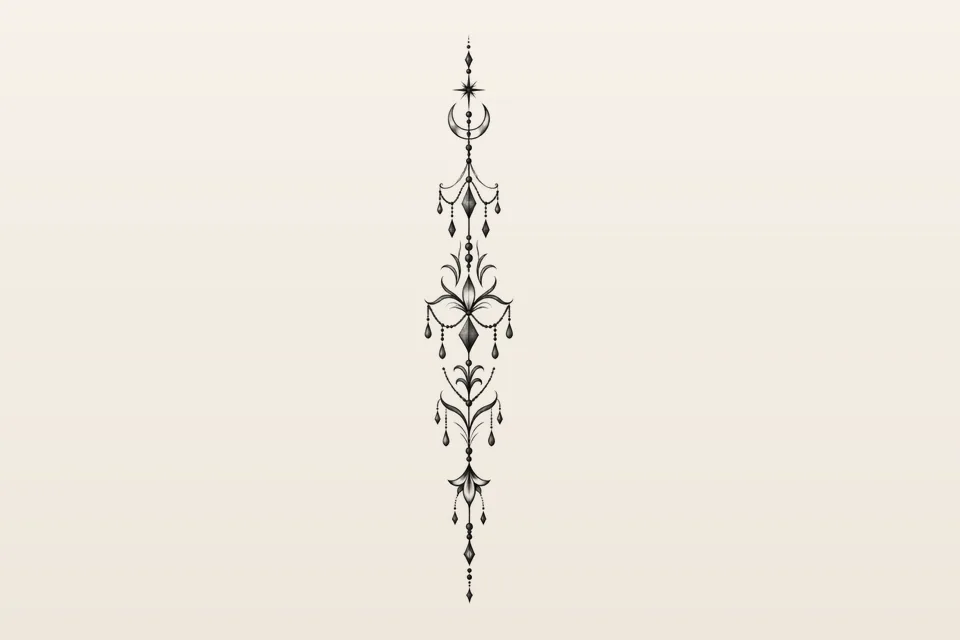
Down the spine
A vertical chain of beads and small ornaments makes a long, slim piece. Keep it centered: any drift off the spine shows.
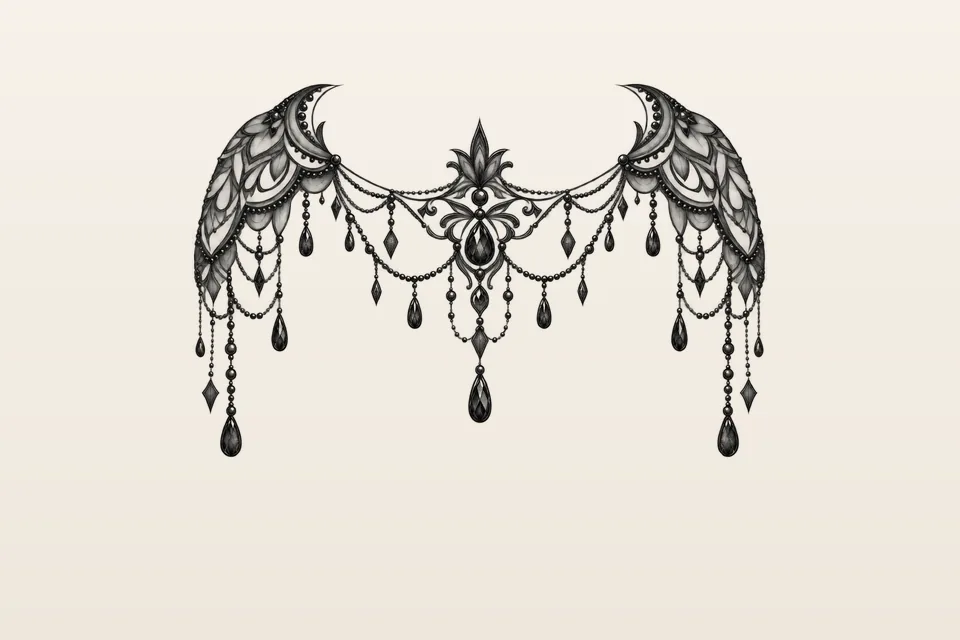
Shoulder caps and epaulettes
The round top of the shoulder suits a lace or filigree "epaulette" that spills down the upper arm, often with drops at its lower edge. It is also a natural first piece of an ornamental sleeve.
Back of the arm
The back of the upper arm suits a tall mirrored design: a chandelier, a pendant or a filigree column. Center it as you stand naturally, not with your arm held out.
Thighs and garters
A lace garter band with a bow wraps the upper thigh; the front or side of the thigh has room for wide scrolls.
Hands and fingers
Henna-style vines and fingertip details are a classic, but small lines on hands tend to blur and fade sooner. Our hand tattoo guide covers what to plan for.
Chest for men
For men, ornamental often means a wide mirrored piece across the upper chest or a filigree gorget at the collarbones, with bolder lines. See our chest tattoo page for sizing across the pecs.
For small pieces, choose one element: a single drop pendant, a short bead strand or a lace cuff on the wrist or ankle. For a full plan of spots and trade-offs, see tattoo placement.
Fine line or bold: line weight and ageing
Ornamental fine line means thin filigree, tiny beads and light stippling, like lace drawn in pencil. Bold ornamental uses heavier outlines and denser dotwork, closer to blackwork. They age differently.
- Fine line looks delicate when fresh, but thin lines can soften and fade over the years, and lines laid very close together may merge. It needs size: keep loops open and leave space between strands.
- Bold lines hold their shape longer and read from across a room, at the cost of some delicacy.
- A mix often works best: a firm outer contour and main scrolls, with fine accents and dotwork inside.
These are general tendencies; your artist will adjust weights for your skin. Our fine line tattoo guide goes deeper on how thin lines settle.
Combining ornament with other motifs
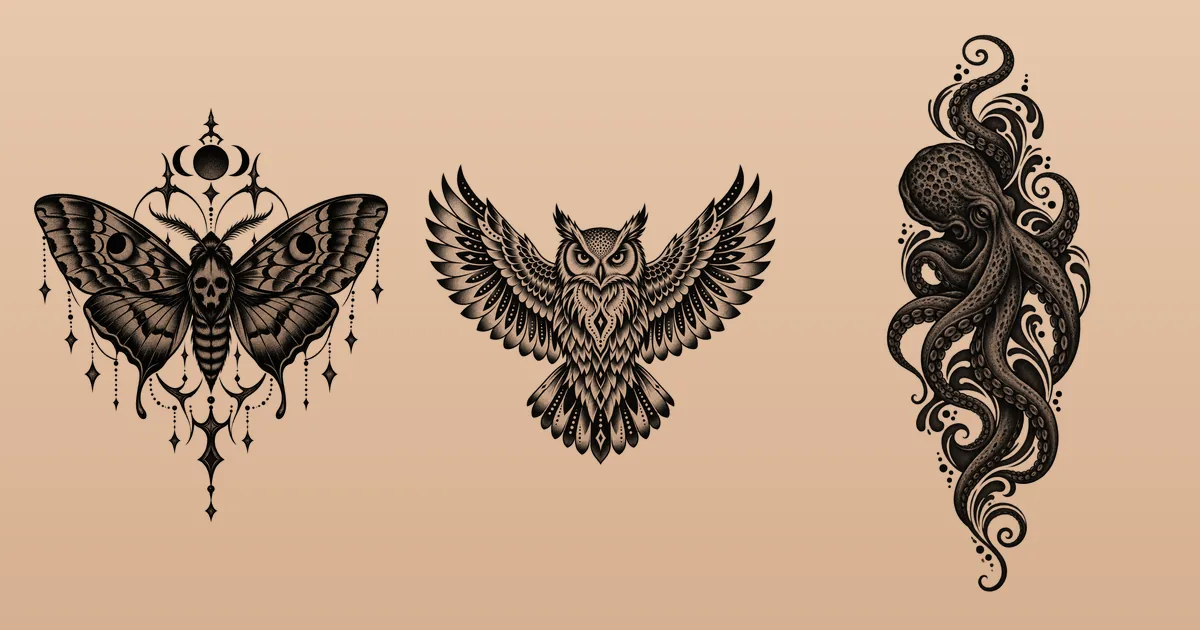
Ornament is a frame by nature, so it pairs easily with a subject: a peony or lotus as the central jewel, a moth with filigree wings, a crescent moon hung with beads. Lace and bead strands can also join separate tattoos into one ornamental sleeve; our sleeve tattoos guide covers flow. Keep one star: if the subject is detailed, keep the ornament lighter, and the other way round.
Sketching an ornamental tattoo in click2ink
click2ink is our own design studio: you describe a tattoo in a chat, an AI artist draws an original design, and it lands on a 3D figure. To plan ornamental work there:
- Pick the spot first. Tap the chest, upper back, shoulder, upper arm, thigh or another area on the small figure, or choose a sleeve.
- Choose "ornamental" among the 16 styles (or dotwork & mandala for something rounder).
- Describe it from the center out: "a mirrored filigree piece centered on the sternum, a small teardrop jewel in the middle, lace scallops to each side, three strands of beads hanging below, light dotwork shading, about 14 cm tall."
- Check it on the body. Sizes are in real centimeters, sized to the figure's height. Turn the figure to check the symmetry from the side, and use "Arms out" to see the inner arm and the back of the arm.
- Use the Adjust panel. Mirror flips the design, handy for a matching pair on both shoulders or thighs; rotate, resize and wrap it around the limb for bands and garters.
New accounts start with 3 free credits (see pricing), and the library designs on this page are free to place. When it's right, print a true-size stencil and bring it to your artist, who will refine the lines for your skin. How it works shows each step.
Ornamental tattoo questions
What does an ornamental tattoo mean?
Usually, whatever you want it to. Ornamental work is decorative by definition, so most people choose it for its beauty, its jewelry-like feel or the way it flatters a body part. Specific elements can carry meanings from their sources, such as motifs drawn from henna traditions or religious art, so if your design borrows something recognizable, read up on where it comes from.
Is an ornamental tattoo a good choice for men?
Yes. Ornament isn't gendered; it's a matter of scale and weight. Men often choose bold ornamental chest pieces, filigree gorgets at the collarbones, ornate frames for a central symbol, or ornamental sleeves with heavier dotwork. The same building blocks, such as scrolls, beads and mirrored symmetry, simply get larger and stronger lines.
Can an ornamental tattoo be small?
It can, if you reduce it to one or two elements: a single pendant drop, a short strand of beads, a narrow lace cuff on the wrist or ankle. Small pieces can't carry full filigree, because tight loops close up as lines soften. If a design looks busy at its real size on screen, it will look busier on skin.
How do I plan an ornamental sleeve?
Anchor it at the round parts first: an epaulette or mandala on the shoulder cap, maybe a rosette at the elbow. Then connect them with vertical elements, such as bead strands, filigree columns and lace bands, that follow the arm. Leave open skin between sections so the pattern stays readable, and decide early how dense the dotwork should be overall.
Does a sternum ornamental tattoo hurt?
Pain is personal, so nobody can promise how it will feel for you. In general, bony areas with thin skin, like the breastbone, are described as more sensitive than fleshy ones, and long sessions add up. Talk to your artist about what to expect, breaks and splitting a large piece over more than one session.
Is a henna-style tattoo cultural appropriation?
Opinions differ. Henna is a living tradition tied to weddings, festivals and family ceremonies in South Asia, the Middle East and North Africa, and a permanent copy changes what it is. Approach it with respect: learn about the tradition, avoid copying ceremonial designs without understanding them, and consider an artist with roots in or deep knowledge of it.
Will ornamental fine line work last?
Fine lines tend to soften and may fade over the years, and lines placed very close together can merge. Fine line ornamental work lasts best when it is large enough for its detail, with open loops, space between strands and sun protection once healed. A firm outer contour with fine accents inside is a common compromise.
How do I find an artist for ornamental work?
Look for healed photos of ornamental pieces, not just fresh ones: straight center lines, even symmetry, smooth dotwork gradients and loops that stayed open. Check that the portfolio matches the weight you want, since delicate fine line filigree and bold blackwork ornament are different skills. Bring your design and placement, and be open to their adjustments.