Blackwork tattoo: bold black, bare skin and the space between
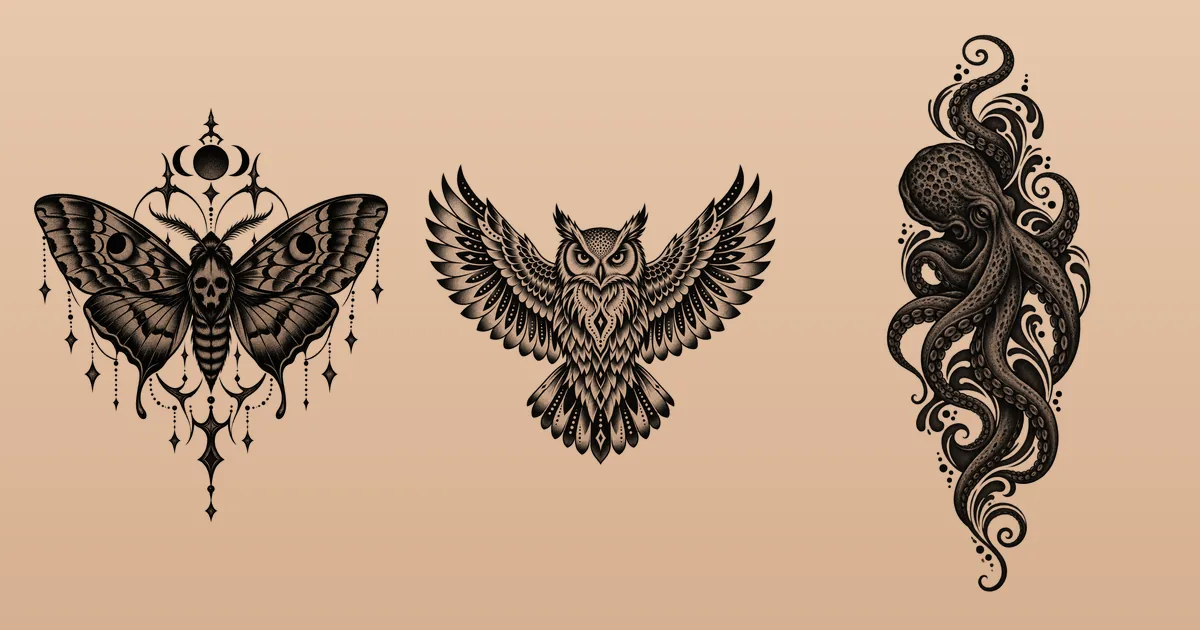
Long before it named a tattoo style, blackwork named a kind of embroidery: needlework generally worked in black thread, most strongly associated with Tudor England. The blackwork tattoo shares the name and the contrast, with black ink, bare skin and no color at all. Done well, the skin you leave untouched matters as much as the ink.
Ink, skin and line: the parts of a blackwork tattoo
Blackwork uses one ink and nothing else, so everything you see comes from four tools:
- Solid black. Areas packed fully dark: a silhouette, a band, a background, a moon.
- Negative space. In art and design, negative space is the empty space around and between the subjects of an image. In blackwork that's bare skin, and it's drawn as deliberately as the ink: a pale flower is really a flower-shaped gap in the black.
- Line. Heavy outlines, fine hatching or crisp geometric lines.
- Texture. Dotwork and stippling that fade the black into the skin.
Printmakers will recognize the logic. In a woodcut, a relief print, the areas the artist cuts away carry no ink, so the picture is made as much by what's removed as by what's left. Blackwork thinks the same way, and some of it borrows the look of woodcuts and engravings openly.
Six directions a blackwork tattoo can take
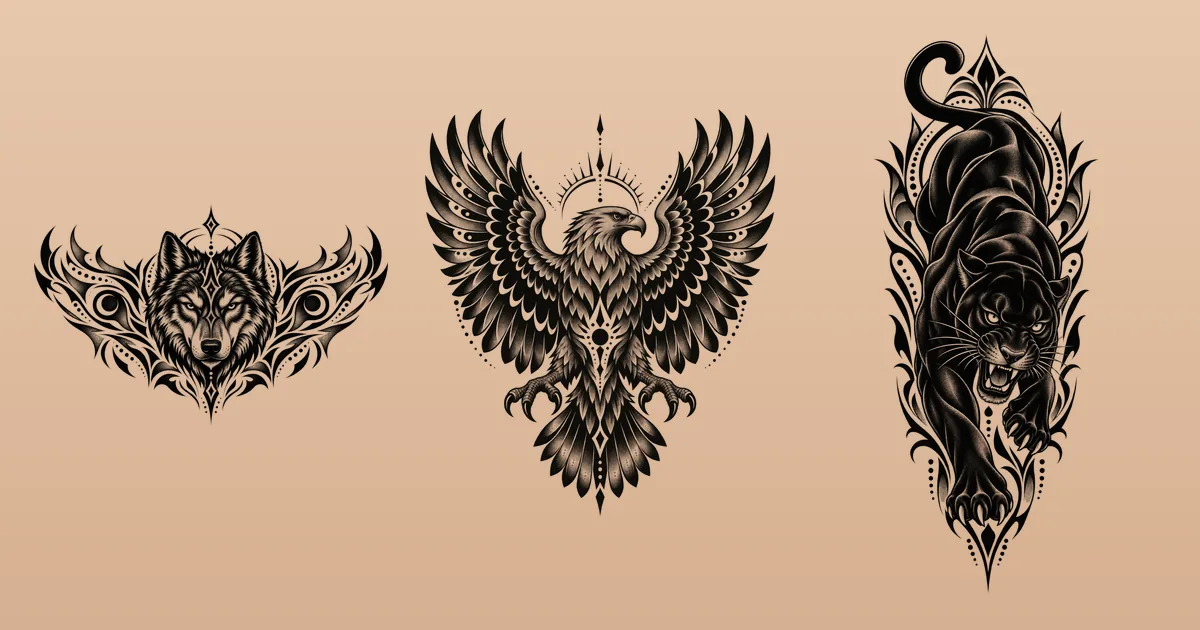
Bold silhouettes
Animals and objects as solid shapes, with feathers, fur or veins carved out in skin: a raven, a panther, a moth.
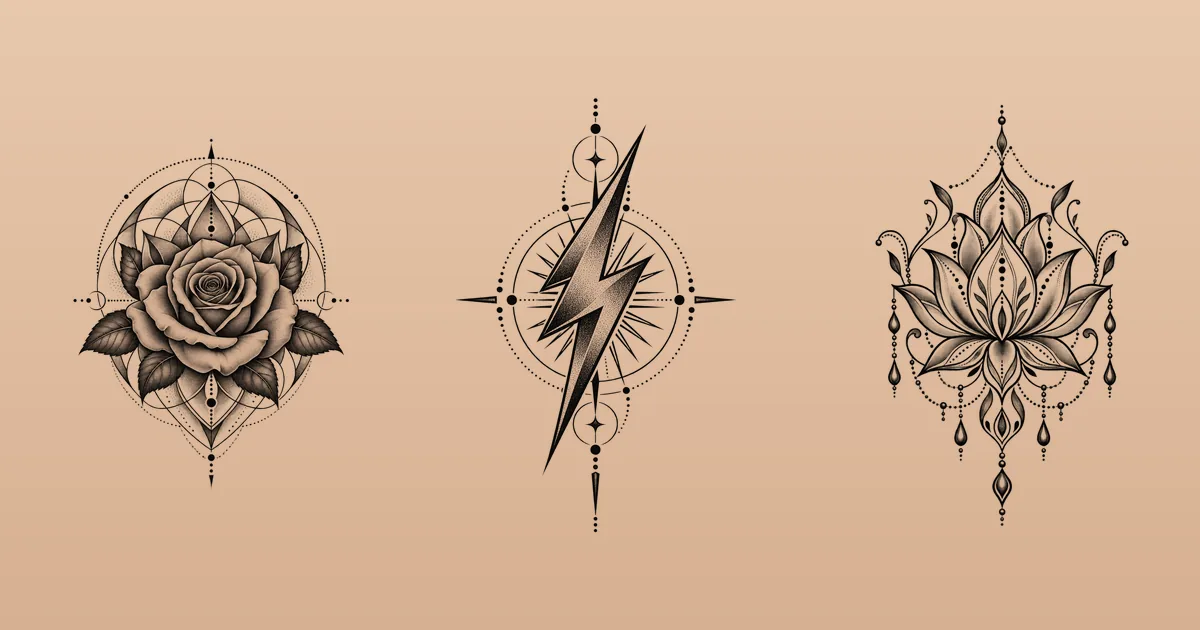
Ornamental and dotwork
Lace, filigree, mandalas and stippled gradients, where blackwork overlaps with dotwork; our mandala and geometric tattoo guide covers that side.
Geometric
Lines, triangles and sacred-geometry patterns, with some shapes filled solid for weight.
Illustrative and etched
Engraving-style hatching for skulls, botanicals and mythical creatures, readable in black alone.
Heavy fills and blackout
Large areas of solid black, sometimes covering a whole section of an arm or a leg, sometimes with a pattern left open in bare skin.
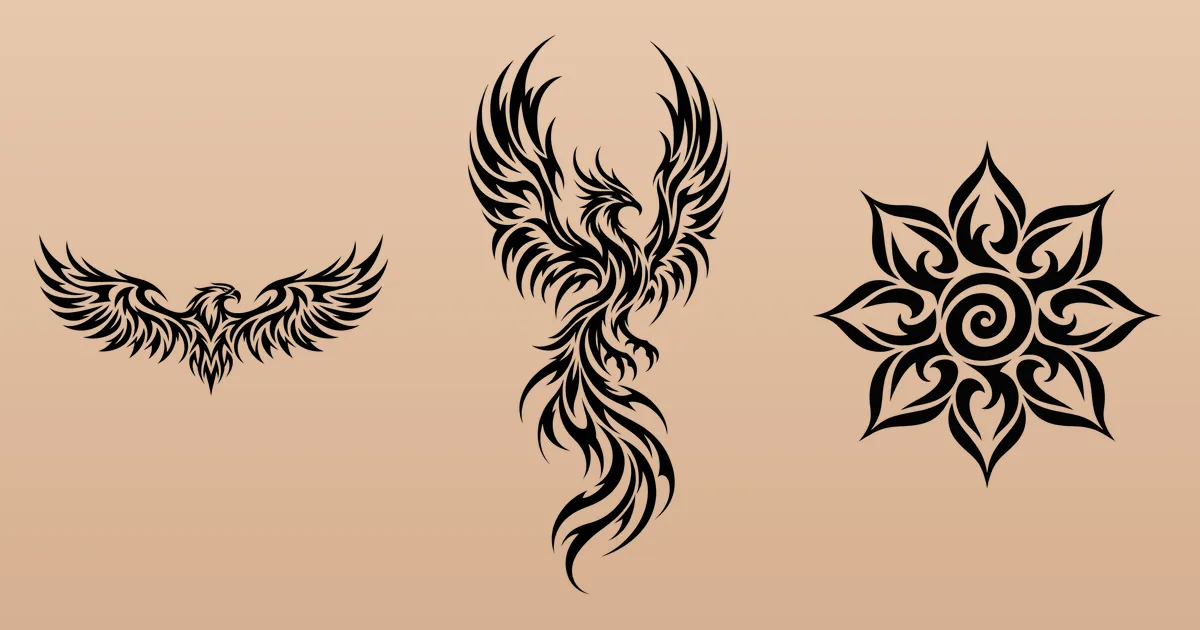
Tribal-inspired
Bold, flowing black shapes. Many come from cultures whose patterns carry their own histories and meanings, so read our tribal tattoo guide before borrowing one.
Blackwork sleeves, bands and big pieces
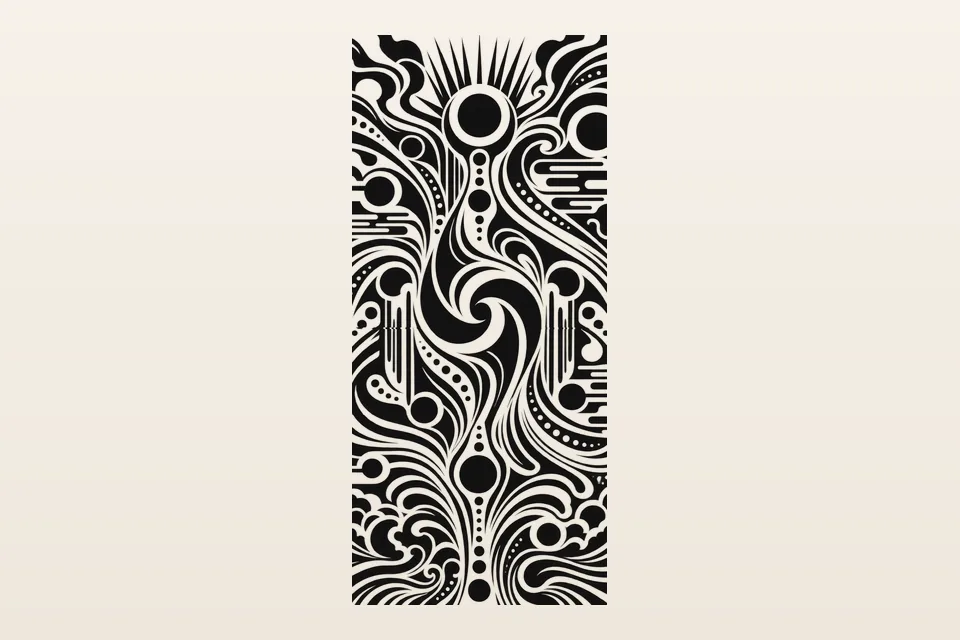
Blackwork scales up well because it doesn't depend on delicate color blends. A blackwork sleeve can be one continuous pattern wrapping the arm, like the one below, a stack of bands, or one large subject on a solid black background. Armbands and legbands are the simplest version: a ring of pattern around the limb, which has to line up where it meets itself.
Plan the negative space first. On a full sleeve, the bare-skin shapes are what make the pattern read from across a room; fill too much, and the arm becomes one dark mass, unless a blackout is exactly what you want. The elbow and the inner arm are where patterns bend, so ask how your artist will carry the design through them.
In click2ink you can start a full, half or forearm sleeve, right or left, or a leg sleeve. The AI artist draws one continuous design around the limb, and you set its length, turn it around the arm and let it carry onto the chest and back. Our sleeve tattoos guide covers flow and planning.
Blackwork over old ink
Dark, dense designs hide old tattoos best, and nothing is darker than solid black, which makes a blackwork tattoo one of the strongest options for a cover-up. A black area can sit right over the old lines while the pattern around it gives the eye something new to read.
What's generally true: the new design usually has to be bigger than the old one, very dark or heavily saturated old ink may need laser lightening first, and only an artist who sees your old tattoo in person can say what will cover it. A full blackout, solid black over the whole area, takes the old tattoo out of view, but it's a big look to live with. Our tattoo cover up guide walks through the options, from reworking to lightening. To prepare, attach a photo of the old tattoo in click2ink: the AI lifts it off the skin as a clean design you can place on the 3D figure, to see how much room a cover would need.
Aging, skin tone and commitment
A bold blackwork tattoo holds its shape well as skin ages, which is a big part of the style's appeal. The risk runs the other way: lines, dots and gaps placed too close together can merge into solid black over the years, so keep the negative-space shapes generous, especially in small pieces.
Because blackwork relies on the contrast between ink and skin rather than on color, it reads on light and deep skin tones alike; on deeper skin, ask for bolder shapes and slightly wider gaps so the pattern stays clear. Large solid areas take time to pack evenly, so a big piece may be split into sessions, and your artist will tell you what to expect while it heals.
It's also a style to be sure about. Nothing lighter can cover solid black later, and while the FDA notes that dark blue and black are the easiest colors to remove with lasers, removal still takes multiple treatments and isn't always complete.
Describing a blackwork design that works
Blackwork briefs go wrong when they only name the subject. Say what should be solid, what should stay bare skin and how it's shaded:
- "An owl with spread wings, blackwork, feathers as solid black shapes with bare-skin edges, no grey, about 20 cm across the upper back."
- "A moth with its body on the spine, crescent moons above and below, dotwork shading on the wings, small ornamental drops hanging from the wingtips."
- "A forearm sleeve of bold abstract swirls and circles, roughly half black and half skin, with the largest open shapes on the outer arm."
In click2ink, pick blackwork as the style when you start, or dotwork & mandala, geometric or ornamental for a lighter take. Designs come without white ink unless you ask for it, so the light parts are bare skin, which is how blackwork works anyway. Try the result on the figure's six skin tones, or on one matched to yours with "Make it look like me," and print a true-size stencil when it's right. See how it works for the whole flow.
Solid black, honest answers
Does a blackwork tattoo hurt more than other styles?
Not because of the ink itself, but large solid areas mean the artist works over the same skin for longer, which can feel more intense than linework. Placement matters more than style: bony, thin-skinned spots are generally described as more sensitive than fleshy ones. Ask your artist what to expect, and split big fills over more than one session if you need to.
Is blackwork the same as a blackout tattoo?
No. A blackout is one kind of blackwork: a large area filled with solid black, often to cover old tattoos or simply for the look. Blackwork is the broader style, from fine botanical silhouettes and dotwork ornaments to geometric bands, and most of it leaves plenty of bare skin. A blackout is also far harder to change later.
Can blackwork be delicate?
Yes. Blackwork is defined by black ink only, not by heaviness, so it can be a fine botanical silhouette, a small dotwork moon or a thin geometric band. Delicate pieces still need generous gaps between lines and dots for their size, because black spreads a little in skin over the years. Ask for bold shapes with fine accents rather than fine lines everywhere.
Can blackwork link the tattoos I already have?
Often, yes. Bands, patterns, dotwork gradients and solid backgrounds can join separate pieces into one sleeve or back piece, because black sits comfortably next to almost any style. Bring clear photos of what you have. In click2ink you can attach a photo of a tattoo on your skin, and the AI lifts it off as a clean design you can place and plan around.
Can a blackwork tattoo include color?
Strict blackwork is black only, but a single accent color, such as red in a flower or an eye, can be a striking twist in a black-heavy design. Plan it from the start, because color can't go on top of solid black: it has to sit in skin left open for it. Adding color to an existing piece later only works where there's bare skin to fill.
How do I find a good blackwork artist?
Look at healed work, not only fresh photos. Good blackwork has solid areas that look even and fully dark once healed, crisp edges where black meets skin, and negative-space shapes that stay open over time. Check that the portfolio includes the kind of blackwork you want, since bold blackout, fine ornamental and dotwork are different skills.
Where does blackwork look best on the body?
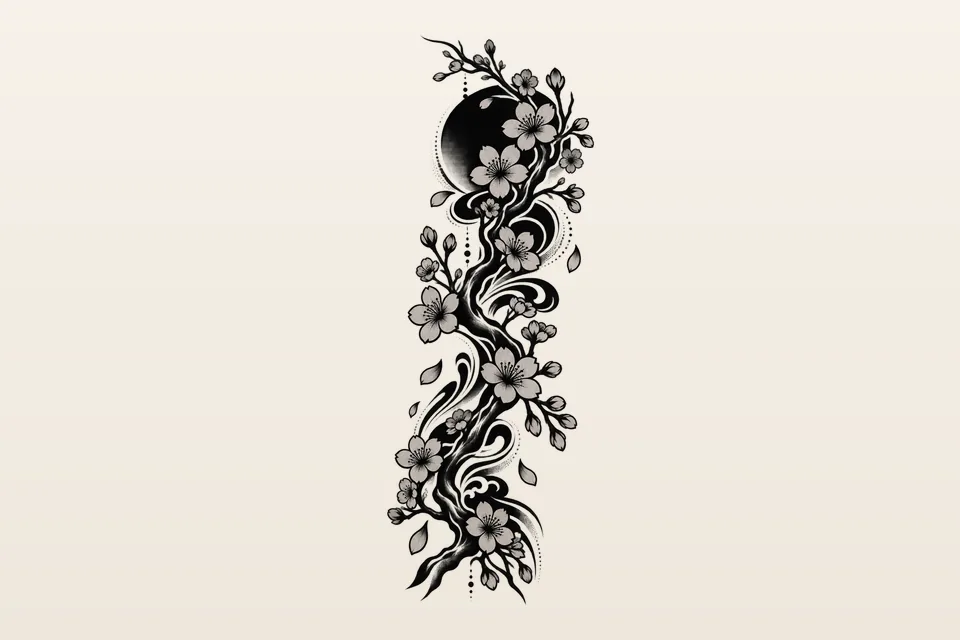
Almost anywhere, because bold black reads from a distance. Bands suit the forearm, the upper arm and the calf; ornamental pieces suit the sternum, the spine and the back of the neck; big silhouettes suit the thigh, the back and the ribs, like the cherry blossom above. Patterns that wrap need a limb, and symmetrical ones need a center line.
Is a blackwork tattoo easier to remove than a colorful one?
The color helps: the FDA notes that dark blue and black are the easiest colors to remove, while green, red and yellow are the hardest. But large solid areas hold a lot of ink, removal takes multiple treatments a few weeks apart, and complete removal isn't always possible. Treat blackwork as permanent and choose it with that in mind.
How much bare skin should a blackwork tattoo have?
There's no fixed ratio, but the bare skin has to form clear shapes of its own, wide enough to stay open as the ink settles over the years. The smaller the design, the bigger those gaps need to be compared with the lines. If the pattern only reads up close on screen, ask for fewer, larger shapes before the stencil is made.