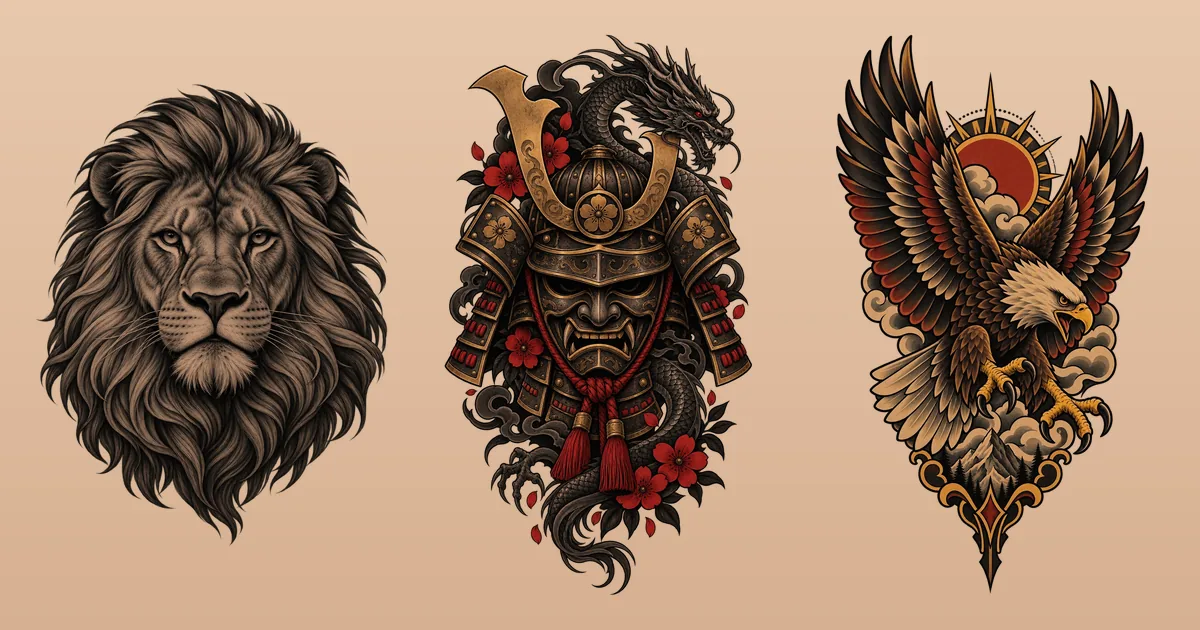
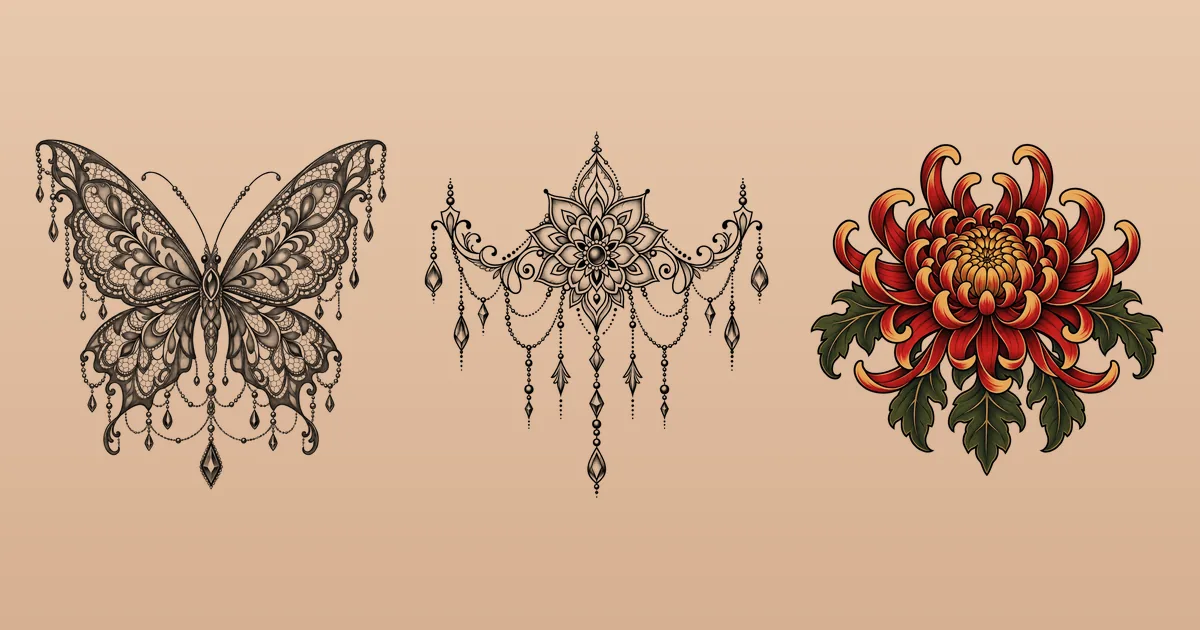
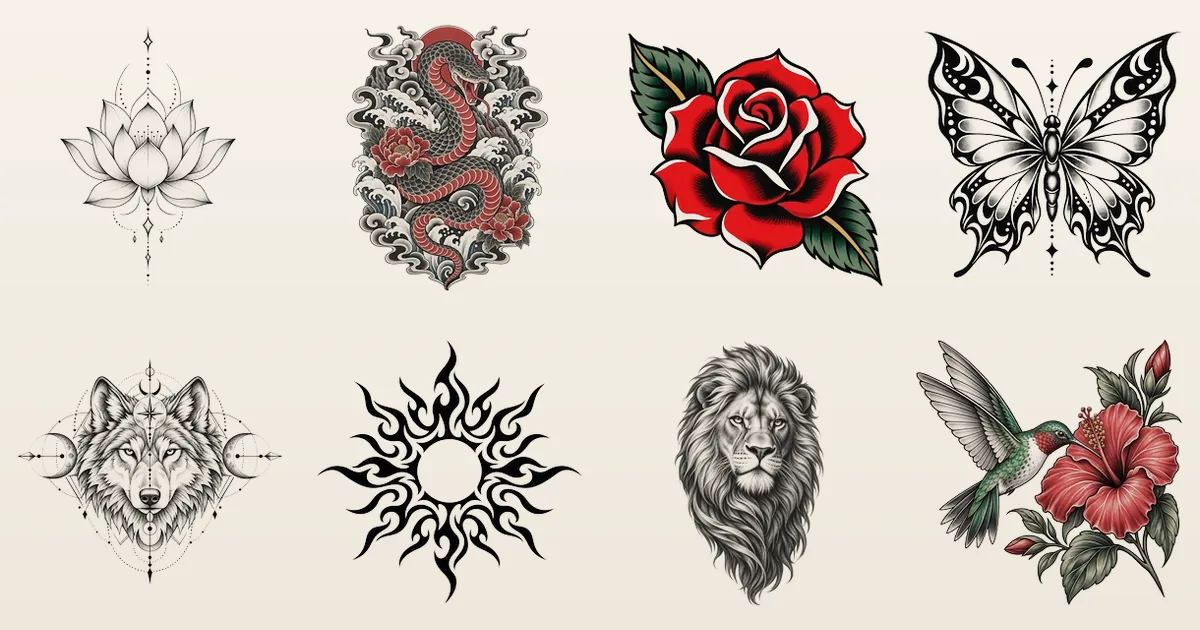
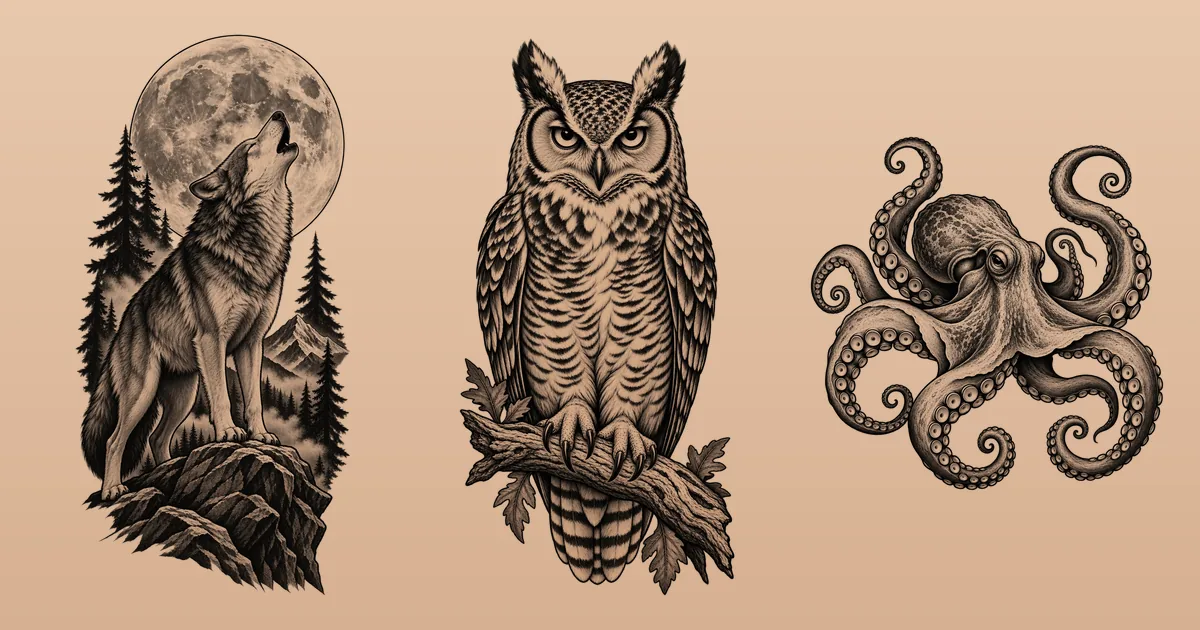
Tattoo designs: a field guide to choosing yours
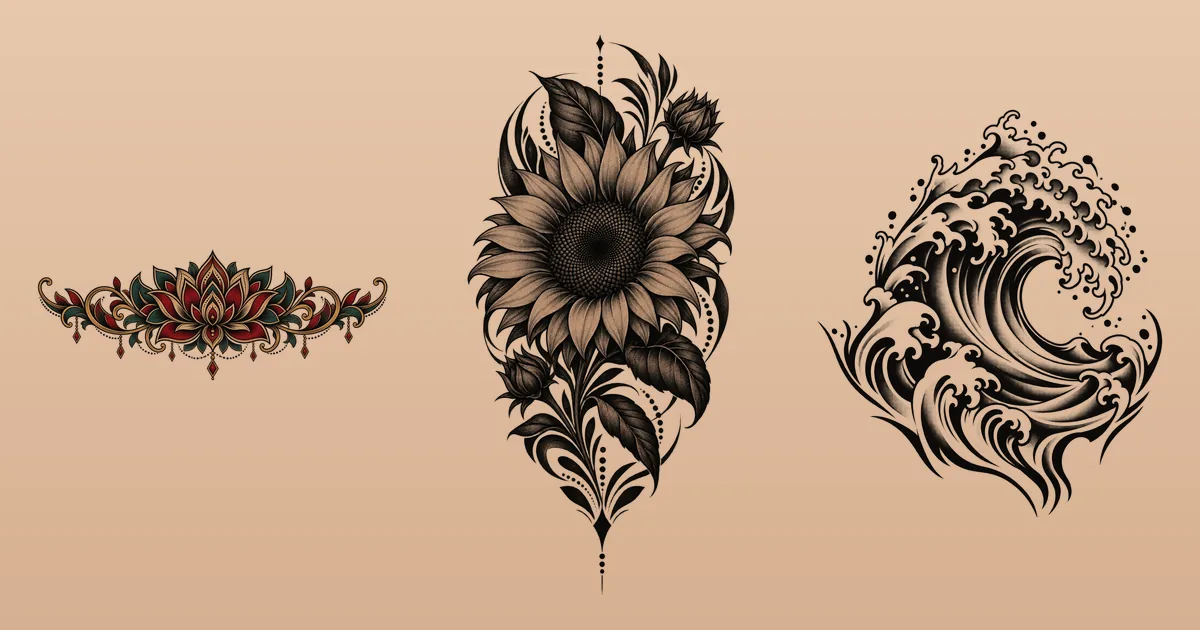
A drawing only has to look good on paper. Tattoo designs have a harder brief: read clearly from across a room, bend around a forearm or a shoulder blade, and stay crisp after years in skin. This guide sorts designs into families, shows how a design's shape points to its spot, and walks through where good designs come from.
The anatomy of good tattoo designs
Hold a strong tattoo next to an illustration of the same subject and the differences come down to a handful of parts. Every good design gets each of them right:
- The outline. It holds the shape together and does most of the work from a distance. Traditional styles keep it bold; fine line keeps it thin but unbroken.
- The values. Most tattoos are built from three: solid black, a range of greys or colors, and bare skin. A design that still reads in a blurry photo has its values in order.
- The open skin. Untouched skin between elements, the negative space, keeps a design readable and gives it air. It's also where the brightest highlights live.
- The flow. The path your eye takes through the design. On a limb it should run with the bone, not across it; on the back it can sweep diagonally.
- The edge. How the design ends: a hard frame such as a circle or a banner, a soft fade into the skin, or an open edge that can grow into a sleeve later. It's the part people forget to choose.
Get those right and the subject almost takes care of itself. Get them wrong and even a beautiful subject turns muddy on skin.
Eight families of designs, and where each sits best
Almost every design you'll scroll past belongs to one of a few families. Each tends to take a particular shape, and the shape points to the spots that suit it:
| Family | Typical subjects | Usual shape | Spots that suit it |
|---|---|---|---|
| Botanical | roses, peonies, sunflowers, ferns, wildflower sprigs | tall stems or round blooms | forearm, calf, spine, ribs |
| Animals | wolves, lions, owls, koi, birds | round heads, tall bodies | shoulder, upper arm, thigh, back |
| Celestial | moon phases, suns, stars, constellations | lines, circles, scattered points | spine, collarbone, forearm |
| Symbols and geometry | compasses, arrows, triangles, mandalas | balanced, often mirrored | sternum, back of the neck, center of the chest |
| Lettering | names, dates, single words, short lines | long and narrow | ribs, collarbone, inner arm |
| Ornamental | lace, filigree, jewel-like chains | wide and symmetrical | sternum, back of the hand, lower back |
| Japanese motifs | waves, koi, dragons, peonies, wind bars | large and flowing | sleeve, back, thigh |
| Traditional flash | swallows, anchors, daggers, panthers | compact and bold | almost anywhere, small to medium |
Families mix happily: a botanical frame around lettering, a celestial background behind an animal. Style is a separate choice, since the same peony can be fine line, blackwork or Japanese; our guide to tattoo styles covers each one. The Japanese family deserves extra care, because its imagery comes from a tradition with its own history and conventions. Read our Japanese tattoo guide and look for artists who work in that tradition.
Read a design's shape before you fall for it
The three designs at the top of this page make a good test. Each is strong, and each wants a different spot:
- The mandala band is wide and mirrored around its center. It sits naturally where the body has a center line: across the sternum, on the upper back between the shoulder blades, or on the lower back.
- The sunflower is tall, with a dotted line running through it like a spine. It belongs on the outer forearm, the calf, the outer thigh or along the spine itself.
- The wave curls into a rough circle. Round designs love round places: the shoulder cap, the outer upper arm, the back of the calf.
Make this a habit. Before you save a design, name its shape: tall, wide, round or free-form. Then ask whether the spot you have in mind is the same shape. If it isn't, either the design needs reworking or the spot does. Our tattoo placement guide walks through the shape of each area.
Flash, custom or AI: where tattoo designs come from
Flash
Tattoo flash means ready-made designs, shown on shop walls or in binders so walk-in clients can pick one. Many studios now work mostly custom and use flash as a source of ideas, though some artists still paint their own sheets to tattoo as drawn. Flash is quick and proven; the trade-off is that someone else may wear the same design. Our guide to flash tattoos goes further.
Custom
An artist draws a design for you after a consultation. It's the most personal route and usually the slowest, often with a deposit, some back-and-forth and a wait for a busy artist's books to open. Our guide to custom tattoo design explains how that process works.
AI and ready-made libraries
An AI draws a design from your description in a minute or two and changes it as often as you like. It's the fastest way to explore, and the result is a reference for your artist rather than a finished stencil. click2ink, our own studio, offers both routes: an AI artist that draws each design from scratch for your request, and a library of 450+ ready-made designs drawn especially for click2ink, free to use. Other tools work differently, so check their current details on their own sites.
Try designs on by body area
A gallery tells you whether you like a design. It can't tell you whether you like it on you. In the click2ink library you can browse by body area, so you only see designs shaped for the spot you're considering, and one click puts a design on the 3D figure. From there you drag it, set its size in real centimeters and turn the figure to see it from every side.
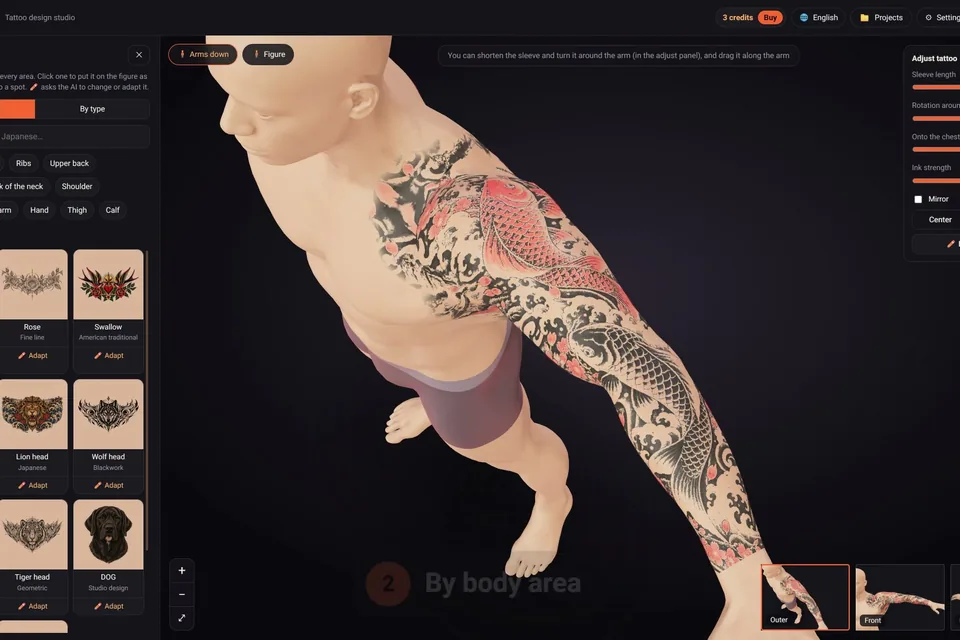
Browsing, placing and moving library designs cost nothing. Asking the AI artist to adapt one is a message, so it uses a credit, and new accounts get three free. The features page shows the rest of the studio.
Mistakes that sink good designs
- Judging at thumbnail size. A design that looks crisp as a phone thumbnail may be planned for 20 cm of skin, or the reverse. Always ask what size it was drawn for.
- Stacking subjects. A wolf, a compass, a clock and a rose in one 10 cm piece are four tattoos fighting for room. Pick one hero.
- Ignoring the neighbors. If you already have tattoos, a new one should share their direction or style, or sit far enough away to stand alone.
- Borrowing a look that isn't yours. Dense blackwork on a friend's back can feel heavy on your wrist. Try a style on your own figure before committing.
- Copying a custom piece. Someone else's custom tattoo was drawn for their body and their story. Learn from it, then have your own drawn.
Still at the "what do I even want" stage? Our guide to finding tattoo ideas helps you start from your own story. We've also sorted tattoo designs for men and tattoo designs for women by placement, style and meaning, and every idea on both pages suits anyone.
Choosing tattoo designs: quick answers
How do I choose between two tattoo designs I love?
Put both on your body at their real size and live with them for a few days. One usually starts to feel more like you. If they're truly tied, ask which you'd still choose with no one watching, or whether they could become one piece, with one as the main subject and the other as its frame or background.
Where can I find a design nobody else has?
Have one drawn for you. A custom design from your artist, or an AI design drawn from scratch for your request, is made for you rather than picked from a shared sheet, and your own details keep it that way: a specific flower, a place, a date, a pet's pose. Galleries and flash are shared by nature, so use them for ideas.
Which designs age best?
Designs with a strong outline, clear contrast and some bare skin between elements tend to hold up best, because lines soften and spread a little over the years. Very small, very detailed pieces are the most likely to blur. There's an old shop saying, "bold will hold," and it exists for a reason.
How much detail can a tattoo design have?
It depends on the size. Think about how close the lines sit: lines packed tightly together tend to merge as a tattoo ages. A 5 cm piece can carry a few simple elements, while a 25 cm piece can hold fine texture and small details. When in doubt, make the design bigger or simplify it.
Do tattoo designs need to be symmetrical?
No. Symmetry suits the body's center line: the sternum, the spine, the back of the neck, or a matching pair on both forearms. Elsewhere, asymmetric designs often flow better, because limbs aren't flat or straight. A koi swimming diagonally around a calf looks more alive than one squared up in the middle of it.
What does filler mean in a tattoo?
Filler is the background that joins separate pieces or fills the gaps between them: wind bars, clouds, waves, smoke, dotwork, leaves or geometric patterns. It turns a collection of tattoos into one composition, especially on a sleeve. Good filler matches the main pieces' style but stays a step darker or lighter, so the main subjects still stand out.
Are flash designs cheaper than custom ones?
Sometimes, since the drawing already exists, but pricing is up to each shop. Many artists price by size, placement and time rather than by where the design came from. Ask for a quote on the specific piece and spot you have in mind, and remember that well-made flash deserves the same care as custom work.
Can one design work on different body parts?
Sometimes, with changes. A round design can move from the shoulder to the calf with little more than a resize, but a tall forearm piece rarely suits the chest without being redrawn wider. In click2ink you can drag a design to another spot and resize it in centimeters to see whether it still fits before asking for a new version.
Can the same design work in color and in black and grey?
Usually, but it's rebuilt rather than just recolored. Color designs lean on contrasting hues, while black and grey leans on contrast between dark shading and bare skin. A design that reads well both ways was built on a strong value structure. In click2ink, the one-tap Black & grey change shows you a version within a few minutes.