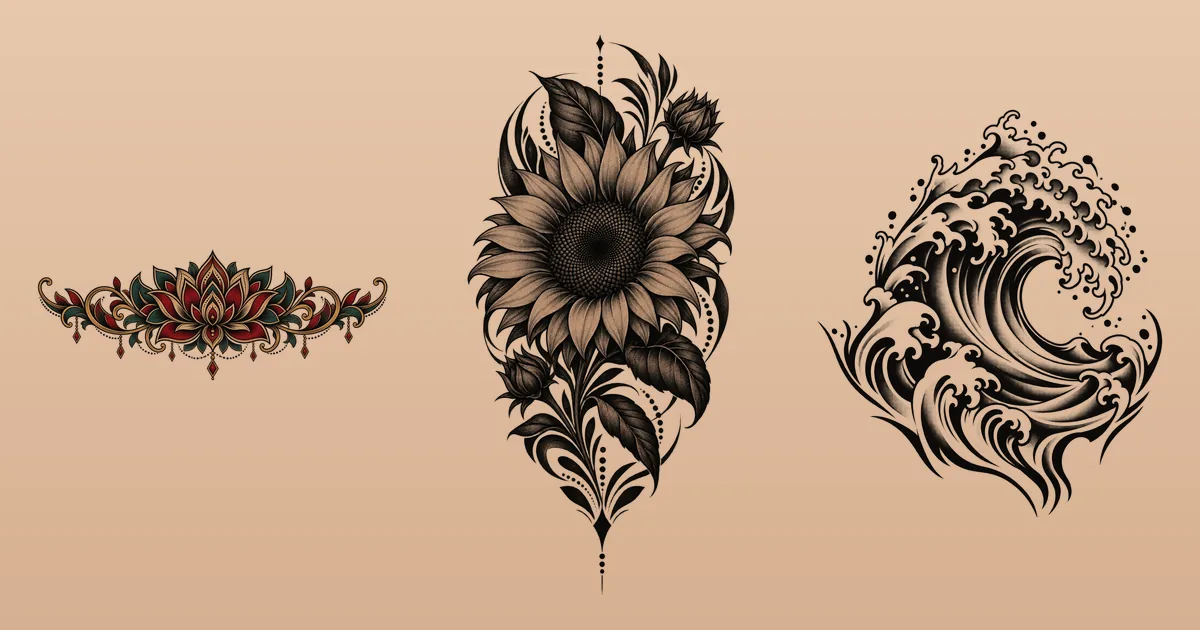
Tattoo designs for men: placement first, then style and meaning
The usual way through a list of tattoo designs for men goes like this: scroll until a lion or a compass jumps out, then figure out where it goes. That's backwards. The spot decides the shape, and the shape decides the design, so a great lion squeezed onto the wrong forearm stays wrong. Below, ideas start with placement, and every one of them works for anyone.
Why the spot comes before the subject
Every part of the body is a different frame. The outer forearm is a tall rectangle that shows whenever you roll your sleeves up. The chest is wide and split by the sternum. The shoulder cap is round, the calf is long and tapered, and the back is the largest flat canvas you have. A design drawn for one frame rarely sits well in another.
Muscle matters too. Tattoos move with the body, so a design that follows the line of the forearm or the curve of the shoulder looks alive, while one placed against the grain looks stuck on. Decide first how visible you want it, then which frame suits that, and the long list of tattoo designs for men shrinks to the few that fit you.
Tattoo designs for men, placement by placement
Outer and inner forearm
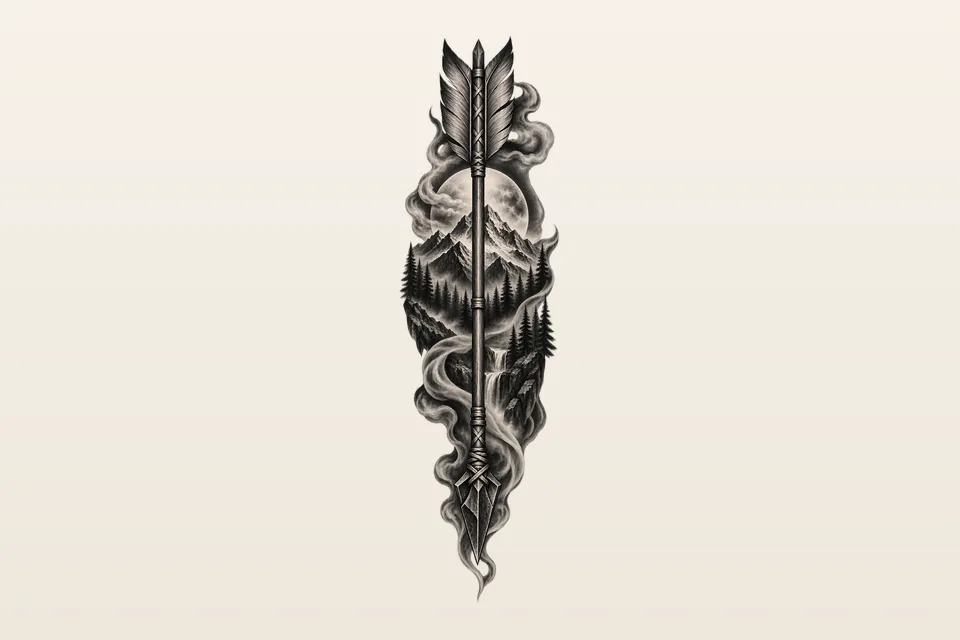
The outer forearm suits tall, vertical designs: an arrow, a dagger, a pine tree, a lighthouse, a portrait framed in a long oval. The inner forearm is flatter and more private, good for script, fine line and small symbols. Designs that wrap all the way around are the first step toward a half sleeve.
Upper arm and shoulder
The shoulder cap is round, so round compositions shine there: a lion's head, a compass rose, a mandala, a coiled snake. The outer upper arm takes medium pieces that can later join a half sleeve, and it's a classic home for American traditional designs such as a panther, a swallow or an eagle.
Chest
Decide between one side and both. A single pec piece, such as a sacred heart or a pocket watch, sits over the muscle and stops before the sternum. A full chest piece spans both sides, either mirrored, like two swallows facing each other, or as one wide image, like an eagle with its wings across the chest. Chest pieces change shape when the arms go up, so check them that way too.
Back
The back holds the biggest single images: a full-back dragon, a phoenix, a landscape. If that's too much commitment, the upper back between the shoulder blades takes wide designs, and the spine takes a single vertical line of script or a column of symbols.
Calf and thigh
The calf is long and tapered like the forearm, so tall designs suit it, and it's easy to show in shorts. The thigh is a big, private canvas for a large animal or a Japanese piece that can grow onto the hip.
Hands and neck
These are the most visible spots there are. Some artists prefer not to make them anyone's first tattoo, and hand tattoos tend to need touch-ups sooner. Bold, simple designs last best here.
Styles that hold up at each size
Search results for tattoo designs for men mostly fall into a handful of styles, and each needs a certain amount of room to look its best:
| Style | Look | Room it needs | Ideas that suit it |
|---|---|---|---|
| American traditional | bold outlines, a few solid colors | any size; holds up well small | swallow, panther, dagger, eagle |
| Neo-traditional | bold lines with richer color and ornament | medium and up | an eagle with a sun, a lion with flowers |
| Black and grey realism | smooth shading, photographic depth | medium to large | a lion's face, a landscape, a portrait |
| Japanese | large flowing scenes with waves, clouds and wind bars | large | koi, dragon, tiger, kabuto |
| Blackwork | solid black shapes and patterns | any | bands, ornamental panels, bold silhouettes |
| Geometric and dotwork | precise lines, shapes and stippling | small to large | a mountain range in a hexagon, a mandala |
| Fine line | thin, precise lines | small to medium, with space | script, constellations, small botanicals |
Whatever the style, the rule holds: the smaller the piece, the fewer and bolder its elements. Our guide to tattoo styles covers each one in depth.
Meaning, without the clichés
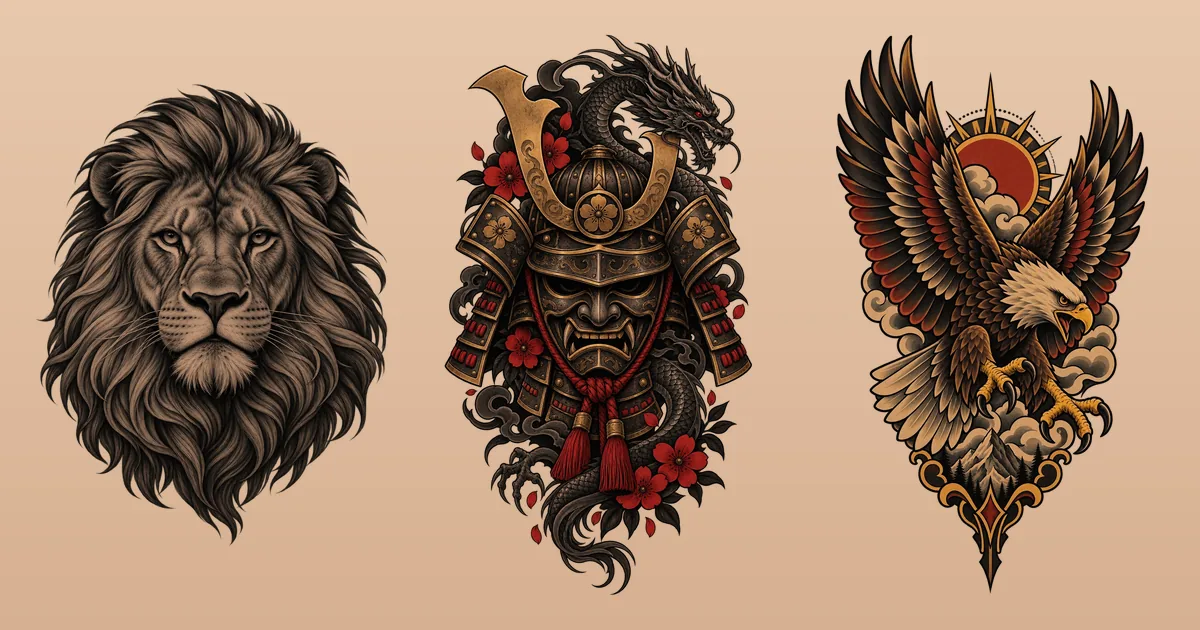
Plenty of classic tattoo designs for men come with a meaning attached. A lion is often chosen for courage or family, an eagle for freedom, an arrow for direction, mountains for something climbed, literally or not. The kabuto in the picture at the top is the helmet of Japanese warriors, later part of samurai armor, and as a tattoo it's often read as protection and discipline.
Those meanings are a starting point, not a rule. The strongest pieces add something only you would add: the mountain range you actually climbed, your kid's birth flower in the lion's mane, the date of a finish line on the eagle's banner. That's what turns a common subject into your tattoo.
Some styles carry meaning of their own. Japanese tattooing has deep roots and its own conventions; our Japanese tattoo guide explains them. Māori tā moko carries genealogy and identity, and designs made in its style for others are called kirituhi; the history of tā moko explains why wearing moko itself has been called appropriation. If a cultural style speaks to you, work with an artist from that tradition.
Test it on a body like yours
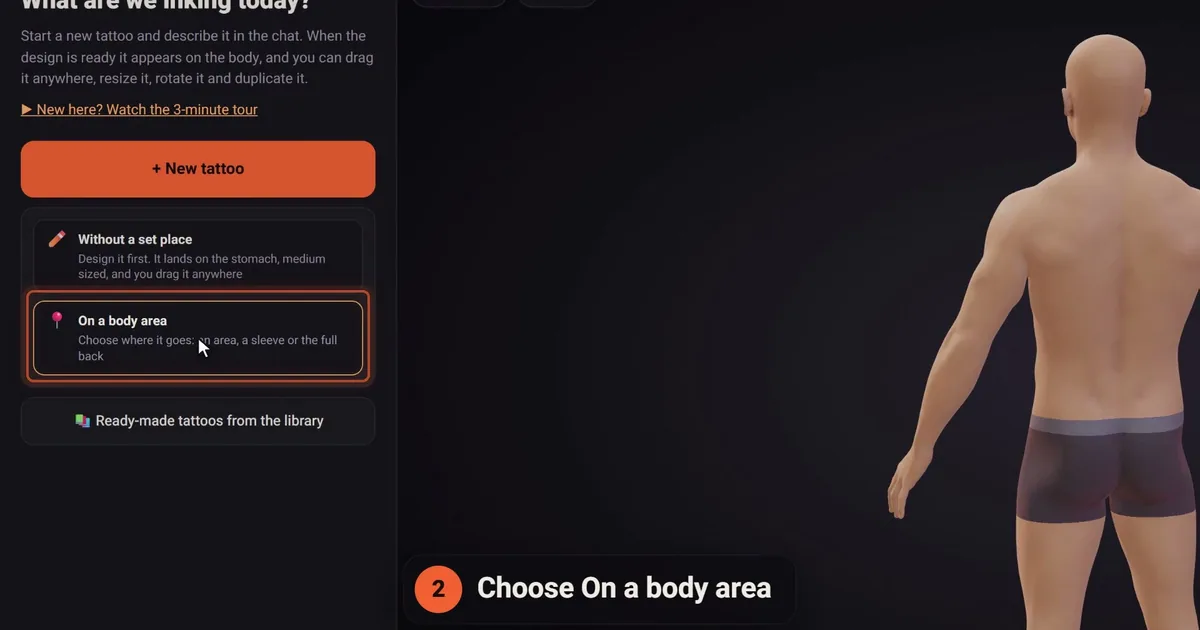
A design that looks right on a model in a photo may sit differently on you, so check it on your own proportions. In click2ink, the 3D figure can be a man or a woman, from slim to full, with more or less muscle, at your height, in one of six skin tones. "Make it look like me" goes further, with your height, weight and build, and optionally your face from a photo that's processed in your own browser and never leaves your device.
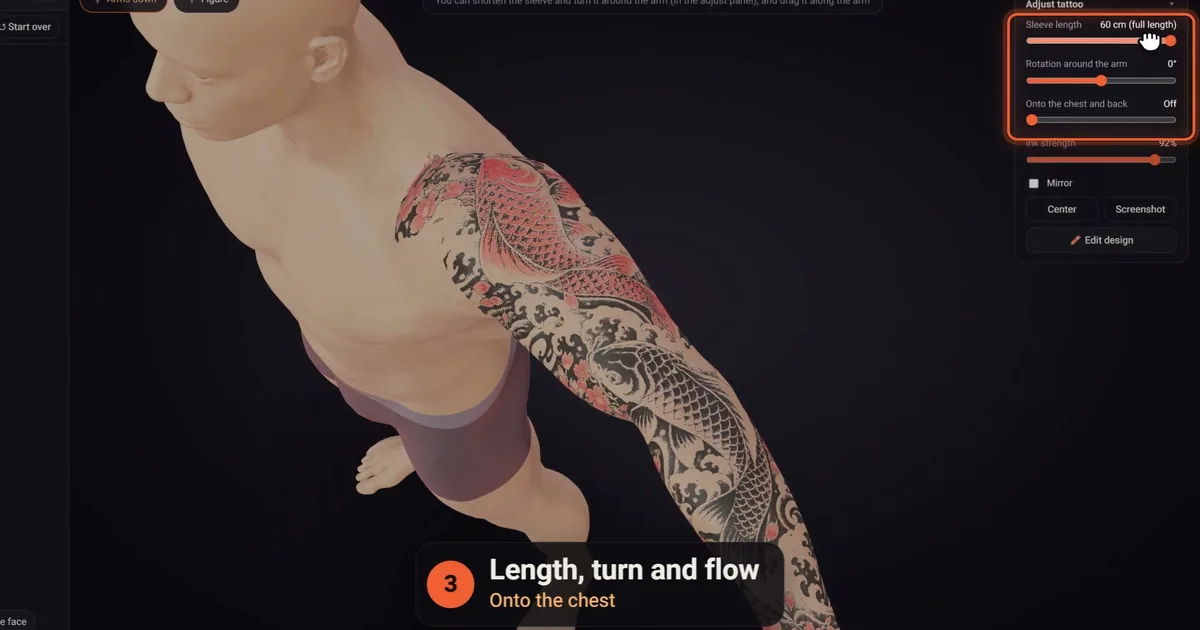
Then put the design where you want it and test it as a tattoo, not a picture. Set its size in centimeters, rotate it to follow the muscle, and let a forearm piece wrap around the limb. Turn the figure, and use "Arms out" to see the inner arm and the sides of the chest. Our tattoo placement guide lists what to check at each spot, and the features page shows the figure's settings.
From one piece to a sleeve
Many sleeves start as a single forearm or upper-arm piece. If yours might grow, plan for it now: keep the first piece in a style you'd happily fill an arm with, leave its edges open rather than boxed in by a hard frame, and place it where a second and a third piece can join. A shared background later, such as smoke, waves or geometric patterns, ties the pieces together.
The click2ink library includes 20 ready-made sleeves, a quick way to see how a full arm can be composed. When you're ready to plan one, our guide to sleeve tattoos covers themes, flow and sessions, and our tattoo designs guide sorts more subjects by family and shape.
Questions worth asking before you book
Are these designs only for men?
No. The phrase is simply what people type into search, but nothing here belongs to one gender. A lion, an arrow or a full Japanese back piece suits anyone who loves it, and the same goes for the florals, ornaments and fine line work that usually get listed for women. Choose by placement, style and meaning, whatever a list says.
What's a good spot for a first tattoo?
The outer forearm, the outer upper arm, the shoulder and the calf are popular first spots: fairly flat, easy to show or cover, and big enough for a clear design. Many people leave the hands, neck and face for later, once they know how they feel about being tattooed and how visible they want their ink to be.
Does body hair affect a tattoo?
Not much. Your artist shaves the area before starting, and the hair grows back over the healed tattoo. Thick hair can soften how a design reads from a distance, so bolder lines and stronger contrast help on hairier spots like the forearm, chest or calves. Ask whether to shave before the appointment, since some artists prefer to do it themselves.
Which placements tend to hurt the most?
Bony, thin-skinned areas such as the ribs, sternum, spine, elbows, knees, hands and feet are commonly described as the most painful, and fleshier areas such as the outer arm and thigh as easier. Everyone's different, though. Your artist can tell you what to expect for a specific spot, and a doctor is the right person for any health questions.
What does a samurai helmet tattoo mean?
The kabuto was the helmet of Japanese warriors and later part of samurai armor, often decorated with a crest at the front. As a tattoo it's usually read as protection, discipline and honor, and it often appears with a dragon, a mask or flowers. Because it comes from Japanese tradition, an artist experienced in Japanese work will compose it best.
How do I add my kids' names without it looking like a list?
Build them into the design instead of lining them up. Initials can sit on a banner, inside a compass's points or along an arrow's shaft; dates work well in small roman numerals; birth flowers can stand in for names entirely. In click2ink's editor you can add a name or a date to a design by hand at no credit, then check the spelling twice.
Can I hide a forearm tattoo for work?
A long sleeve covers the whole forearm, so most forearm pieces can be hidden when you need to. The inner forearm is easier to keep out of sight than the outer, and anything above the elbow is easier still. If your job has a dress code, check it before choosing a very visible spot; it's your call, but better made knowing.
Black and grey or color: which lasts longer?
Both last when they're done well. Black and grey relies on dark shading against bare skin and tends to keep its contrast; colors, especially pale ones, can fade sooner, above all in strong sun. Either way, good aftercare and sun protection matter most. Ask your artist what works best for your skin tone and the spot you've chosen.
Can I get the same design on both forearms, mirrored?
Yes, and mirrored pairs can look great on the forearms, the calves or the two sides of the chest. Ask for a design that works both ways, because some details, lettering above all, can't simply be flipped. In click2ink, the Mirror option in the adjust panel flips a design on the figure, so you can check how the second side would look.