Sun tattoo: how to build one that still shines in twenty years
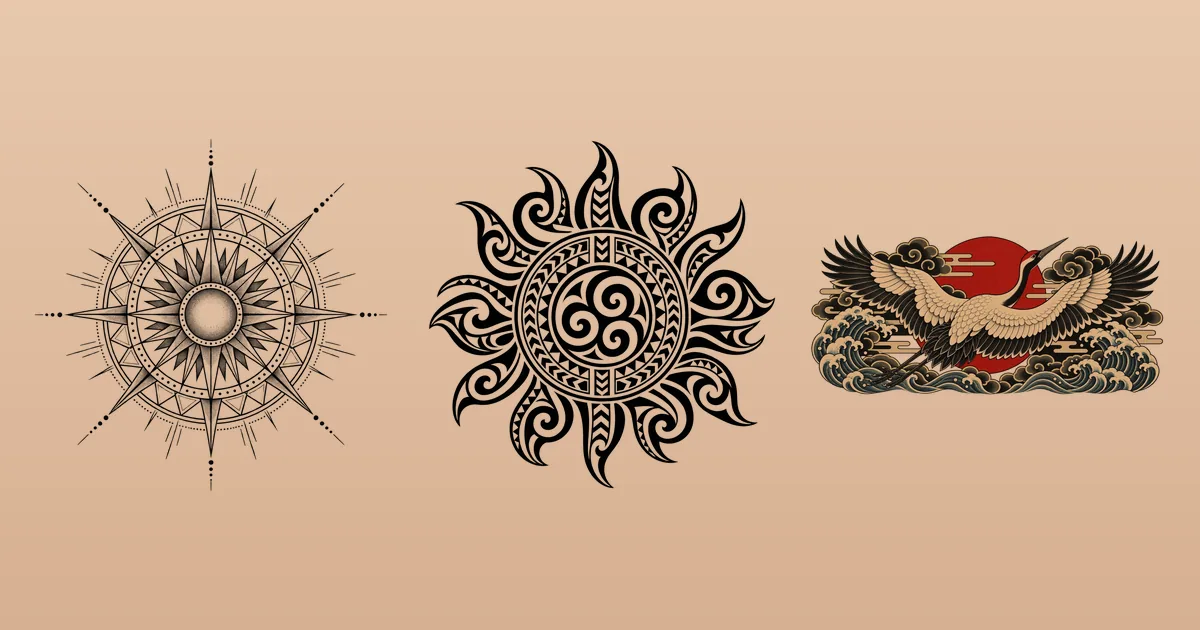
How many rays should a sun tattoo have? Eight, twelve, sixteen, or so many they become a halo? That choice, with the shape of each ray and the size of the disc, decides whether your sun reads as a sun across a room or as a blurry asterisk. This guide takes the design apart piece by piece, then puts it on the body.
The anatomy of a sun tattoo
Every sun, from a 2 cm wrist doodle to a sleeve centerpiece, is two parts: a disc and the rays around it.
The disc
The disc is the anchor. A solid black or firm grey fill holds its shape for years; a single thin outline is lighter but depends on one line staying crisp. As a rough rule, give the disc a third to a half of the total width, so the rays have room without swallowing the center.
Ray count and ray shape
Even counts (8, 12, 16) look balanced; a very high count reads as glow rather than rays, which only works at a larger size. The shape of each ray sets the mood:
| Ray shape | Feel | Works best |
|---|---|---|
| Straight, thin lines | Clean, minimal | Fine line, with generous gaps |
| Triangles | Bold, graphic | Blackwork and traditional; survives small sizes |
| Wavy | Warm, moving | Palm size and up, so each wave stays distinct |
| Flame-like | Heat, drama | Shoulder, chest or back |
| Alternating long and short | Sparkle, rhythm | Almost any size |
| Spirals | Growth, motion | Bold black work, often Polynesian or Maori style |
Faces in suns
A face turns the sun into a character: serene with closed eyes, stern like a carved idol, or grinning old-school flash. Plan on a disc of at least 5 to 6 cm before adding eyes and a mouth, or they melt into a smudge. A face also fixes which way is up, so think about how it sits when your arm hangs.
Small, fine-line and geometric suns
A small sun tattoo works on simple rules: fewer rays, wider gaps, a solid center. At 2 to 3 cm, eight or twelve straight or triangular rays around a filled disc stay clear; twenty-four hairline rays won't, because ink spreads a little in skin over the years and close lines merge. Our guide to small tattoos covers minimum sizes for other motifs too.
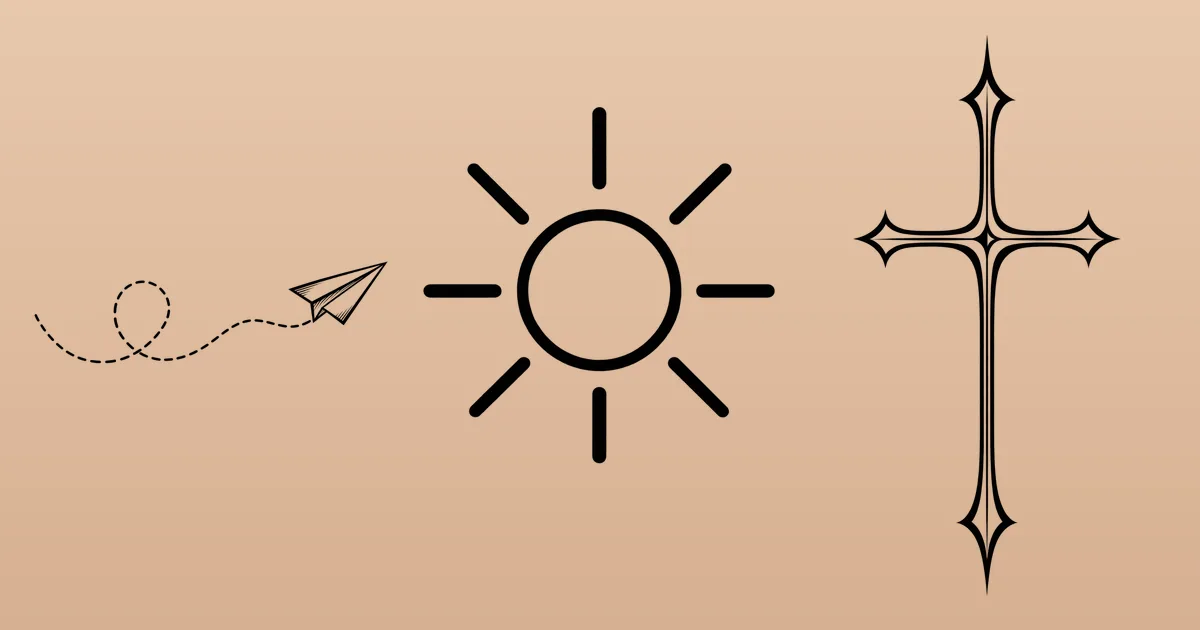
Fine line suns lean on negative space: an open circle, long single-needle rays, a tiny dot at the center. They suit the inner wrist, behind the ear or the ankle, but give them a little more size than you think.
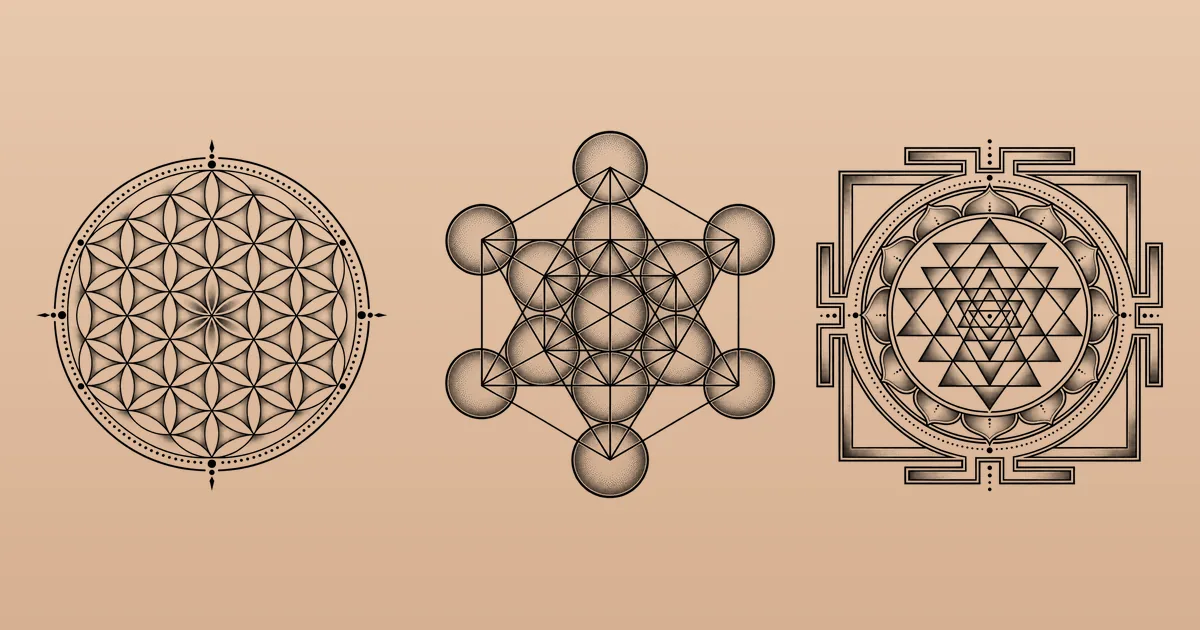
Geometric suns build the disc from concentric rings, dotwork gradients or a figure like the Seed of Life, with long rays of even length; the fine-line sun at the top of this page uses rings, dots and long, sharp rays. Our sacred geometry tattoo guide explains how those figures are constructed and how much space their lines need.
The sun as a frame or a backdrop
Some of the best sun tattoos aren't about the sun. A big disc behind a subject works like a spotlight: a bird or a mountain in front of a rising sun, a palm against a sunset. Keep the subject darker and more detailed than the sun, or the eye won't know where to land.
A sun low over waves is a classic of Japanese-style work, like the crane in front of a red sun at the top of this page. One version needs care: a red disc with sixteen red rays spreading to the edges is the Rising Sun Flag, Japan's former military flag. Wikipedia's article notes that many people, especially in South Korea and China, see it as a symbol of Japanese wartime aggression, a reading Japan's government rejects. A plain disc avoids the issue; our Japanese tattoo guide covers the rest of that tradition.
A sun sharing a piece with a crescent is its own design: the sun and moon section of our moon tattoo guide covers how to balance the two.
Suns from living traditions
Tribal-style suns
Bold black suns with thick, curved or pointed rays read from far away and last. Ask for a general bold-black style rather than borrowing a specific culture's symbols; our tribal tattoo guide explains the difference.
The Aztec sun stone
The most famous carved sun is the Aztec sun stone, a Mexica basalt monolith about 3.6 m across, found in 1790 near Mexico City's Zócalo and now in the National Museum of Anthropology. Its central face is often identified as Tonatiuh, the sun god, though scholars debate it; a ring around the center holds the twenty day signs. Despite its nickname, it was not a working calendar.
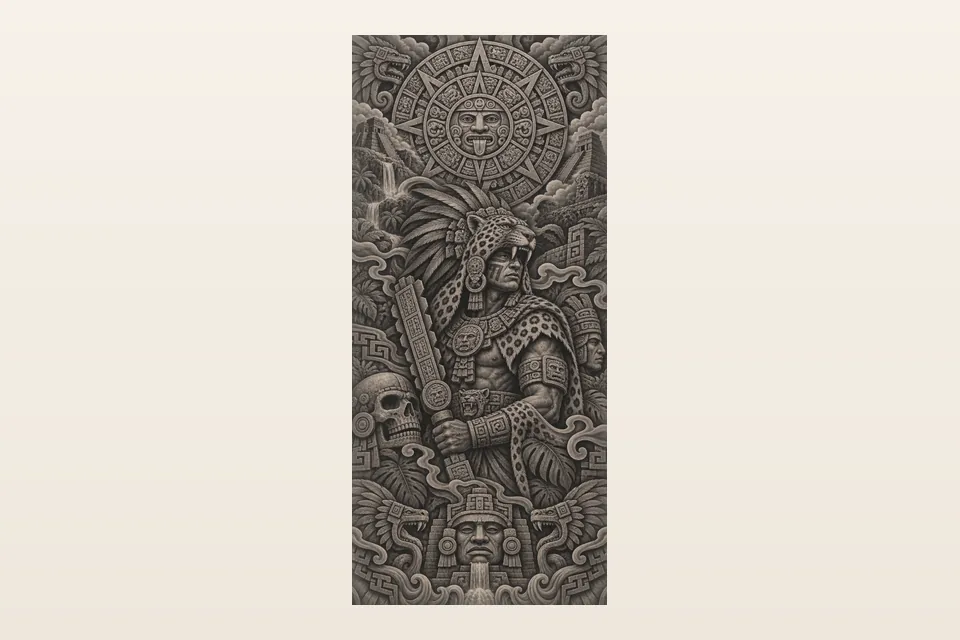
It is a real monument with a real culture behind it, so work from good photographs of it rather than loose copies, and give it size: a palm-sized version keeps the outline but has to simplify the glyphs.
Polynesian and Maori-style suns
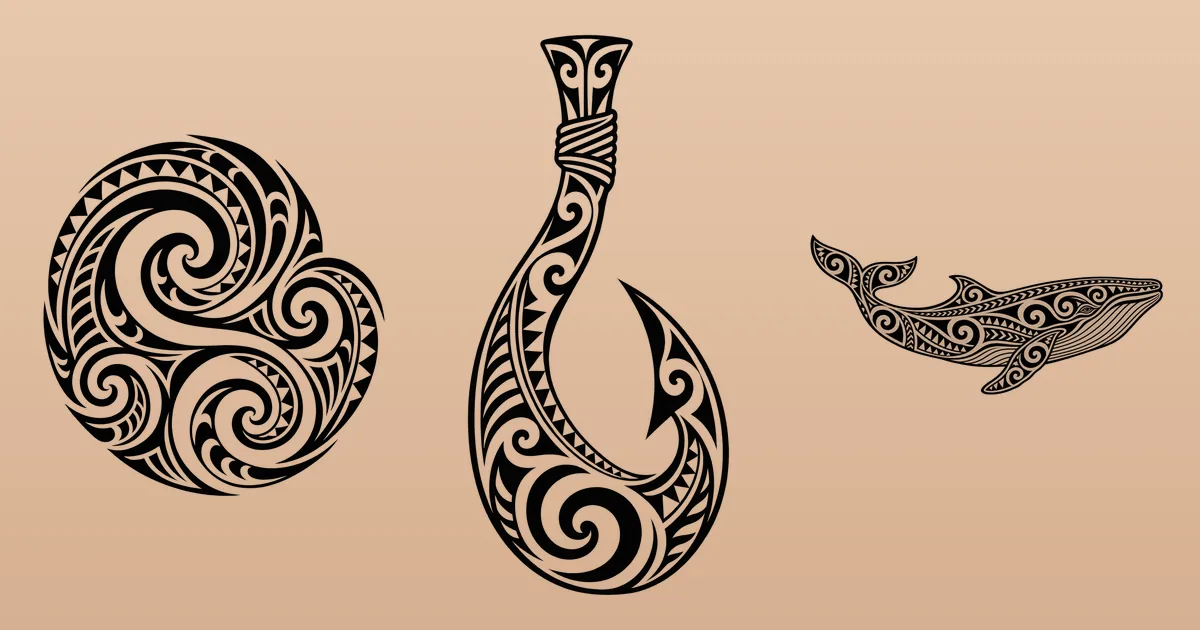
Polynesian work often draws the sun as a disc with pointed or spiral rays among bands of pattern. In Maori art the koru, an unfurling fern frond, stands for new life and growth, and koru-style rays like those on the black sun at the top of this page borrow that shape.
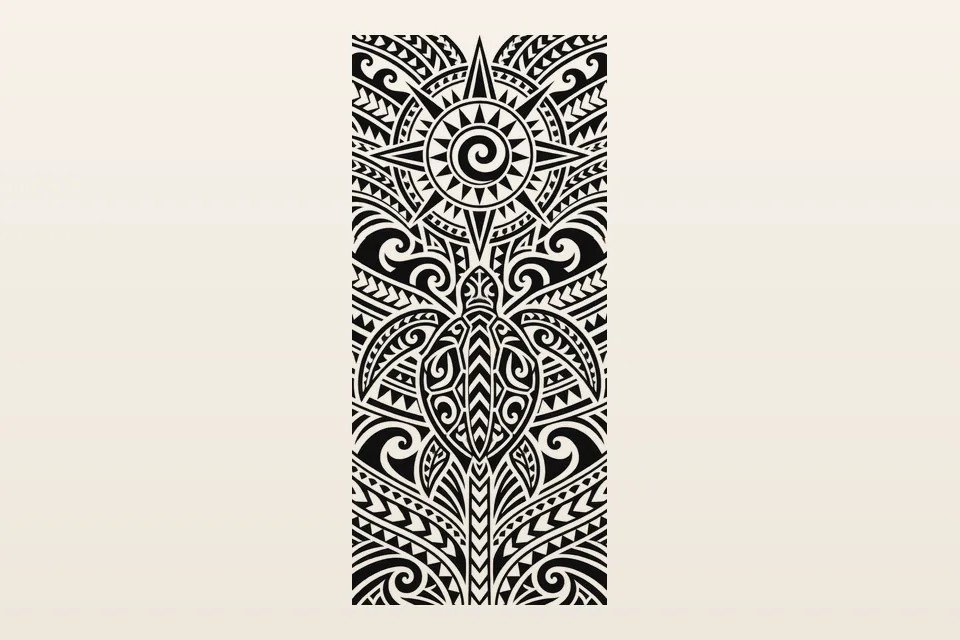
These are living traditions. Wikipedia's article on tā moko explains that a true moko involves consent and genealogy, while kirituhi ("skin writing") is a design with a Māori flavor anyone can wear. If you're not from those cultures, ask for kirituhi or a Polynesian-inspired design, and consider an artist from the tradition. Our Maori and Polynesian tattoo guide goes deeper.
What the sun has meant
The Wikipedia article on solar deities lists Ra in Egypt, Helios in Greece, Surya in Hinduism, Inti of the Inca and Tonatiuh of the Aztecs. Sun gods are often thought of as male, but not everywhere: Amaterasu in Japan and Saule in Lithuania and Latvia are goddesses, and in Germanic myth the sun is female.
The readings people wear today follow from that: life, warmth, energy, a new start after a hard time. None is a rule; a sun for the place you grew up counts just as much. It's also why sun tattoos for men and for women share one symbol, and the style and size do the work.
Where a sun tattoo sits best
- Shoulder. The natural home: the disc on the shoulder cap, rays spilling down the arm and over the collarbone, at 8 to 14 cm.
- Sternum. Symmetrical by nature, with long lower rays down the breastbone. Check wide rays from an angle as the chest curves away.
- Back of the neck. A 3 to 5 cm sun centered under the hairline, hidden or shown with your hair.
- Elbow. The disc on the point of the elbow, rays opening as the arm bends. Skin there folds and stretches, so many artists prefer solid shapes to fine lines.
- Wrist, ankle, behind the ear. Simple suns of 2 to 3 cm.
Bony, thin-skinned spots such as the elbow, sternum and spine tend to be more uncomfortable than fleshy ones; your tattoo artist can tell you what to expect. Our tattoo placement guide compares every spot.
In click2ink, choose the shoulder, chest or back of the neck when you start. There is no elbow area, but you can pick the upper arm or forearm and drag the design onto the elbow on the 3D figure; switch on "Arms out" and turn the figure to see it from the side. Sizes are in real centimeters, matched to your height.
How to describe a sun tattoo
Name the disc, the rays, the style, the size and the spot:
- "A small sun, solid black disc, twelve rays alternating long and short, fine line, 2.5 cm, inner wrist."
- "A geometric sun with the Seed of Life in the disc, sixteen long even rays, dotwork shading, 10 cm, sternum."
- "A crane flying in front of a plain red sun over Japanese-style waves, no rays, outer upper arm."
- "A bold black sun with spiral rays and a calm face, for the point of my right elbow."
In click2ink, our own studio, you write that in a chat and an AI artist draws an original design onto a 3D figure. Ask for one change at a time ("make the rays thicker") and only that part changes; Simpler helps when a small sun looks crowded. New accounts get 3 free credits, 12 messages (pricing, how it works). Then print the stencil at true size for your tattoo artist, who will adapt it to your skin.
Sun tattoo questions
What does a sun tattoo mean?
Most often life, warmth, energy and new beginnings, because the sun returns every morning. Many cultures had sun deities, such as Ra in Egypt, Surya in Hinduism and Inti among the Inca, and some see the sun as female, like Japan's Amaterasu. These are traditions, not rules: a personal reason, such as a sunrise you remember, counts just as much.
How many rays should a sun tattoo have?
There is no correct number, but even counts such as 8, 12 or 16 look balanced. Small suns need fewer rays with wider gaps, so eight to twelve suits a 2 to 3 cm piece. Large suns can carry many more, or alternate long and short rays. Skip sixteen red rays on a red disc unless you want it read as the Rising Sun Flag.
How small can a sun tattoo be?
A simple sun with a filled disc and eight bold rays can work at around 2 cm on the wrist, ankle or behind the ear. Hairline rays, faces and dotwork need roughly palm size, because ink spreads slightly over the years and close lines merge. Your tattoo artist will tell you their own minimum for your skin and placement.
Is a sun tattoo on the elbow a good idea?
It can look great: a radial design suits the round point of the elbow, and the rays open when you bend your arm. The skin there folds and stretches, so bold, solid shapes usually hold better than fine lines, and bony spots tend to be more uncomfortable. Ask your artist about healing and touch-ups there before you commit.
Is a Japanese rising sun tattoo offensive?
A plain red disc, as in many Japanese-style pieces with cranes or waves, is generally just a sun. The version with sixteen red rays is the Rising Sun Flag, Japan's former military flag, which many people in South Korea, China and elsewhere associate with wartime aggression. If you want the Japanese look without that weight, choose the plain disc.
What is the face in the middle of the Aztec sun stone?
It is often identified as Tonatiuh, the Aztec sun god, but scholars disagree, and some see the earth deity Tlaltecuhtli or another figure instead. The stone is a basalt monolith in Mexico's National Museum of Anthropology, and it was not a working calendar. For a tattoo, work from good photographs so the face and rings stay accurate.
How do I get a sun tattoo stencil?
Your tattoo artist makes the final stencil, but you can bring a clean reference. In click2ink, the editor's outline tool gives a stencil look, and Print makes a stencil at the real size the tattoo has on the body, with a 5 cm check ruler so you can confirm it printed at 100%. Your artist will redraw lines where your skin needs it.
Are there sun tattoo designs for men or for women?
Not really: the symbol is the same, and style and size change it. Bold blackwork suns on the chest or shoulder, Aztec sun stones and Polynesian-style sleeves are popular big pieces, while fine-line suns behind the ear or on the wrist suit small ones. Choose by placement and taste rather than by gender.