Skull tattoo: what it says, and how to draw one that reads
Stand at the bottom right of Hans Holbein's The Ambassadors, painted in 1533, and a stretched shape on the floor between the two men turns into a skull. Renaissance portraits often carried a reminder like that: memento mori, remember that you will die. A skull tattoo can carry the same message, and for many people it's a reason to live well rather than a dark thought.
Memento mori, from old paintings to skin
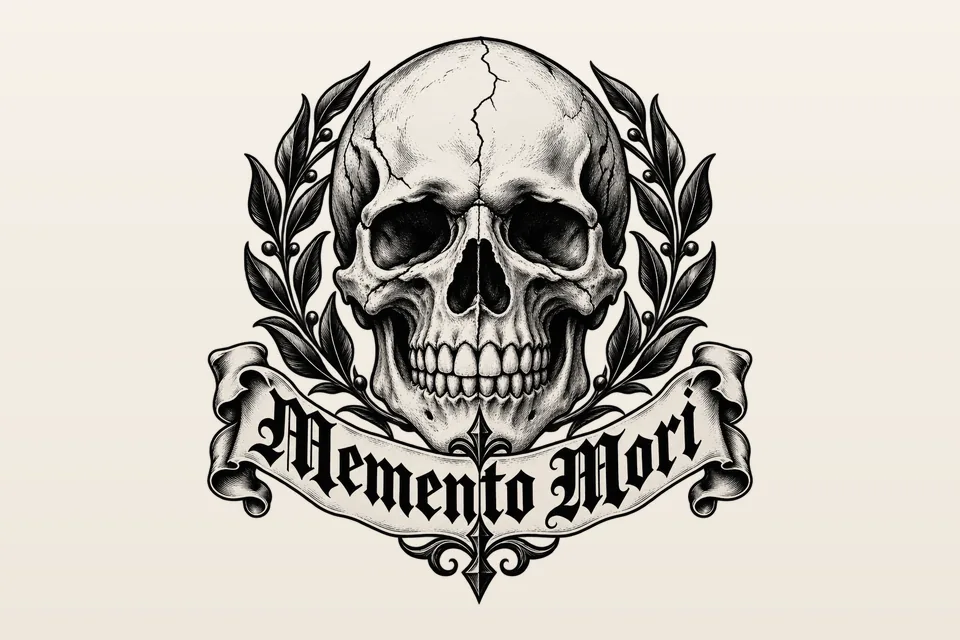
The Latin phrase memento mori means "remember that you have to die," and its most common symbol is a skull, often with bones, alongside hourglasses, candles and wilting flowers. The Stoic philosopher Seneca filled his letters with reminders to think about death; the aim was to live with more focus, not to dwell in gloom. In the late 16th and 17th centuries, memento mori jewelry was popular: mourning rings, lockets and brooches, one ring enameled with a tiny skull and the words "Die to Live."
That's why a skull so often comes with company: a banner reading memento mori, an hourglass, a candle burned halfway, or roses in full bloom. Worn this way, a skull says "make today count" far more than "death is coming."
Not every skull tattoo is about death
A skull's meaning shifts with what surrounds it, and with the culture it comes from. Combinations you'll meet, and how they're often read:
| Design | Often read as | Worth knowing |
|---|---|---|
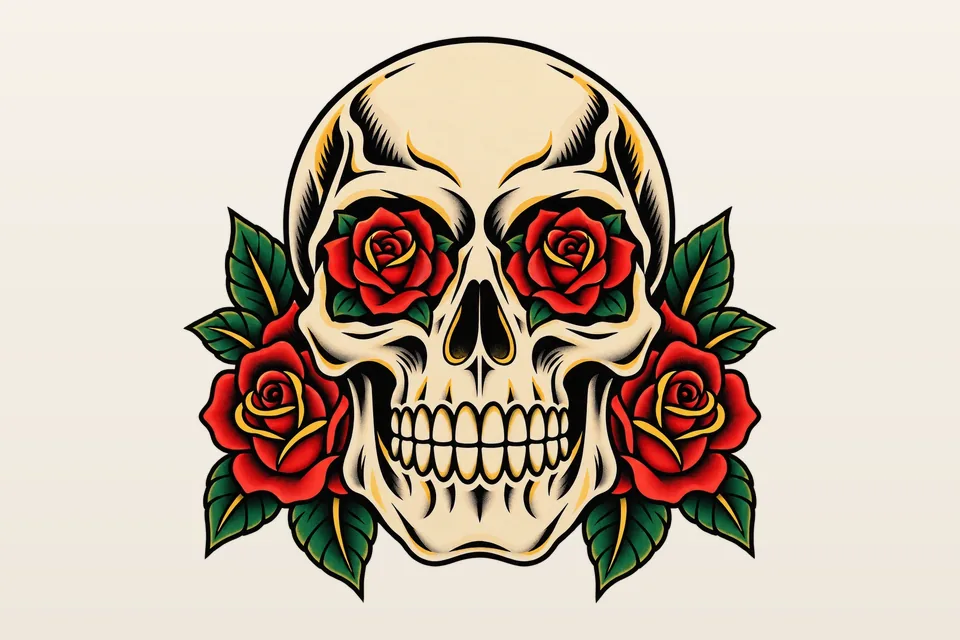
| Skull and roses | Life and death side by side; love that outlasts loss | A classic of American traditional flash; the rose brings its own meanings, covered in our rose tattoo guide |
| Sugar skull (calavera) | Remembering, even celebrating, someone who has died | Part of Mexico's Day of the Dead; see the note below |
| Skull with an hourglass or candle | Time running out, so use it well | Straight from memento mori and vanitas painting |
| Skull and snake | Danger, temptation or renewal | The snake's meaning changes from culture to culture; our snake tattoo guide explains |
| Skull and crossbones | Rebellion, danger, a pirate streak | The skull and crossbones on black is the design most tied to the pirates' Jolly Roger |
| Skull with a crown | Death takes kings too: power doesn't last | A sharp memento mori for anyone who likes irony |
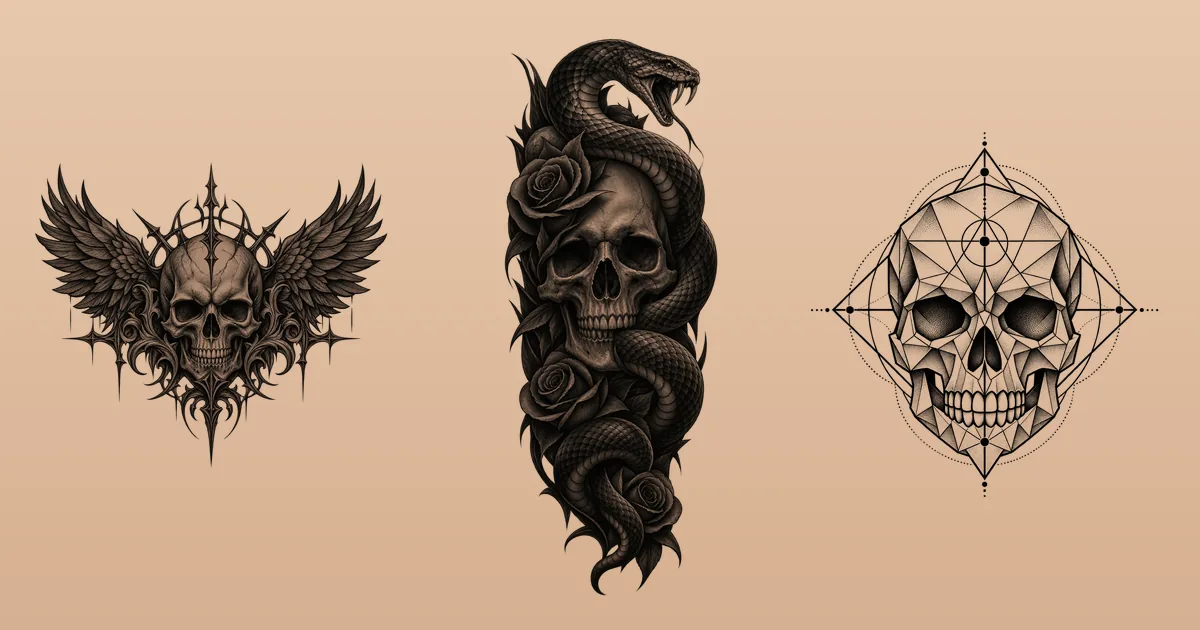
| Winged skull | A soul taking flight, or freedom | Wide by nature: made for the chest or the upper back |
The sugar skull deserves a note of its own. Calaveras belong to the Day of the Dead, which UNESCO describes as a festivity marking the brief return of deceased relatives and loved ones, held each year from the end of October into early November. Sugar skulls are placed on altars as offerings, and the name of the person being remembered is often written across the forehead in icing, as Wikipedia's page on the calavera describes. A calavera for someone you've lost, with their name on its brow, is close to that tradition; our guide to memorial tattoos has more ideas in that spirit.
The anatomy that makes a skull look right
Few people have studied a real skull, yet almost everyone notices when one is wrong. Whatever the style, these details separate a convincing skull from a cartoon:
- A big cranium. The braincase is large next to the face. Shrink the dome and the skull starts to look like a mask.
- Deep eye sockets. A heavy brow above, a squarer edge below. Shading them darkest gives the face its stare.
- A nose that's an opening, shaped like a pear or an upside-down heart, never two dots.
- Cheekbones that flare out to the sides, giving the skull its width at eye level.
- Teeth on a curve. Seen from the front, the back teeth turn away and look narrower; drawn as a flat row, they look like a zipper.
- A jaw that sets the mood. Closed, the skull is calm and solid; dropped open, it laughs or screams. Leaving the jaw off shortens the design for small spots.
Stylized skulls break these rules on purpose: a traditional skull exaggerates the sockets and the grin, and a geometric one turns bone into facets. Bending a rule works. Not knowing it shows.
Sketching your skull in the studio
In click2ink you describe the skull in a chat, an AI artist draws an original design, and it appears on a 3D figure you can turn and zoom. Pick one of the 16 styles, or let the artist choose, and name the angle, the jaw and the company it keeps:
A human skull in illustrative etching style, three-quarter view, jaw closed, a snake winding through one eye socket, crosshatched shading, about 18 cm tall for the outer calf.
Ask for one change per message ("open the jaw slightly," "thinner snake") and the AI keeps everything else as it was. The one-tap Black & grey and Simpler changes are handy when a color draft feels too busy. In the editor, the outline tool shows a stencil look, and you can add a name or a date by hand at no credit, which suits a calavera. The skulls on this page come from the free library of 450+ ready-made designs, and new accounts start with 3 free credits; see the pricing page.
Styles and spots for a skull
A skull is roughly round, so it fits almost anywhere; what you add to it sets the shape.
- Chest and sternum. Wide layouts: a winged skull, a memento mori banner, roses spreading to both sides.
- Outer forearm and calf. Tall compositions: a snake winding through the sockets, or a skull stacked above roses or an hourglass.
- Shoulder and upper arm. A round skull or a sugar skull follows the curve of the deltoid well.
- Hand. A small, bold skull with big dark sockets. Hand skin works hard, so ask your artist how fine lines will hold there.
- Back. Room for a whole vanitas scene with clocks, candles and books.
Style changes the character completely. Blackwork turns a skull into solid black and crisp negative space (see our blackwork tattoo guide); black and grey realism gives it weight, cracks and age, which our realism tattoo guide covers; American traditional keeps it bold and cheerful, as our traditional tattoo guide shows.
Common questions about skull tattoos
What does a skull tattoo mean?
Often it's a memento mori: a reminder that life is short, which many people read as "live fully." Others wear a skull for someone they've lost, especially as a sugar skull, or for toughness and rebellion. What surrounds it shifts the reading: roses add love and loss, an hourglass adds time, a snake adds danger or renewal. Your reason is what makes it yours.
Is a skull tattoo bad luck?
Superstitions differ between families and cultures, but the skull's long history in art points the other way: memento mori jewelry and paintings used it to encourage a better life, and Mexico's calaveras celebrate the people being remembered. If someone close to you finds skulls upsetting, roses, flowers or a bright sugar skull soften the look without losing the idea.
What does a sugar skull tattoo mean?
A sugar skull, or calavera, comes from Mexico's Day of the Dead, a festivity for the return of deceased loved ones. Real sugar skulls are placed on altars, often with the person's name written across the forehead. As a tattoo, it usually honors someone who has died, with a celebratory rather than mournful feel. Adding their name or favorite flowers keeps it close to the tradition.
Can I get a sugar skull tattoo if I'm not Mexican?
Many people do, and it can be respectful when the meaning is honored: remembrance, not a costume. Learn about the Day of the Dead before you book, think about who the skull is for, and consider an artist who knows the tradition well. If you mainly like the look, a floral skull in another style avoids borrowing a ritual symbol you don't hold.
What does memento mori mean on a tattoo?
It's Latin for "remember that you have to die," a phrase artists and philosophers have long used to keep life in perspective. On a tattoo, it usually sits on a banner under a skull or around an hourglass. Blackletter suits its old-world feel, and Roman capitals look calm and classical. Check the spelling twice; it's easy to drop a letter in Latin.
What does a skull with roses mean?
Usually life and death side by side: beauty that doesn't last, or love that outlasts a loss. It's one of the classic pairings of American traditional tattooing, with bold outlines, red roses and green leaves. Some people choose it for a person they've lost, others as a reminder to enjoy things while they bloom. Roses in the eye sockets give it a softer, almost playful twist.
Is the skull and crossbones a hate symbol?
Not in general. The ADL lists one specific design, the Totenkopf used by the Nazi SS, as a hate symbol, and stresses that other images of a skull and crossbones aren't. Pirate skulls, sugar skulls and traditional flash have nothing to do with it. If a design reminds you of military insignia, especially with runes or eagles, check it before you book.
How small can a skull tattoo be?
A simple skull with bold lines and big, dark eye sockets holds up small, which is why a little traditional skull can work even on a hand. Detailed realism needs room: cracks, teeth and soft shading start to merge when the skull is too small, so think palm-sized or larger. Your artist will tell you the minimum for the style you've chosen.
Can a skull tattoo look delicate?
Yes. Fine line skulls with flowers growing through them, ornamental skulls with lace-like patterns, dotwork shading, or a skull half hidden by a butterfly's wings all read as delicate. Keep the line weights light and leave plenty of open skin. A skull doesn't have to be grim; the style and what surrounds it decide its voice.