Nautical tattoo ideas: how to build anchors, ships and lighthouses that hold up
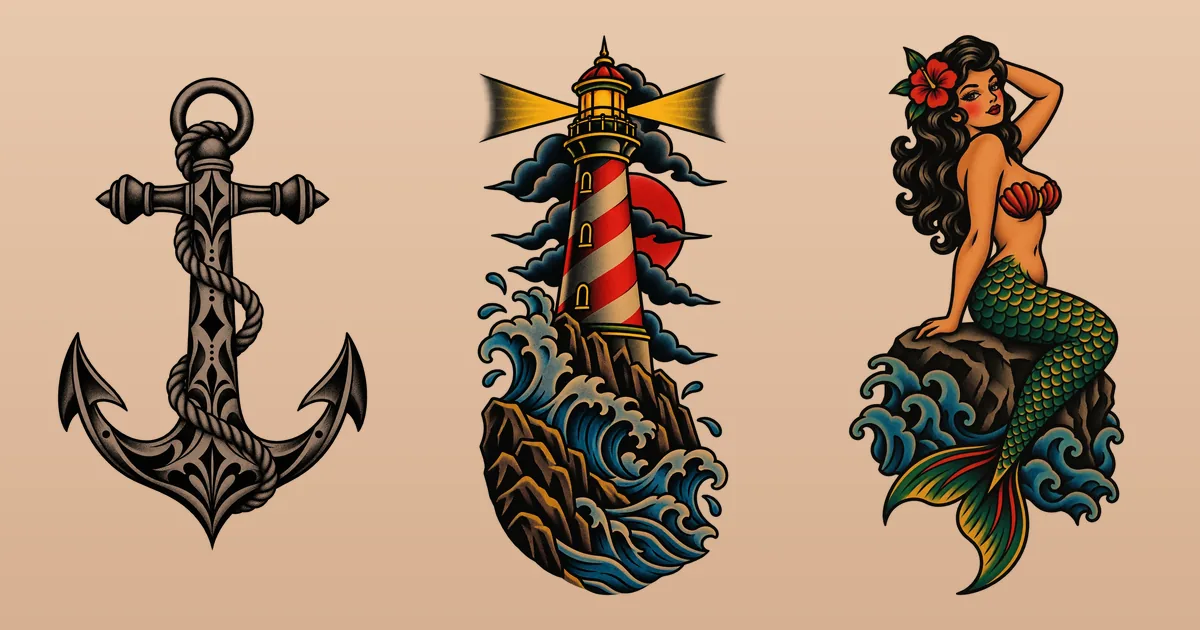
Iron, rope, canvas and a light on the rocks: a nautical tattoo draws on the gear and stories of life on a ship, not on the water itself. Each motif has a strong, simple shape, which is why they mix so easily. This guide covers how each one is built, how they combine, and what size and spot suit them.
The anchor tattoo, piece by piece
The anchor rewards a little knowledge of the real object. Wikipedia's anchor article describes the classic shape: a central shank with a ring at the top for the line, a stock set crosswise near the ring, and arms ending in pointed flukes that grip the sea floor.
- The shank sets the height. Long and slim suits the forearm or calf; short and stout suits the hand or a shoulder cap.
- The stock is a natural crossbar. It can carry initials, a date or a small banner.
- The flukes give the anchor its silhouette. Exaggerate them slightly so the shape still reads from across a room.
- The ring is where rope, a chain or a heart usually attaches.
Anchor with rope
Rope coiled around the shank is the classic pairing, and it does real design work: the twisted strands add texture and curves to a stiff, straight object. Keep the rope to two or three loose turns. Tight coils with every strand drawn turn into a grey stripe at small sizes.
Anchor with names or a banner
A banner across the shank, or a name running down it, is the usual way to make an anchor about someone. Banners need width, so allow roughly 1 cm of height for each line of short text, and keep a name to one line.
Small anchors and anchors on the hand
A small anchor can be a simple outline from about 2 to 4 cm: shank, stock, flukes and no rope. Behind the ear, on the wrist or the side of a finger, that is plenty. On the back of the hand, bold outlines hold up better than fine detail, because hand skin works constantly and tends to need touch-ups sooner; our hand tattoo guide covers the trade-offs, including visibility at work.
What an anchor tattoo can mean
Hope and steadiness are the readings with the longest history behind them. According to Wikipedia's page on Christian symbolism, early Christians adopted the anchor as a symbol of hope, and by the 2nd and 3rd centuries it appeared often in epitaphs in the catacombs. Others read it as staying grounded or a family that holds you: readings, not rules. For the stories sailors told about their anchors, see our traditional tattoo guide.
The other nautical tattoo motifs and how each is built
Ships and sailboats
A full-rigged ship is the showpiece: hull, masts, layered sails and rigging lines. Rigging blurs first, so a ship with every rope drawn needs about 12 cm or more; smaller, a single-masted sailboat with two clean sails reads better. Heel it over slightly, cutting through a wave, and it looks like it's moving.
Lighthouses
A lighthouse is tall and narrow by nature, ideal for the forearm, calf or ribs. The tower's stripes and the beams of light do most of the work. Waves breaking on the rocks at its base give it a bottom edge, as in the traditional lighthouse at the top of this page.
Mermaids
In folklore, a mermaid has the head and upper body of a woman and the tail of a fish. In tattooing she ranges from the pin-up mermaid of American traditional, sitting on a rock as in the picture above, to a fine-line silhouette or a darker siren. Her curling tail suits a calf or the ribs.
Swallows, stars and compasses
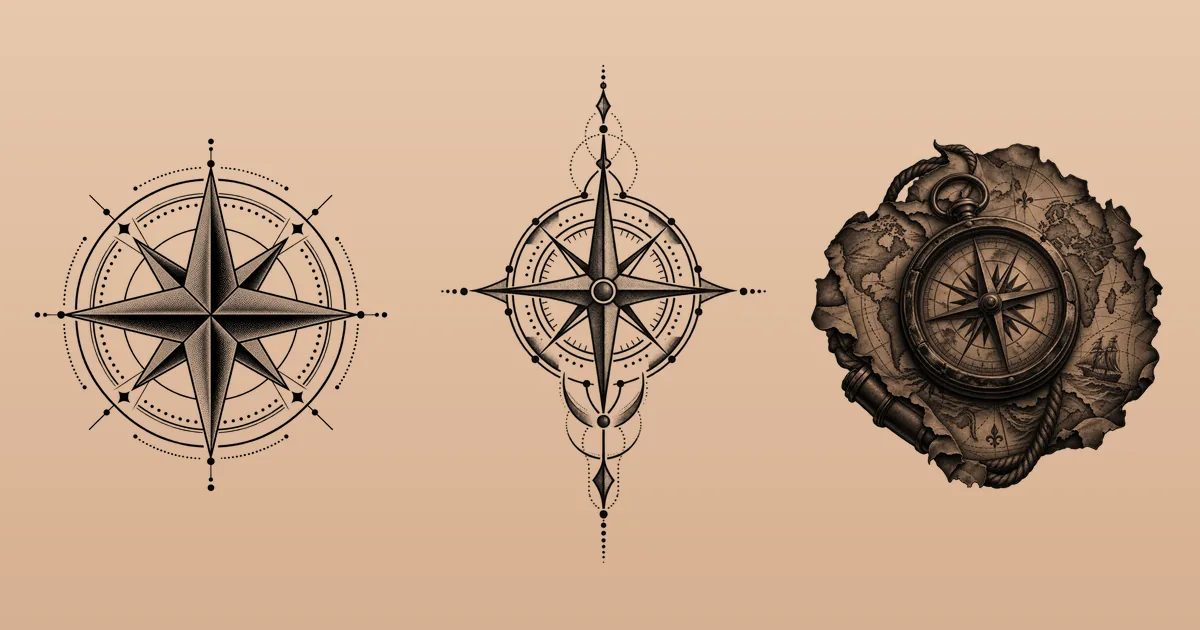
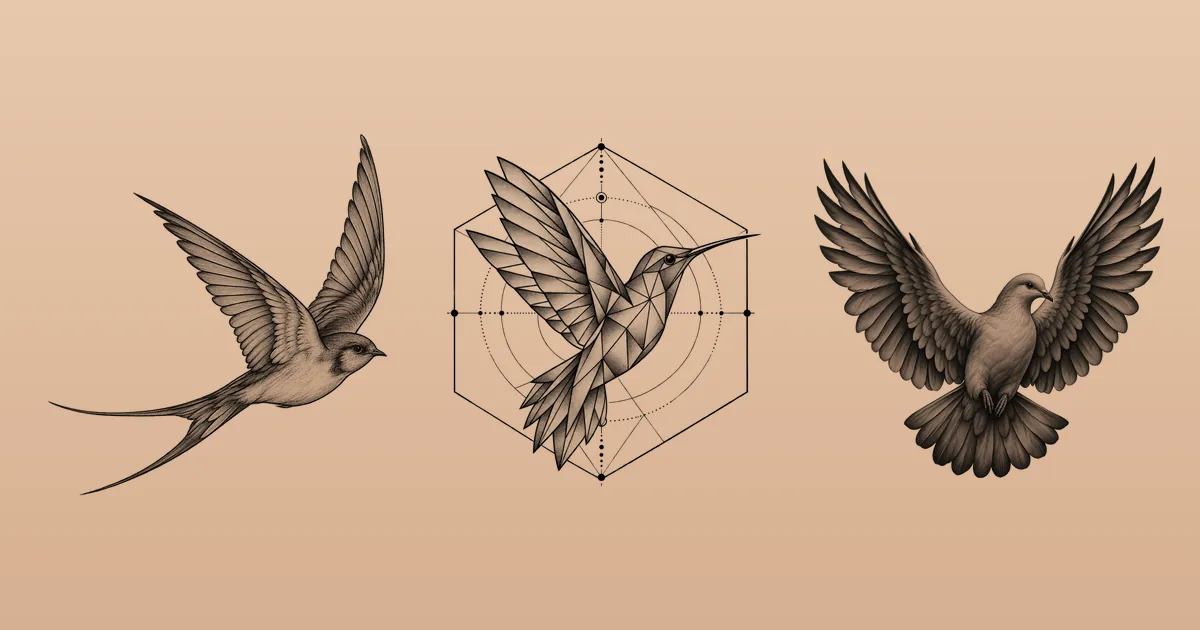
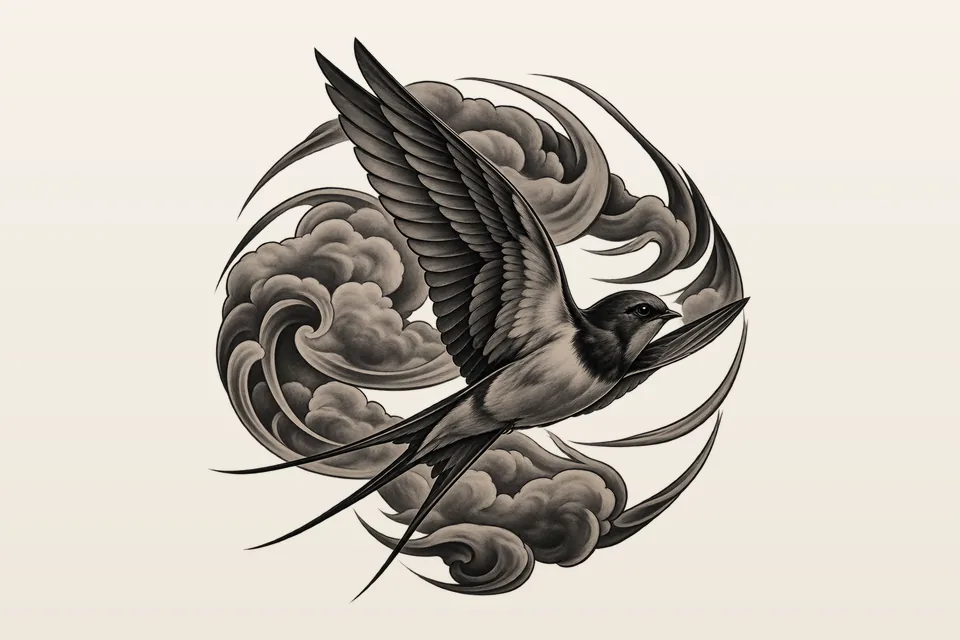
The swallow is the sailor's bird; our bird tattoo guide covers wing poses and placements. The nautical star is a five-point star with split light and dark points, and the compass tattoo guide explains how it differs from a compass rose and how to build a compass.
Rope, knots and the ship's wheel
Rope makes a border: around a wrist, framing a ship, or tied into a reef knot or a figure-eight under a name. Draw knots from a real reference so the strands pass over and under correctly. A ship's wheel is round with spokes and handles, a natural fit for a shoulder cap or the center of a chest piece. Keep the spokes evenly spaced, since any wobble shows.
Putting motifs together, up to a nautical sleeve
Two or three motifs with one clear leader beat six fighting for space:
- Anchor, rope and banner: one tall stacked piece for the forearm or calf.
- Lighthouse and waves: the tower upright, the sea at its base. If the sea itself is the subject, see our ocean tattoo guide.
- A ship in a frame: a rope circle, a porthole or a ship's wheel around a small ship holds a scene together.
- Anchor and compass: a cross and a circle, for a balanced chest or upper arm piece.
A nautical sleeve can be a patchwork of separate traditional pieces with bare skin between them, or one planned scene: a ship on the upper arm, a lighthouse on the forearm, and waves, rope or clouds running between them to bridge the elbow. Put the strongest piece on the outer arm, where it's seen first. Our sleeve tattoo guide covers planning.
Styles: the same anchor five ways
| Style | How it looks | Starting size |
|---|---|---|
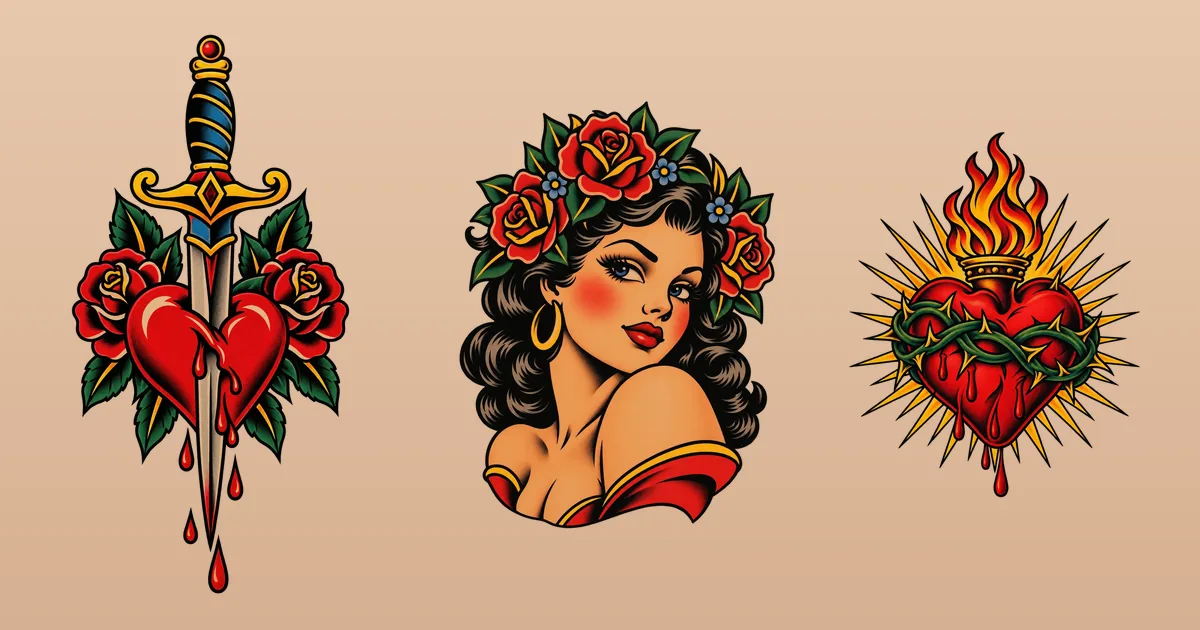
| American traditional | Heavy outlines, red, yellow, green and black, flat fills | Holds up small: 6 to 10 cm |
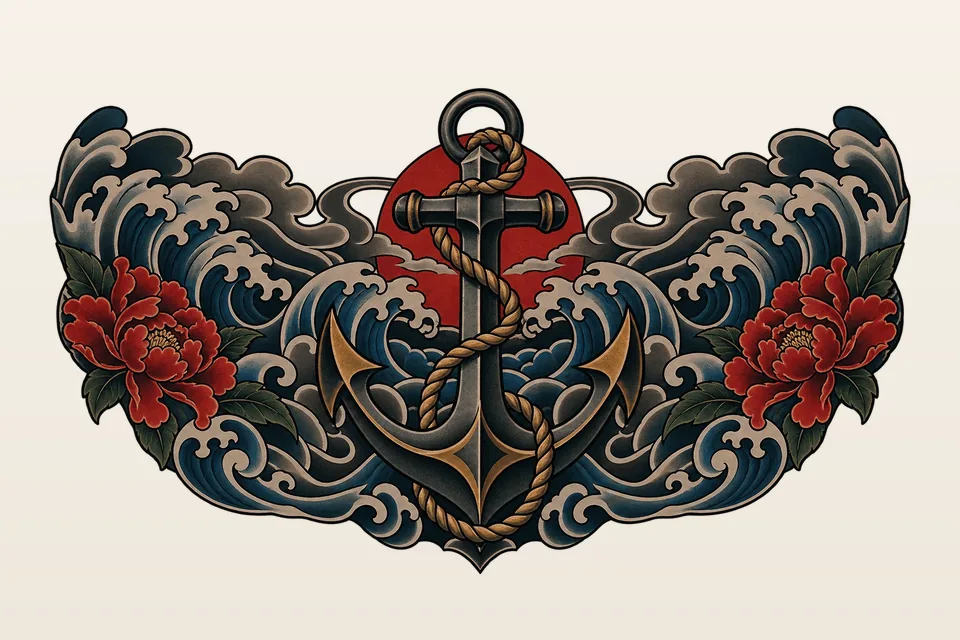
| Japanese | Bold outlines, waves, flowers and a sun or clouds as a wide background | 20 cm and up |
| Blackwork | Solid black, cut-outs and ornament, no color | 6 to 12 cm |
| Black and grey realism | No hard outline; rusted iron, worn rope, soft clouds | 12 cm and up |
| Fine line and minimal | One thin line, little or no shading | 2 to 6 cm, a bit larger than feels needed |
Fine lines need room to stay open as the ink settles; our fine line tattoo and small tattoos guides explain the spacing. All sizes here are general starting points; your artist sets the real limits.
Making it yours, whoever you are
Nautical tattoos for men and nautical tattoos for women are both real searches, and the honest answer is that the motif doesn't decide. Style, size and line weight change the feel, so choose those for the look you want.
Personal details:
- A boat's name on a banner or across the stern of the ship: a family boat, your first boat, one you crewed on.
- Coordinates of a home port under an anchor or around a compass; the compass guide explains how to keep the digits legible.
- A family's sea history: a grandparent's ship, a lighthouse from the coast they came from, a ship's wheel for someone who steered. Our meaningful tattoos guide helps turn a story into a symbol.
Sizes and placements
- Forearm: tall designs, 10 to 18 cm: an anchor with rope, a lighthouse, a mermaid. See the forearm tattoo guide for inner vs outer.
- Calf: 12 to 20 cm, the same tall shapes, or a ship side-on.
- Chest: a ship or a pair of swallows across it, or a wheel or compass at the center.
- Hand: 5 to 8 cm, bold and simple; an anchor or a swallow.
- Wrist, ankle, behind the ear: 2 to 4 cm outlines.
Our tattoo placement guide compares each spot in more depth.
Describing your nautical design and trying it on
Name the motif, the style, the extras, the size and the spot:
- An anchor with rope wrapped twice around the shank and a banner reading "Marlin," American traditional, red and black, 12 cm, outer left forearm.
- A striped lighthouse on rocks with waves breaking around it, black and grey, beams as bare skin, 15 cm, right calf.
- A small anchor outline, fine line, no rope, 3 cm, inside the right wrist.
In click2ink, our own studio, a first tattoo starts with four questions: where on the body (a spot, a sleeve or a full back), the style (American traditional, Japanese, blackwork, black & grey realism and fine line are among the 16), your description and an optional picture. The design lands on a 3D figure sized in real centimeters to your height; turn it, move the tattoo and change one thing at a time ("thinner rope, keep the banner"). The library designs shown above are free to try on. Print a true-size stencil for your artist. New accounts get 3 free credits; how it works shows the flow.
Nautical tattoo questions
What are the classic nautical tattoo ideas?
Anchors, full-rigged ships and sailboats, lighthouses, mermaids, swallows, nautical stars, compasses, rope, knots and ship's wheels, often with a banner. They're closely tied to sailors' tattooing and American traditional, but each works in blackwork, Japanese, realism or fine line too.
Should my anchor tattoo be in color?
It's your call. Black alone suits blackwork, fine line and realism, where rusted iron and worn rope are shades of grey. Color suits American traditional, with red rope or a yellow banner, and Japanese, with a gold anchor or a red sun. Ask your artist how a color looks on your skin tone, and look at their healed color work.
Which way should an anchor point on the arm?
One option is ring up toward the elbow or shoulder and flukes toward the wrist, so it hangs the way a real anchor does and reads upright for people facing you. Some prefer it to read upright for themselves when they look down. Try the stencil both ways on your arm before deciding.
Can I get an anchor tattoo stencil to bring to my artist?
Yes. Once you have a design you like, click2ink prints it as a stencil at the real size it has on the body, with a 5 cm check ruler so the print can be verified at 100%. Your artist may still adjust it for your skin.
Do I need a connection to the sea to wear nautical designs?
No. These motifs moved off the docks long ago and are worn by people who have never sailed. A few readings belong to particular sea traditions, so read up on any that matter to you, then give the picture your own story.
What can I put on the banner of a nautical piece?
Anything short: a name, a boat's name, a port, a year or a word or two. Keep it to one line where you can, because each letter needs room to stay readable as the ink settles. Check the spelling yourself before the stencil is made, and ask your artist for their minimum letter height.
What is a good small nautical design?
A plain anchor outline, a tiny swallow silhouette, a simple sailboat with two sails or a single wave under a star, around 2 to 5 cm. Keep it to one motif and skip rope and lettering, which need more space. Wrist, ankle and behind the ear suit these.
Does white ink work for highlights on rope and metal?
Most designs don't need it. Bare skin left open between lines reads as shine on iron, light on water and highlights on rope, and it ages more predictably. click2ink designs use no white ink unless you ask for it.