Japanese flower tattoo: choosing the bloom, the background and the size
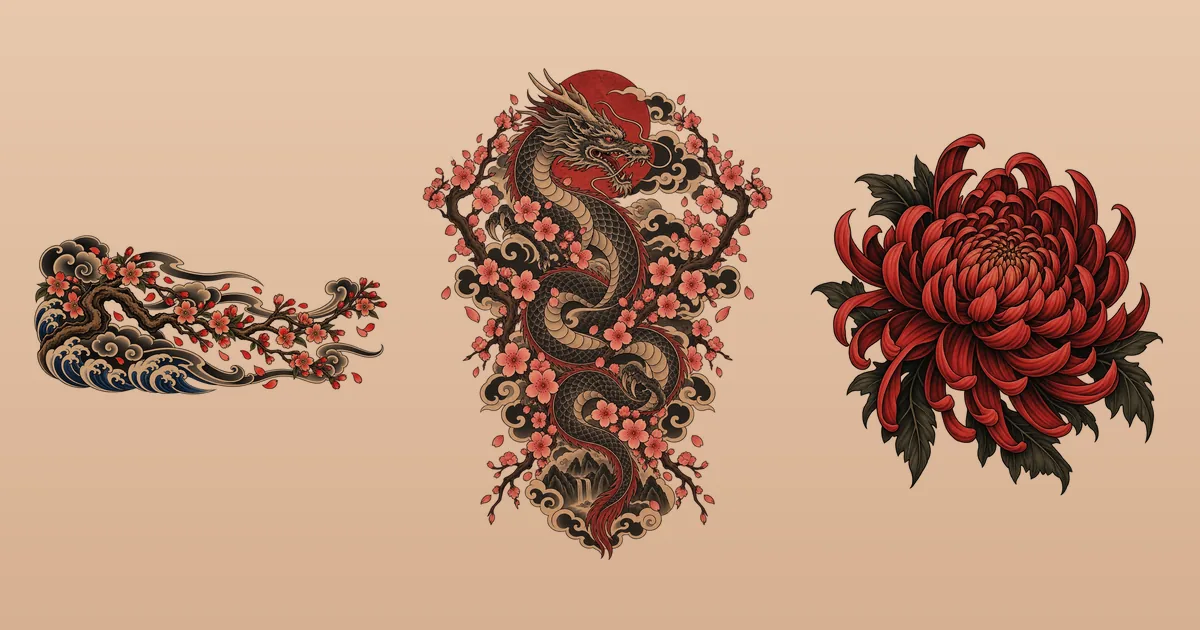
Choosing the flower is only the first step of a Japanese flower tattoo. In Japanese work the bloom is only half the design: what sits behind it, what it grows beside and how big it is decide whether it reads as Japanese or as a pretty sticker. Here are the flowers, how each one is drawn, and how to build them into a piece that holds up.
The flowers of Japanese tattooing, one by one
Wikipedia's article on irezumi lists the core flowers as peonies, cherry blossoms, lotuses and chrysanthemums, with maple leaves and bamboo among the other plants. Each has its own shape on skin, and the readings below are traditions people attach to them, not rules your tattoo has to obey.
Sakura (cherry blossom)
Five small, notched petals in clusters on a dark branch, loose petals drifting away. The cherry blossom article calls sakura a prevalent symbol in irezumi, and in classical waka poetry the blossoms commonly stand for impermanence, an enduring metaphor for how short life is. Small flowers make sakura a natural filler, or a long branch down an arm.
Kiku (chrysanthemum)
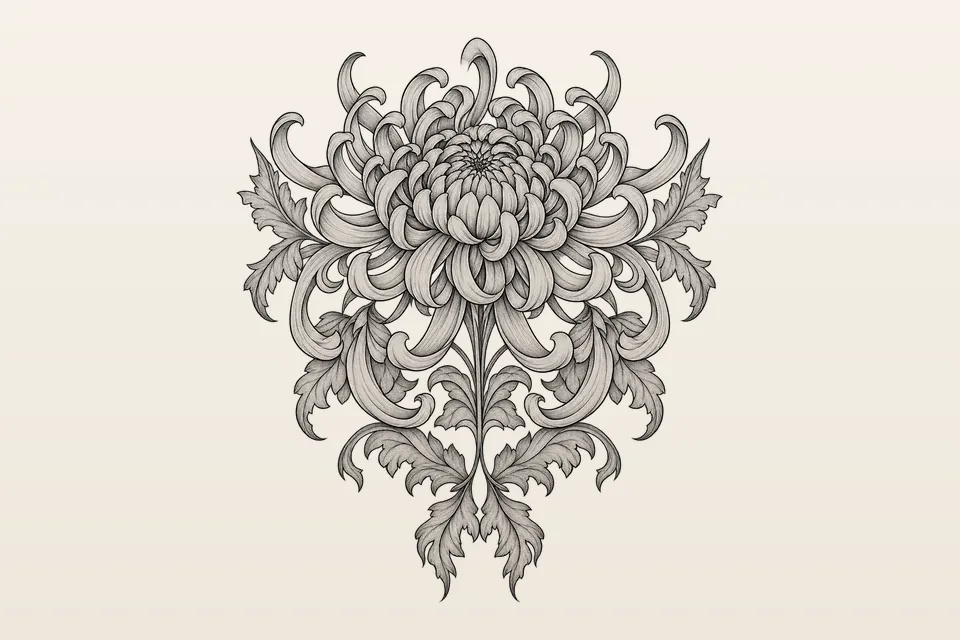
A round bloom of many long, narrow petals radiating from a small center, often drawn in tight, regular rows. Wikipedia's chrysanthemum article says the flower became the imperial family's crest under Emperor Go-Toba and came to symbolize autumn in Japan, and that the monarchy itself is called the Chrysanthemum Throne. The crest, a 16-petal design known as the kikumon, is described on the Imperial Seal of Japan page, which also notes that strictly speaking it is a crest, not a seal. The same chrysanthemum article adds that in Japan, China and Korea white chrysanthemums are linked with grief, worth knowing before you ask for an all-white bloom.
Botan (peony)
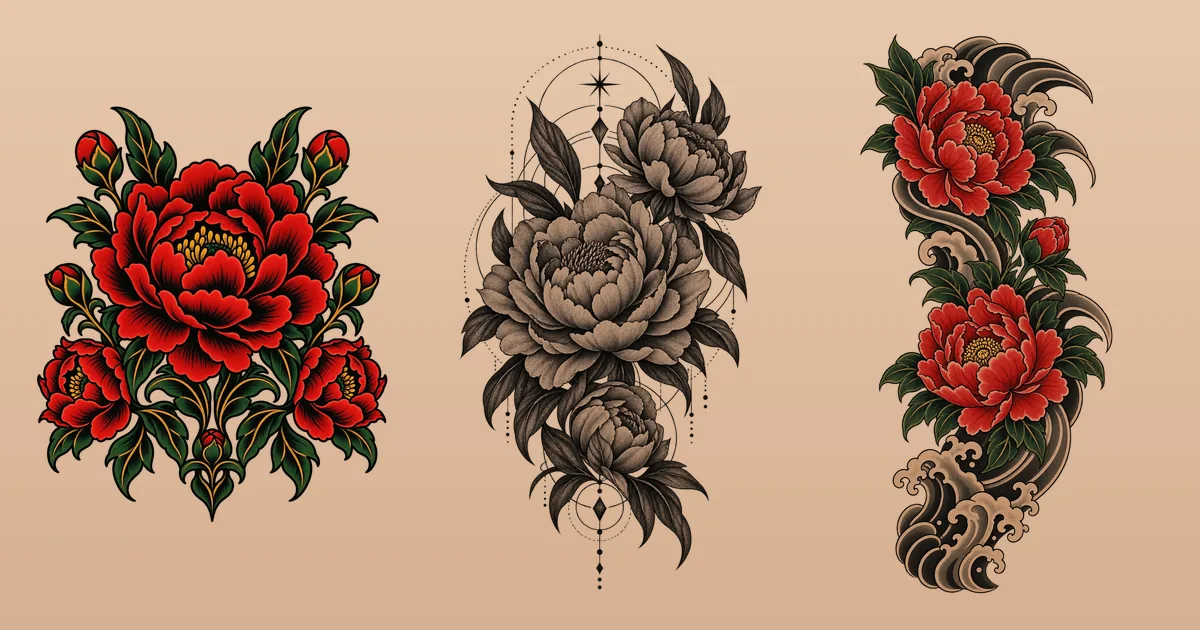
The big, ruffled bloom that often partners lion-dogs and dragons. It has its own guide: our peony tattoo page covers botan, its partners and how to keep it from looking like a rose.
Lotus
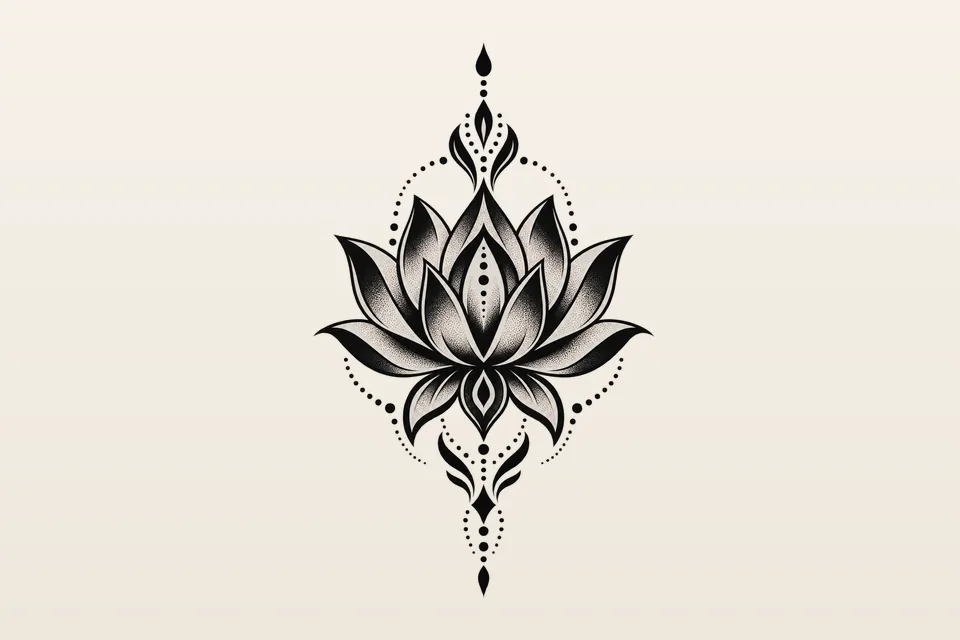
Broad, pointed petals in a symmetrical cup, sitting on water or a flat pad. Its readings come from Buddhism: on the padma page, the Buddha compares himself to a lotus that rises from muddy water unstained, and the flower stands for purity. If you choose a lotus with a Buddhist figure, treat that figure with care and talk to an artist who knows how it is traditionally drawn.
Momiji (maple leaves) and bamboo
Not flowers, but they do the same job. The Japanese maple article gives momiji as one of the tree's Japanese names, and notes how long its autumn colors have been valued and painted in Japan. Five- or seven-pointed red leaves scattered across waves read instantly as autumn. Bamboo brings straight vertical lines, handy on a forearm or calf.
Wind bars, waves and clouds: what goes behind the bloom
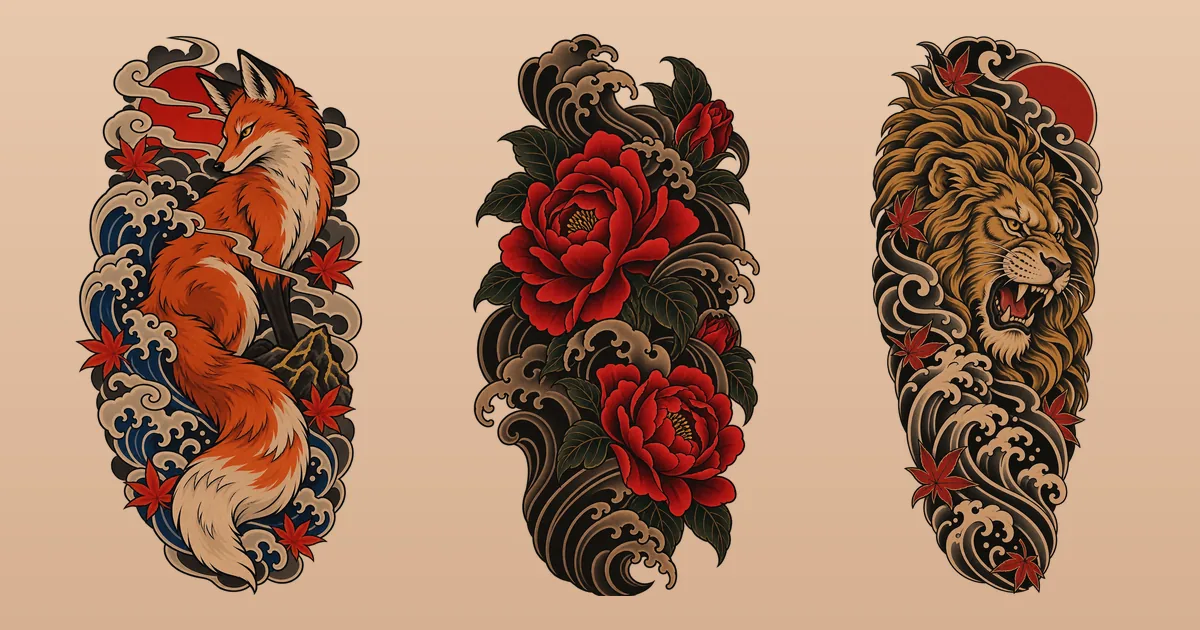
A Japanese flower tattoo floating on bare skin reads as a flower, not as Japanese work. Traditional work sets flowers against a black-and-grey background that moves in one direction:
- Wind bars: dark, curved bands that suggest rushing air. They suit sakura especially, because loose petals can ride along them.
- Waves: curling water with claw-like crests. Natural partners for lotus and for maple leaves drifting on a stream.
- Clouds: rounded, layered shapes with soft shading. Good around chrysanthemums and wherever a dragon will join later.
Our Japanese tattoo guide explains how subject, background and edges fit together in irezumi as a whole.
Flowers with dragons, koi and other main subjects
In a larger piece the flowers play the supporting role: they fill gaps around the main subject, bring color into a dark background and soften the edges.
- Dragon and cherry blossoms: the blossoms fill the spaces between coils, like the dragon in the wide picture at the top of this page. More on the creature in our dragon tattoo guide.
- Koi and lotus or maple leaves: both live on the water, so they share a wave background naturally. See the koi fish tattoo guide for direction and pairs.
- Chrysanthemum and maple: both are tied to autumn by the sources above, so they make an easy, coherent pairing.
Keep it to one or two kinds of flower per piece.
Black and grey or colour?
Both are traditional, and both hold up when the design is bold enough.
| Black and grey | Colour | |
|---|---|---|
| Look | Strong contrast, a moody, sculpted feel | Reds and pinks against grey backgrounds; the flowers become the color accents |
| Best flowers | Chrysanthemum (its petal rows love shading), lotus, peony | Sakura (pink on a dark branch), red maple leaves, red peony |
| Watch out for | Pale flowers need dark shading at petal bases to keep their shape | Light pinks and yellows soften over the years; give them a solid outline |
A "black and white" Japanese flower usually means black and grey: without white ink, the white of a petal is your own skin. click2ink draws that way by default, using white ink only when asked.
From one small bloom to a full sleeve
Size changes what each flower can do. Rough starting points, which your artist will fit to your body:
- Small (5 to 8 cm): a single sakura cluster, one maple leaf or a simplified lotus with fewer petals. A chrysanthemum this small loses its petal rows, so ask for a bolder, simpler version. Our small tattoos guide covers how much detail survives.
- Shoulder (10 to 15 cm): a round kiku or lotus sits beautifully on the shoulder cap, with a few leaves or clouds spilling down the arm.
- Forearm and calf: a sakura branch or bamboo running lengthwise, with wind bars behind.
- Half or full sleeve: flowers around a main subject, joined by one continuous background. Our sleeve tattoos guide walks through anchors and filler from shoulder to wrist.
For men who want a bolder Japanese flower tattoo, one direction is to plan it big: a red peony or chrysanthemum on the chest or a sleeve, dense black backgrounds. The flowers aren't gendered; scale and background set the mood.
How to describe a Japanese flower tattoo to an AI or an artist
Give the same six things every time: the flower, how many and in what stage, the background, any main subject, black and grey or colour, and the spot. For example:
- "A cherry blossom branch with falling petals, pink flowers on a dark branch, black wind bars behind, Japanese style, down the outer forearm"
- "One red chrysanthemum seen from the front, tight rows of petals, grey clouds around it, about 12 cm, for the shoulder cap"
- "A koi among lotus flowers and pads, black and grey waves, Japanese style, half sleeve on the upper arm"
- "Red maple leaves drifting over curling waves, round composition, for the outer thigh"
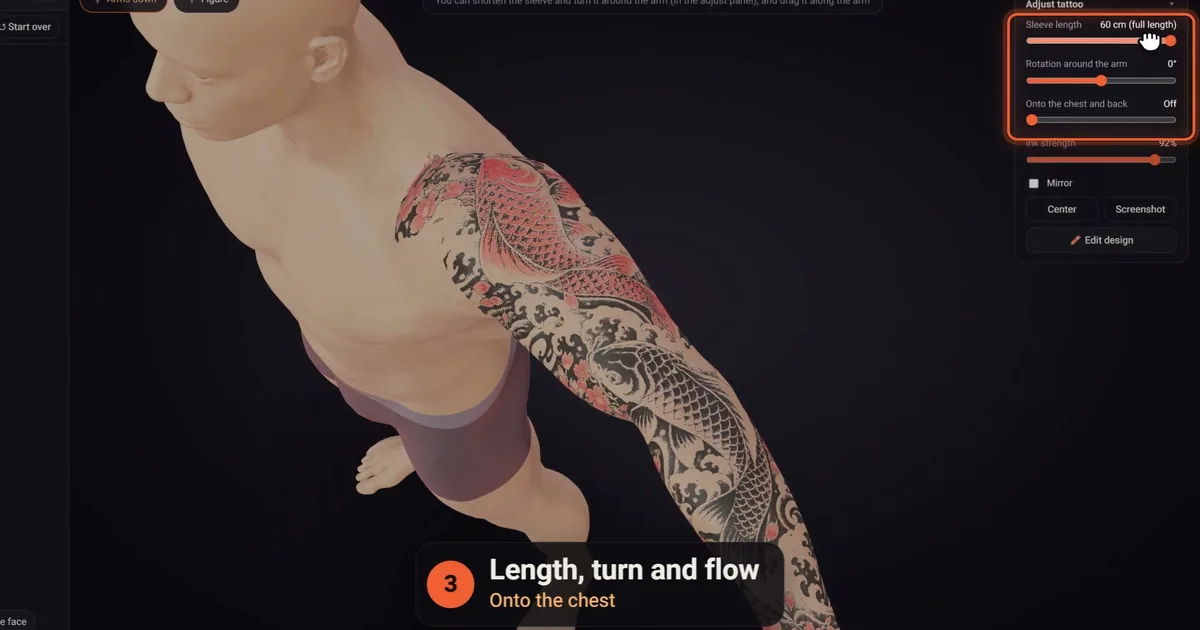
In click2ink you can pick Japanese among the 16 styles, tap the spot on a small figure and send a description like these. The AI artist draws an original design on a 3D figure in your skin tone, sized in real centimeters to your height; ask for one change at a time ("darker wind bars") and only that changes. How it works shows the full flow. For flowers outside the Japanese tradition, see our flower tattoo guide.
What holds up in skin over the years
Lines spread a little as a tattoo ages, so the designs that last are built with room to spare:
- Bold outlines around every petal and leaf.
- Fewer, larger petals. A tattooed chrysanthemum has fewer petals than a real one; the rhythm matters more than the count.
- Solid blacks next to open skin, which keep flowers readable from across a room.
- A healed portfolio. Ask your artist for healed photos of Japanese florals, not only fresh ones.
Healing, pain and skin questions belong with your artist or a doctor.
Japanese flower tattoo questions
What are the main types of Japanese flower tattoo?
The core flowers are the cherry blossom (sakura), chrysanthemum (kiku), peony (botan) and lotus, with maple leaves (momiji) and bamboo used the same way. Each has its own shape and traditional associations, from impermanence for sakura to purity for the lotus. Most designs set one of them against wind bars, waves or clouds.
Is the chrysanthemum the Japanese imperial symbol?
Yes. A 16-petal chrysanthemum, the kikumon, is the crest of Japan's imperial family, and the throne itself is called the Chrysanthemum Throne. Strictly, it is a crest rather than a seal. Most chrysanthemum tattoos carry no imperial meaning, but a flat, 16-petal crest-style design will recall it, so choose that form knowingly.
Can a Japanese flower tattoo be black and white?
Yes, and black and grey Japanese florals are common. The white areas are simply your skin left open, framed by grey shading and solid black backgrounds. Chrysanthemums and lotuses suit it especially well because their petal rows show off gradients. Ask your artist to keep enough contrast that pale petals don't blur into the background.
What is the best placement for a Japanese flower tattoo?
Round blooms such as the chrysanthemum, lotus and peony fill the shoulder cap, the outer thigh and the chest beautifully. Long sakura branches and bamboo suit the forearm, calf and ribs. Flowers also work as filler around the elbow and inner arm in a sleeve. Check the spot from the side as well as the front before you decide.
How small can a Japanese flower tattoo be?
A single sakura cluster or maple leaf can work at around 5 cm. Many-petaled flowers need more room: a chrysanthemum or peony with real petal detail needs roughly 10 cm or more. Below that, ask for a simplified bloom with a bold outline. Very small pieces also lose the background, so they read more as a flower than as Japanese work.
What goes with cherry blossoms in a Japanese tattoo?
Wind bars are the classic background, because petals can be shown blowing along them. Around a dragon, koi or tiger, sakura makes a light filler between the bigger shapes, and a branch can also stand alone down the forearm. Keep the blossoms in clusters with a few loose petals rather than spreading single flowers evenly.
Is a lotus tattoo Japanese or Buddhist?
Both. The lotus is one of the flowers of irezumi, and its symbolism comes largely from Buddhism, where it rises from muddy water unstained and stands for purity. Many modern lotus tattoos, such as blackwork or dotwork versions, aren't Japanese in style at all, so say which look you want.
Do the colors of Japanese flowers mean something?
A few associations exist; white chrysanthemums, for example, are linked with grief in Japan, China and Korea. Most color meanings online are popular readings rather than traditions. In practice, color in Japanese work is chosen for contrast, reds and pinks against grey, so ask an artist who works in the style before picking a color for its meaning.