Peony tattoo: how to design a bloom that reads as a peony
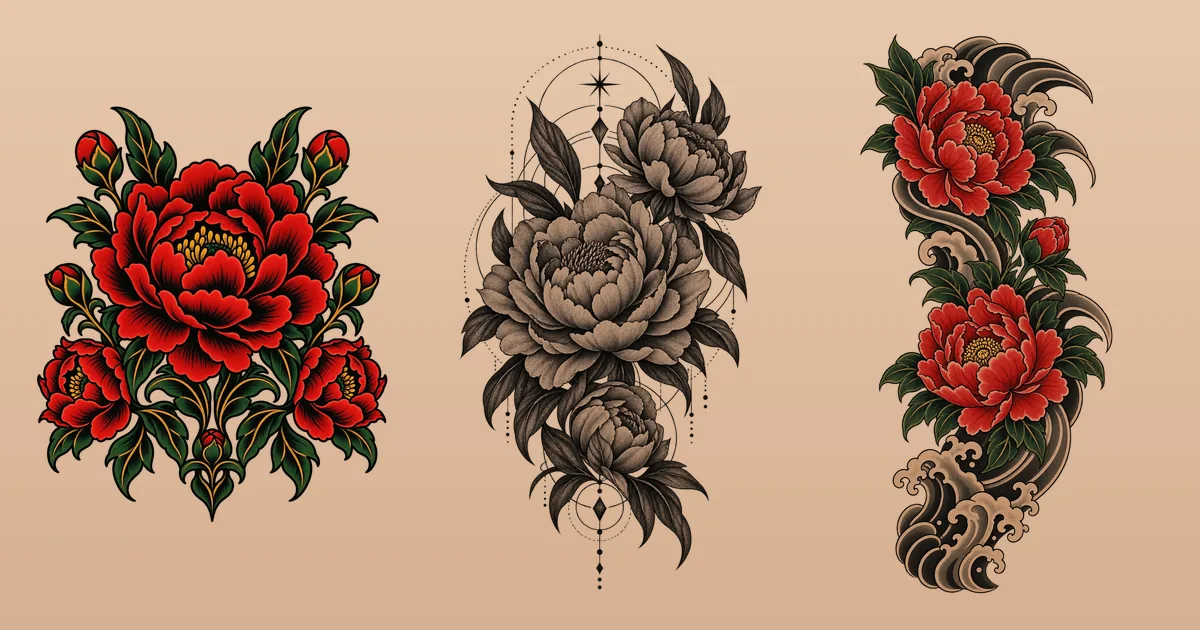
A finished peony tattoo is often mistaken for a rose. That is the real design problem with this flower: it is big, round and generous on skin, but only a few details make it unmistakable. This guide covers those details, the peony's place in Japanese tattooing, the other styles it suits, and real sizes for each spot.
What makes a peony read as a peony
Both are round, layered blooms, and a hurried drawing turns one into the other. The tells that keep them apart:
| Feature | Peony | Rose |
|---|---|---|
| Petal edges | Ruffled, frilled or torn-looking, often with a notch | Smooth edges that curl back at the tips |
| Center | A loose cup; in many designs a visible cluster of stamens or a crumpled heart | A tight spiral that winds into the middle |
| Overall shape | Wide and a little untidy, like a pom-pom or a bowl | Compact and controlled |
| Leaves | Deeply split into pointed, lobed segments, almost like fingers | Oval leaflets with serrated edges |
| Stem | Short and hidden by leaves in most tattoos | Often long, with thorns |
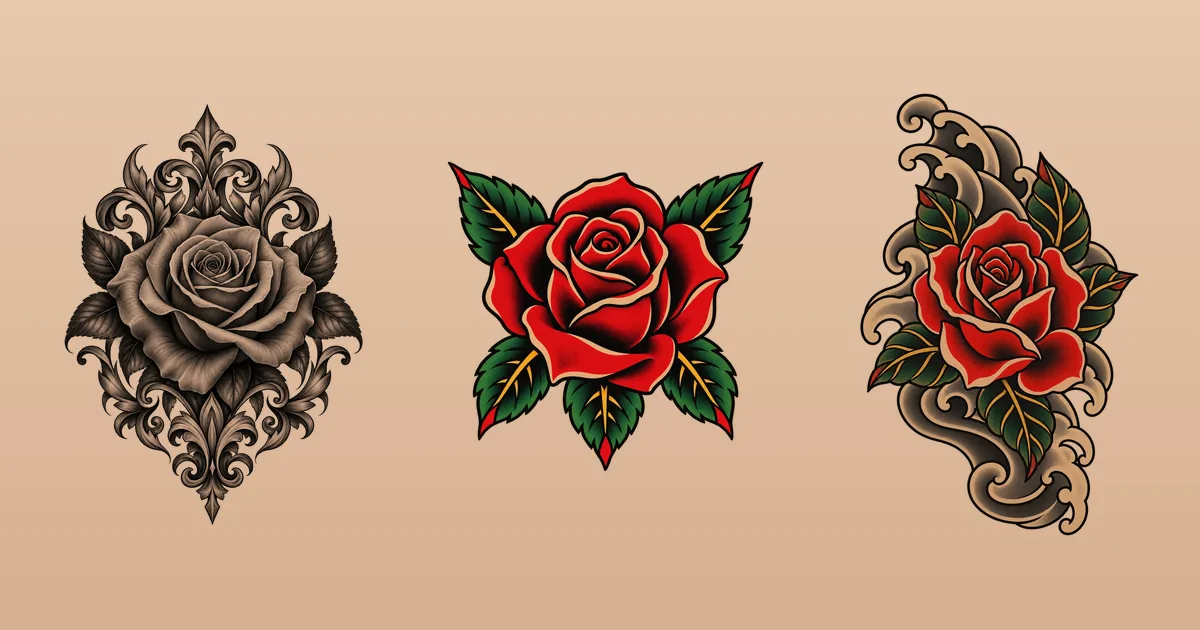
At the least, ask for the lobed leaves and a visible center; the leaves alone do a surprising amount of work. For roses themselves, see our rose tattoo guide.
Bud, half-open or full bloom
A peony bud is a firm ball, sometimes with a line of color at the seam: a small accent. A half-open bloom shows a cup of petals from the side and suits tall spots such as the forearm. The full bloom, from the front or at three-quarters, is the classic centerpiece. One big bloom, one half-open and a bud or two in a spray give depth without a second kind of flower.
Botan: the peony in Japanese tattooing
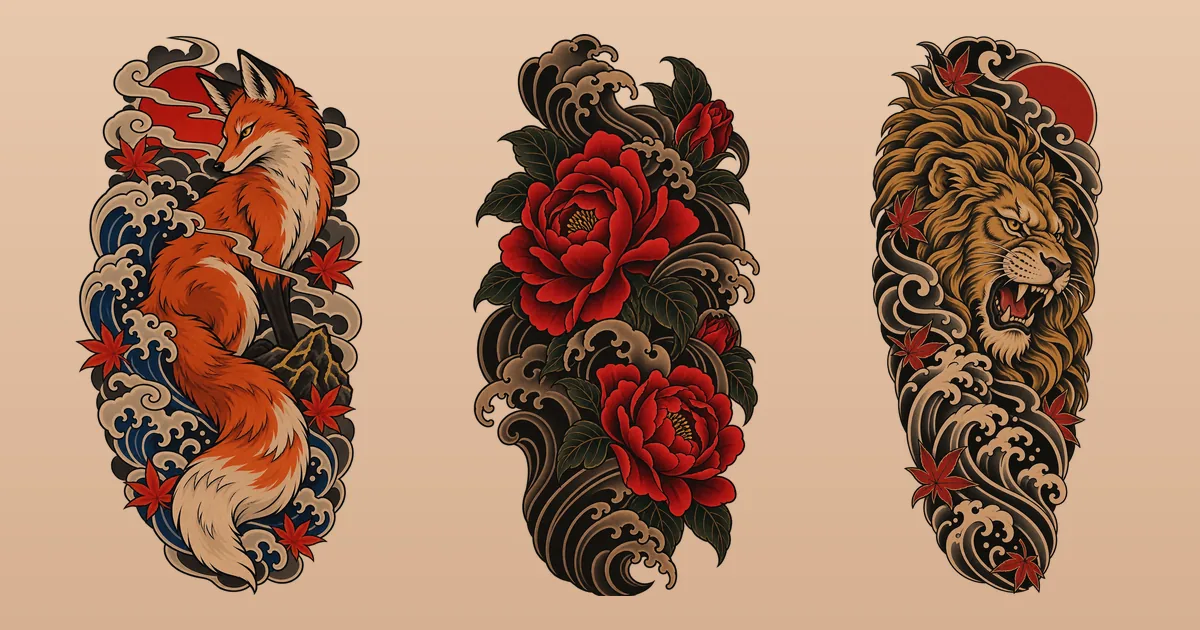
The peony, botan, is one of the core flowers of Japanese tattooing. Wikipedia's article on the peony traces this to the ukiyo-e artist Utagawa Kuniyoshi, whose prints of tattooed Suikoden heroes showed lions, tigers, dragons, koi and peonies. It notes that the peony became a masculine motif, linked to a devil-may-care attitude, and that in China it is the "flower of riches and honor." Our Japanese tattoo guide covers irezumi as a whole; here we stay with the flower.
You will also see bravery and other virtues on lists of peony meanings. The older associations are wealth, good fortune, honor and that reckless air; treat the rest as modern readings.
Lion-dog and peony, dragon and peony
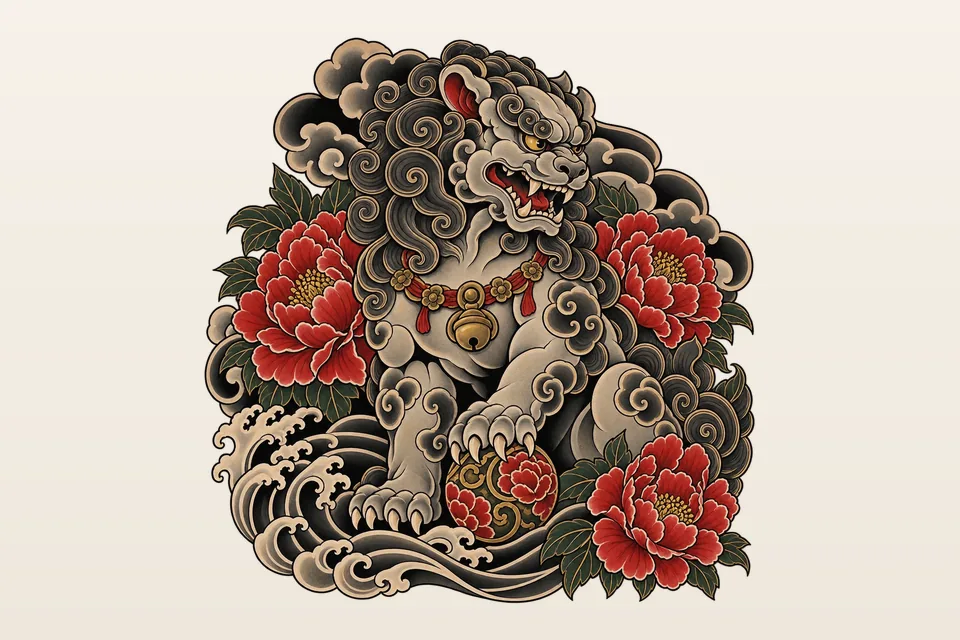
The most famous partner is the lion-dog, the karajishi or shishi, the same creature as the paired komainu statues that guard the entrances of Japanese shrines. Oxford's Ashmolean Museum, describing a Meiji-era hanging of two shishi and their young beneath a waterfall, calls the pairing traditional in Japanese art: the shishi a Buddhist symbol of power and protection, the "king of the animals," and the peony a symbol of wealth and good fortune, the "queen of the flowers." Visually, the lion's curly mane echoes the ruffled petals.
With a dragon, the peony plays the supporting role: the blooms fill the gaps between the coils, add red to a dark composition and soften the edges into the background.
Waves, wind bars and the background
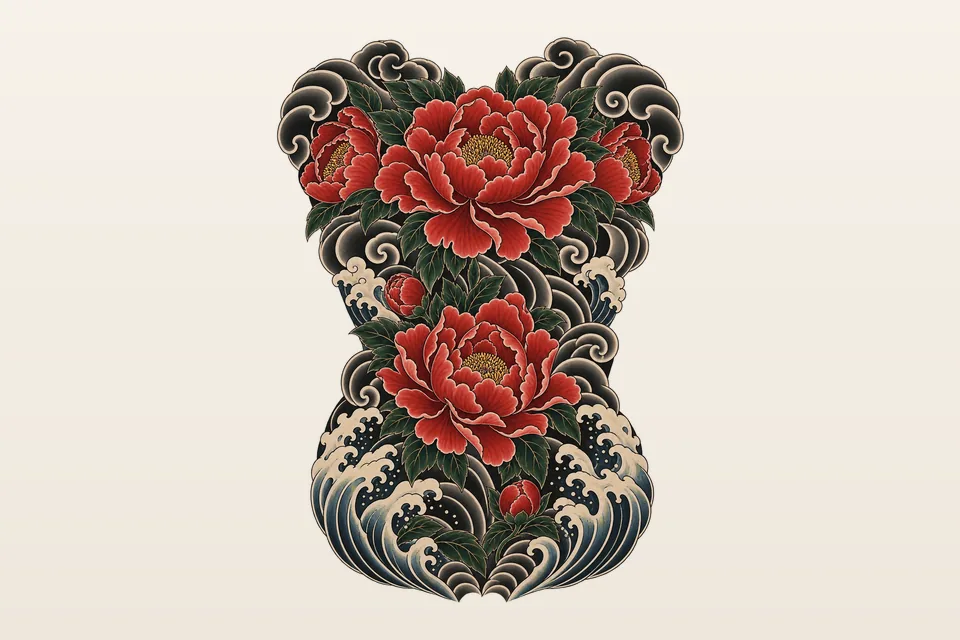
A Japanese peony rarely floats on bare skin. Behind it go waves, wind bars (dark curved bands that suggest moving air) or clouds, shaded in black and grey and flowing in one direction. That background turns separate blooms into one piece, and lets a single botan on the upper arm grow into a sleeve later. Irezumi has its own history and rules of composition, so for a true Japanese piece, seek out an artist trained in it.
Four more ways to draw a peony tattoo
- American traditional: a heavy black outline, flat red or pink petals with black shading at their bases, yellow at the center and bright green lobed leaves. Fewer petals than a real flower, drawn big, so it holds its shape for decades.
- Black and grey: soft gradients from deep black between the petals to bare skin at their edges. It needs room, roughly 12 cm across or more for a single bloom, because the depth lives in those dark gaps.
- Fine line: a single bloom or a bud on a short stem in thin lines with little or no shading. Keep the petal count down; a fine-line peony with forty petals turns into a scribble as the lines soften. Our fine line tattoo guide explains how much space each detail needs.
- Geometric: a peony set against circles, triangles or straight lines, or half the bloom drawn naturally and half as linework, like the black and grey peonies crossed by geometric lines at the top of this page. The contrast of soft petals and hard lines does the talking.
Neo-traditional, ornamental and etching versions work too. For other flowers in these styles, and for building a bouquet, see our general flower tattoo guide.
Peony colors: popular readings, not rules
Color meanings vary from one list to the next and none is a tattoo rule. The common readings: red for passion or good fortune (the classic of Japanese and traditional work), pink for romance, white for purity or remembrance, yellow or coral for warmth and new beginnings.
What matters more in skin is contrast. A red peony against black wind bars reads from across a room; a pale pink one needs darker shading at its petal bases to keep its shape. Without white ink, a white peony is your own skin shaped by grey shading.
Peony tattoo placement and real sizes
A round flower fills round, broad places best. These sizes are typical starting points for real petal detail; your artist will fit them to you.
- Shoulder cap: one bloom of 10 to 15 cm with leaves fanning down the arm. The curve of the deltoid shows off a front-facing flower.
- Ribs: a vertical spray of one bloom and a bud, 15 to 25 cm tall, following the line of the ribcage.
- Thigh: the front or outer thigh takes a bloom of 15 to 20 cm, or a spray of three peonies around 25 cm.
- Half sleeve: two or three blooms from shoulder to elbow, linked by wind bars or waves. Our sleeve tattoos guide covers how anchors and filler work around the whole arm.
- Full back: peonies climbing from waves at the hips to the shoulder blades, or framing a lion-dog or a dragon at the center, the format of the full back pictured above.
Describing a peony tattoo to the AI or your artist
For an AI or an artist, the same details make a clear brief: bloom stage, view, style, partner and background, color and spot. For example:
- "Two red peonies and a bud over dark waves and wind bars, Japanese style, flowing up the outer upper arm as a half sleeve"
- "A komainu lion-dog with its mouth open among red peonies, Japanese style, for the full back"
- "One pink peony in three-quarter view with deeply lobed leaves, American traditional, bold outline, for the shoulder cap"
- "A black and grey peony, half of it realistic and half dissolving into thin geometric lines, 18 cm tall, for the outer thigh"
- "A single peony bud on a short stem, fine line, no shading, about 5 cm, behind the ear"
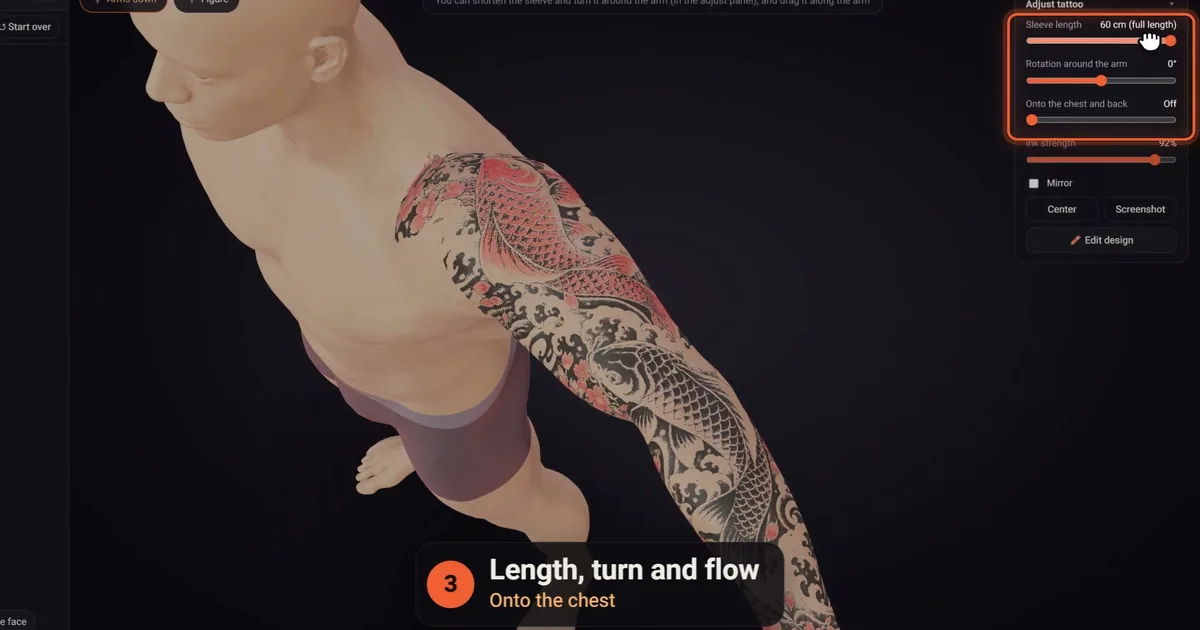
In click2ink, the AI artist draws an original design from a message like these and puts it on a 3D figure in your skin tone, sized in real centimeters to your height, so you can check a shoulder cap from the side. If the result drifts toward a rose, write the change ("deeply lobed leaves, show the stamens") and it changes only that. The peony designs on this page come from the free library of 450+ ready-made tattoos; how it works shows the rest. Then bring your artist the PNG, a stencil printed at real size and a link to the figure.
Peony tattoo questions, answered
How can I tell a peony tattoo from a rose tattoo?
Look at the petals, the center and the leaves. A peony has ruffled, notched petals in a loose cup, a visible center and deeply split, pointed leaves. A rose has smoother petals around a tight spiral, and oval serrated leaflets on a thorny stem. If a design is ambiguous, the leaves are the quickest fix.
What does a peony and lion-dog tattoo mean?
The pairing is a traditional one in Japanese art. In the Ashmolean Museum's description, the shishi is a Buddhist symbol of power and protection, the king of the animals, and the peony a symbol of wealth and good fortune, the queen of the flowers. An artist who works in the tradition can tell you more.
Is a peony tattoo masculine or feminine?
Both, depending on how it is drawn. In Japanese tattooing the peony became a masculine motif with a reckless, devil-may-care air, usually big, red and surrounded by black wind bars. Drawn in fine line and soft pink, the same flower reads as delicate. Style, size and color decide how it comes across far more than the flower does.
Does a peony bud mean something different from an open bloom?
There is no fixed rule, but a closed bud is often used for something still to come, such as a new child, a new start or a hope, while the full bloom stands for something at its peak. Buds at the edges also leave room to extend the piece later.
What is the smallest a peony tattoo can be?
A detailed bloom needs room: roughly 8 to 10 cm across keeps its petals separate as the lines soften over the years. Below about 6 cm, ask for a simplified version with fewer petals, a bold outline and the lobed leaves, or choose a single bud instead. Your artist can tell you what holds up on your skin.
What goes with a peony in a Japanese sleeve?
Classic partners are the lion-dog, the dragon, the tiger and the koi, joined by waves, wind bars or clouds. Peonies often sit near the elbow, the shoulder or the inner arm, filling space between the main subjects and adding red to the dark background.
Can a peony tattoo cover an old tattoo?
Often, yes. Peonies stack petals and dark shadows, and their leaves can stretch to cover stray edges, which makes them a favorite for cover-ups. Darker colors such as deep red, purple or black and grey hide more than pastels. How well it works depends on the old tattoo's size and darkness, so let your artist judge it in person.
Can I get a Japanese peony if I'm not Japanese?
Many people do, and Japanese-style tattooing is practiced around the world. Respect comes from doing it properly: learn a little about the tradition, choose an artist trained in Japanese work who understands its composition, and avoid mixing in symbols you don't understand.