Tiger tattoo: choosing the pose, the tradition and a size that lasts
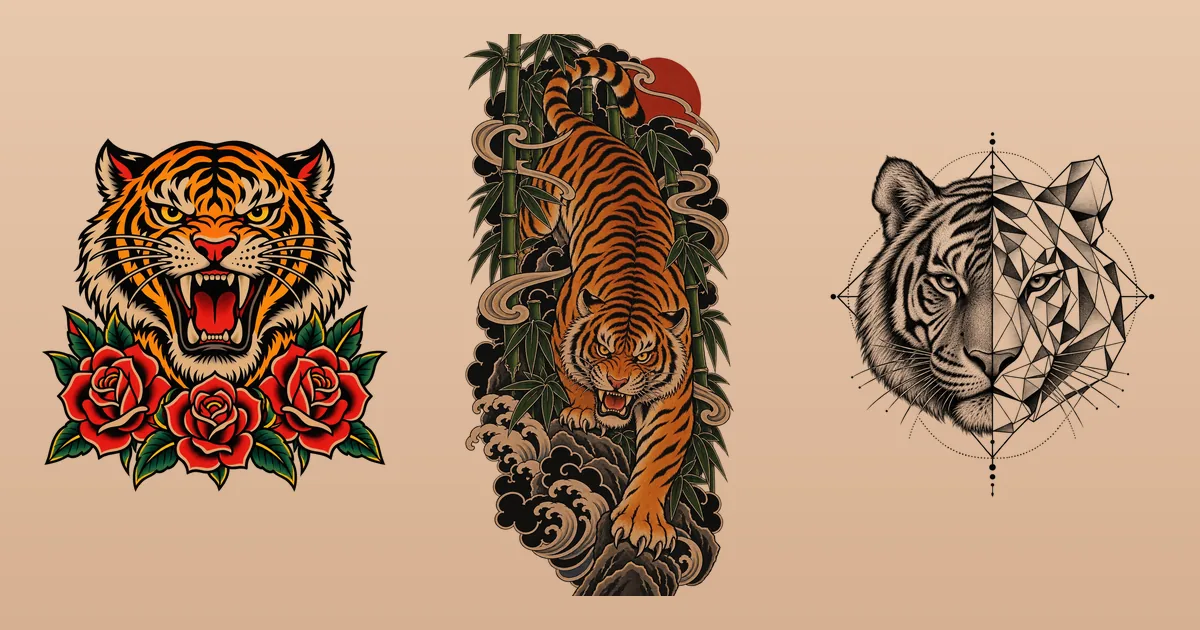
Most people pick a tiger tattoo by style first and end up with the wrong animal for the spot: a stalking tiger squeezed onto a shoulder cap, or a roaring head stretched down a forearm. Start with what the tiger is doing. The pose decides the shape, the shape decides the placement, and only then do the tradition, the style and the stripes fall into place.
Pick the pose before anything else
The Smithsonian's National Zoo describes the tiger as an ambush predator that relies on stealth and strength. Tattoo poses borrow from that, and each has a natural home on the body.
| Pose | What it says | Its shape | Spots that suit it |
|---|---|---|---|
| Roaring head | Defiance, a warning, raw energy | Round or shield-shaped | Shoulder cap, chest, outer thigh, back of the hand for a small bold one |
| Stalking, head low | Focus, patience, something about to happen | Long and diagonal | Forearm, calf, ribs and side, a whole sleeve |
| Crouching or leaping | Action, a fight, a breakthrough | Wide, or a strong S-curve | Upper back, chest panel, full back |
| Coming down a rock | The classic Japanese composition | Tall, head at the bottom | Full back, half or full sleeve, thigh |
| Eyes only | Watchfulness, something hidden | A narrow horizontal band | Across the forearm, upper back, above the knee |
What a tiger tattoo means in China, Korea and Japan
Each East Asian tradition reads the tiger a little differently. These are traditions, not rules.
China: king of the forest, guardian of the west
Wikipedia's tiger article notes that in ancient China the tiger was seen as the king of the forest and stood for the emperor's power. The White Tiger is one of the Four Symbols of the Chinese constellations, the guardian of the west and of autumn. Tiger pictures were also hung at the New Year to scare off evil. And the tiger is the third animal of the Chinese zodiac: recent Years of the Tiger were 1998, 2010 and 2022, and the next is 2034.
Korea: protector and messenger of the mountains
In Korean mythology tigers are messengers of the mountain gods and protectors against evil spirits. Korean folk painting has a funny side too: in the magpie-and-tiger pictures described in Wikipedia's survey of cultural depictions of tigers, the tiger is drawn as foolish on purpose, a joke at the aristocracy's expense. It's a rooted option if a snarl isn't you.
Japan: the tiger of irezumi
Tigers are a standard animal in Japanese tattooing. The irezumi article traces the art's rise to woodblock illustrations for the Japanese edition of the novel Suikoden, which showed heroes decorated with dragons, flowers and "ferocious tigers," and created a demand for tattoos like them. Irezumi has its own rules and history, covered in our Japanese tattoo guide; for a Japanese tiger, find an artist trained in it.
Tiger with a dragon, bamboo, peonies or roses
- Tiger and dragon. In Chinese art the tiger is an earth symbol and the dragon's equal rival, matter against spirit: balance through opposition. They usually split the space, upper arm and forearm, or facing each other across the back.
- Tiger and bamboo. The middle design at the top of this page. Tall stalks give a stalking tiger vertical lines to move through, so it suits the forearm, the calf and a sleeve.
- Tiger and peonies. A Japanese favorite. Big round blooms fill the gaps around a head or a crouching body and soften the ferocity.
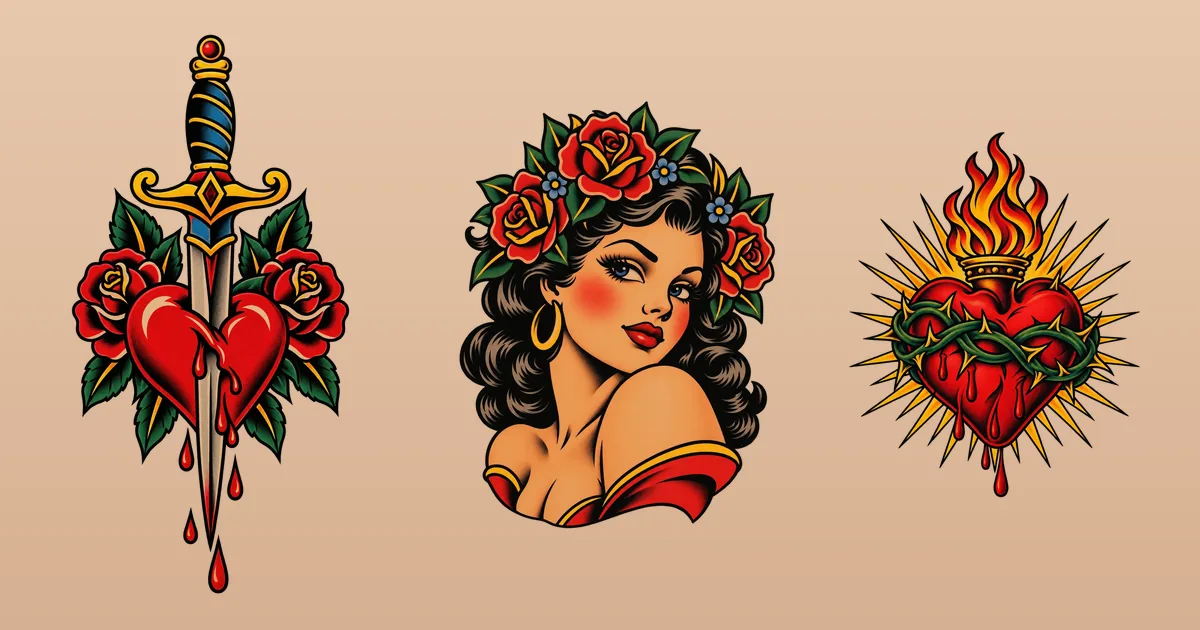
- Tiger and roses. The American traditional answer, like the head over red roses at the top of this page. The roses widen the base into a sturdy shape for the chest or outer thigh.
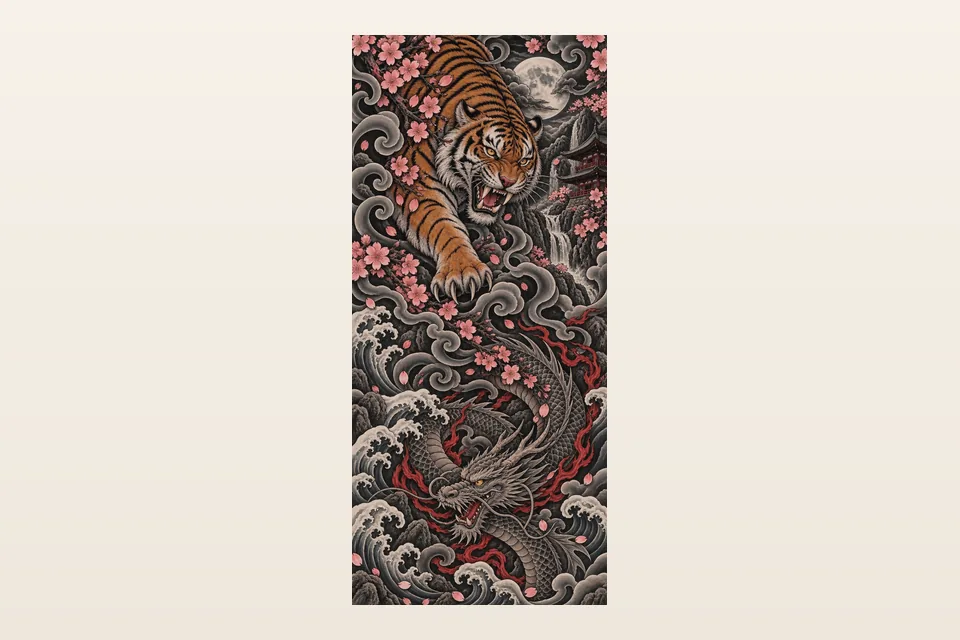
Planning a whole arm? Our sleeve tattoo guide explains how anchors and backgrounds fit together.
How the style redraws the tiger
Each style changes the tiger's temper and the size it needs. Treat these as starting points; your artist will have their own.
| Style | Lines and shading | Typical subject | Size to start from |
|---|---|---|---|
| American traditional | Heavy, even outlines; solid orange, black and a little red or green | A roaring head, often with roses or a dagger | Holds up small: around 7 to 8 cm for a head |
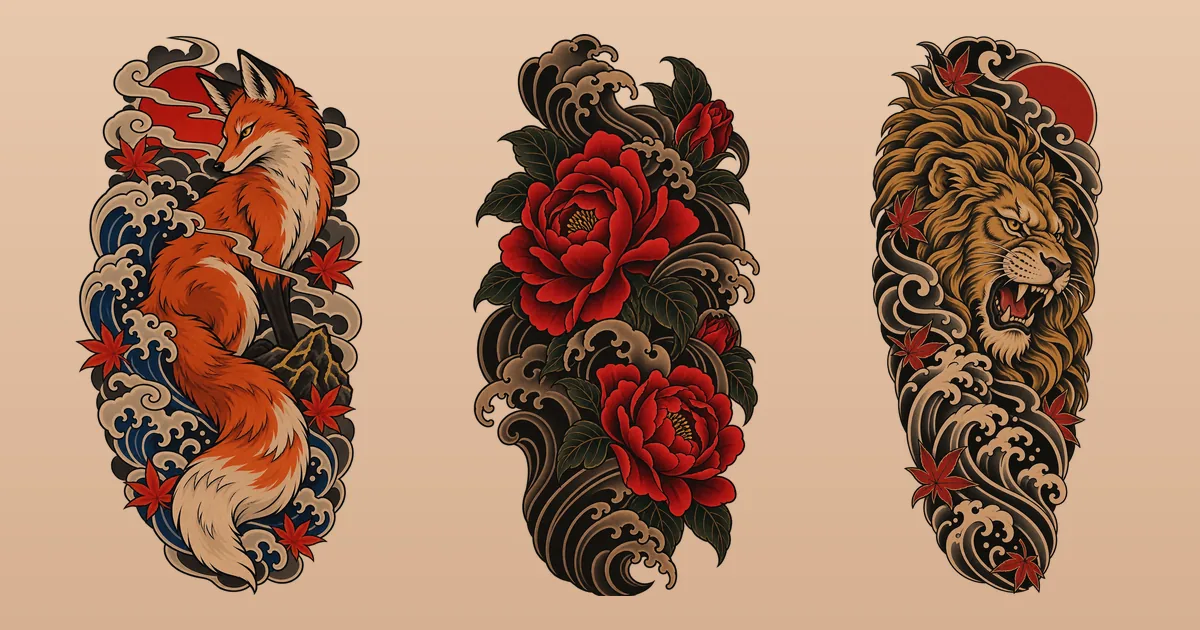
| Japanese | Bold outlines, solid black backgrounds, wind bars, waves | A full tiger on rocks, in bamboo or with a dragon | Large: a half sleeve, a sleeve or the full back |
| Black and grey realism | No outline; soft gradients, fine fur, highlights left as bare skin | A calm or snarling head, close up | Palm-sized and up, about 10 to 12 cm |
| Geometric | Fine, straight, even lines and facets, often half-realistic | A head split between fur and polygons | About 10 cm, so the facets don't crowd |
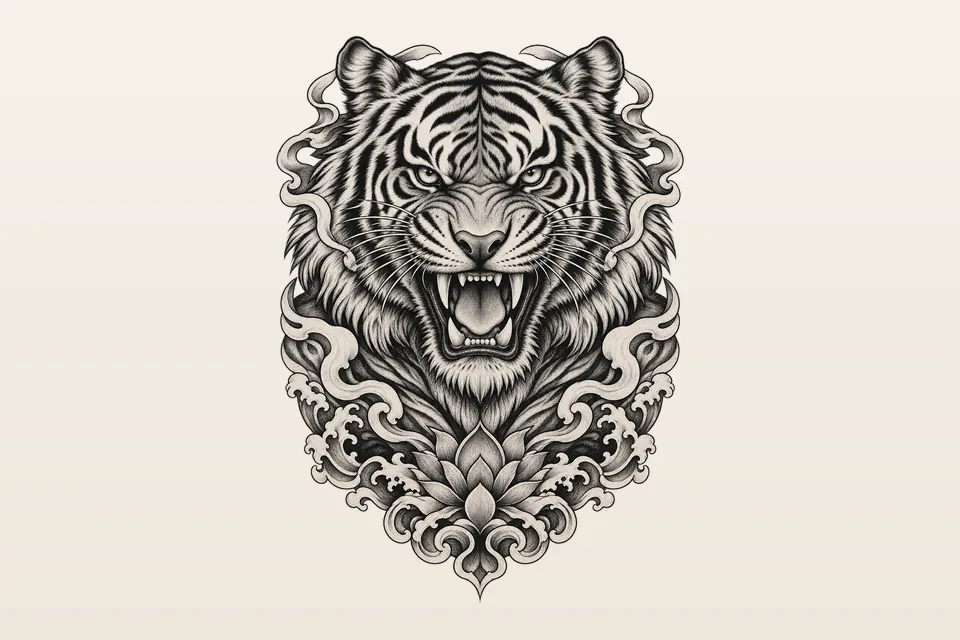
| Illustrative etching | Crosshatching and parallel lines like an old engraving | A roaring head with smoke or ornament | 10 cm and up, to keep the hatching open |
American traditional is the most forgiving, with thick outlines and blocky stripes; our traditional tattoo guide covers its roots. Realism is the most demanding: when the stripes around the eyes soften with age, the expression goes first.
Stripes and eyes: sizing a tiger so it lasts
No two tigers have the same stripe pattern, as the National Zoo points out, so you have freedom in how the stripes run. Use it to make them survive in skin:
- Fewer, bolder stripes. Ink spreads a little over the years, and thin stripes packed close merge into a grey patch. Keep clear skin or color between them.
- Protect the eyes. They carry the mood. Give them a strong dark rim, a clear pupil and a bare-skin highlight, and keep the fur around them simpler.
- Eyes-only needs width. As a band across the forearm or upper back it works; squeezed small, it reads as two dots.
- Match detail to size. A coin-sized head can carry bold traditional lines, not fur. Our tattoo size guide goes through what each size can hold.
Tiger tattoo ideas beyond the obvious
Searches for a tiger tattoo for women usually mean one thing: something that isn't a snarling chest piece. But anyone can wear any tiger, so here are directions by mood rather than by gender.
- A tigress with cubs. In the wild, tigers live alone except when mating or raising young, which makes a mother with her cubs a natural tribute to a parent.
- A fine line stalking tiger down the forearm or along the ribs, mostly outline with a few stripes.
- A tiger among peonies or cherry blossoms on the thigh or the hip, color or black and grey.
- A playful Korean-style tiger with a magpie for someone who wants a tiger with a sense of humor.
- A White Tiger in grey shading, for the guardian of the west or simply for the look.
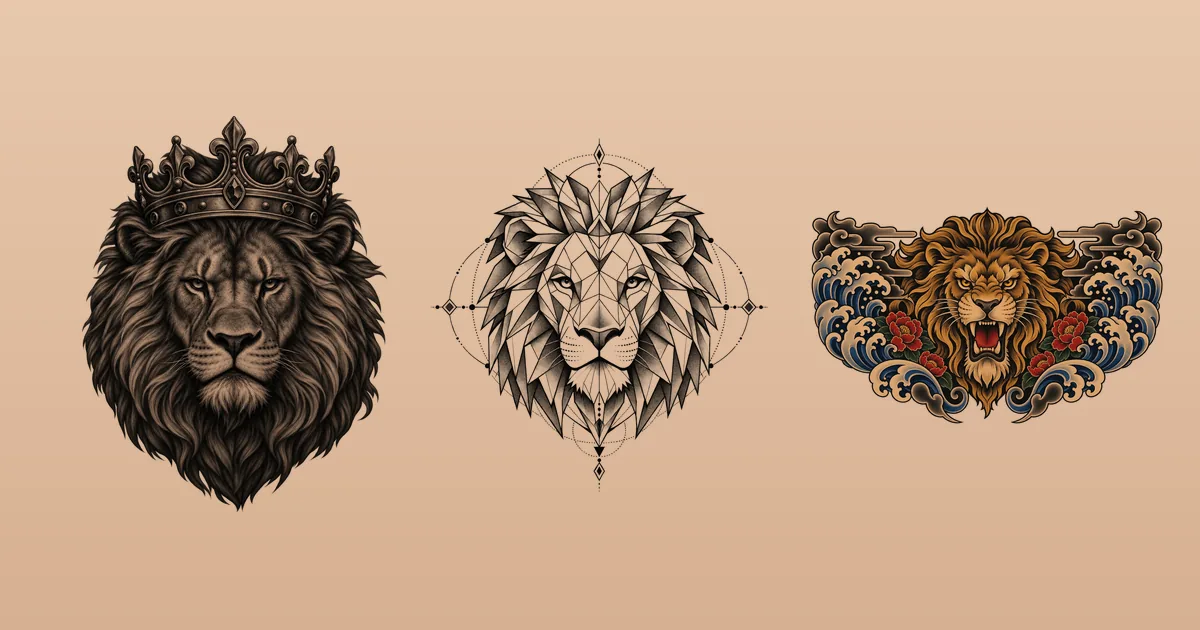
Comparing big cats? Our lion tattoo guide covers a very different set of meanings and a mane instead of stripes.
Sketching your tiger in click2ink
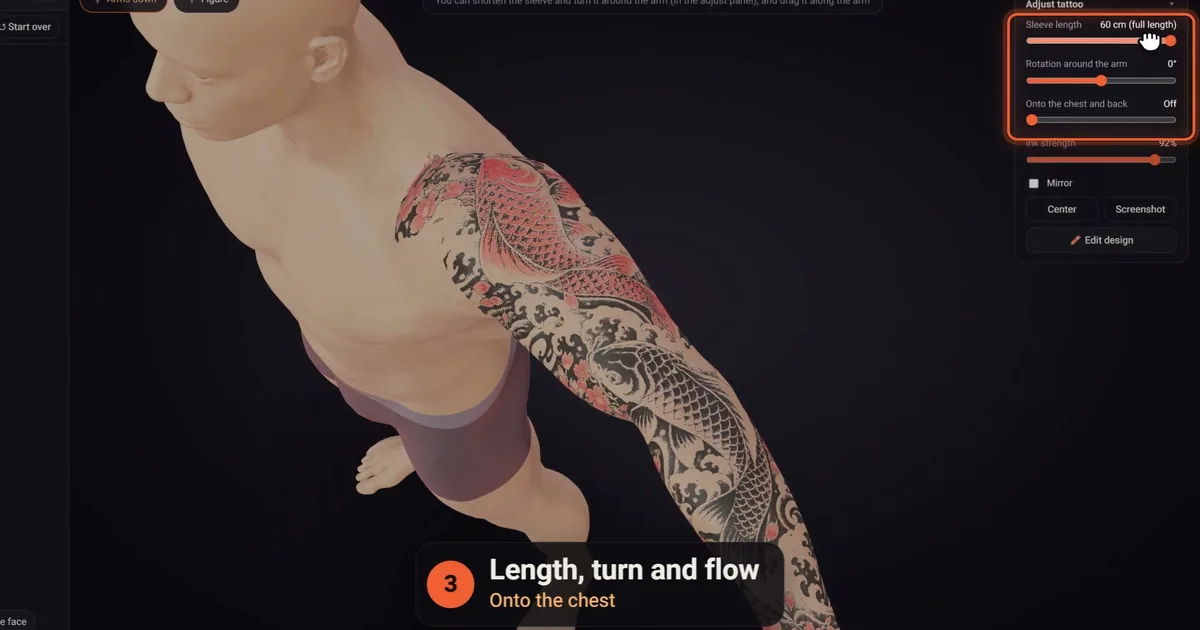
In click2ink, our own design studio, you describe the tattoo in a chat, an AI artist draws an original design, and it appears on a 3D figure sized to your height. For a first tattoo you pick where it goes (a spot, a sleeve, the full back) and a style, then describe the pose, the partner and the placement, for example:
A tiger stalking down through bamboo, Japanese style, red sun behind, head toward the wrist, for the left forearm.
Then change one thing at a time ("thicker stripes around the eyes, keep everything else") and the AI changes only that. A white tiger needs no white ink: designs carry none unless you ask, so the fur is your own skin with grey shading. Turn the figure, drag the tiger to the calf, mirror it if it faces the wrong way, and print a stencil at real size for your artist. New accounts get 3 free credits, enough for 12 messages; see how it works and the pricing page.
Tiger tattoo questions
What does a tiger tattoo mean?
Usually courage, protection and power, with the details depending on the tradition. In ancient China the tiger was king of the forest and a symbol of the emperor's power; in Korea it guards against evil spirits; in Japanese tattooing it stands for courage and protection. Many people add their own reason, such as a Year of the Tiger birth, a fierce parent, or getting through a hard stretch.
What's the difference between a Japanese and a Chinese tiger tattoo?
A Japanese tiger tattoo follows irezumi conventions: bold outlines, a full body on rocks or in bamboo, wind bars, waves and black backgrounds. A Chinese-inspired tiger leans on Chinese symbols, such as the White Tiger of the west or the zodiac year. Tell your artist which tradition you want.
What does a tiger and dragon tattoo mean?
In Chinese art the tiger is an earth symbol and the dragon's equal rival, the tiger standing for matter and the dragon for spirit, so the pair is usually read as balance between opposing forces. Some people choose it for two sides of their own character, or for two people. In a sleeve, one often takes the upper arm and the other the forearm.
What does a white tiger tattoo mean?
In Chinese tradition the White Tiger is one of the Four Symbols of the constellations, the guardian of the west and of autumn. It appears in Japan as Byakko and in Korea as Baekho. In a tattoo, the white fur is usually left as bare skin and shaped with grey shading, which ages better than white ink and looks natural on most skin tones.
Which years are Years of the Tiger?
The tiger is the third animal of the Chinese zodiac, so it comes around every 12 years: recent ones were 1998, 2010 and 2022, and the next is 2034. Each year starts at the Chinese New Year, not on January 1, so if you were born in January or early February, check the exact dates before building a design around it.
Is a tiger tattoo linked to the yakuza?
Tigers are a common motif in irezumi, and for many years traditional Japanese tattoos were associated with the yakuza. A tiger on its own doesn't make a tattoo a gang mark, and many people wear Japanese tigers out of love for the art. If you travel to Japan, note that many public baths, fitness centers and hot springs there still turn away tattooed customers.
Where is the best place for a tiger tattoo on the arm?
It depends on the pose. A roaring head fits the shoulder cap or the outer upper arm, where a round shape sits well. A stalking or crouching tiger needs length, so it suits the outer forearm or a half sleeve, ideally walking down toward the wrist. A full tiger with a background belongs in a full sleeve, where it can wrap around the arm.
Can a tiger tattoo be small?
Yes, if you simplify. A small tiger works best in American traditional, with bold outlines and a few thick stripes, or as a fine line outline with only the main stripes. Realistic fur and detailed eyes need room to stay readable, usually palm size or larger. Below that, choose a simpler style rather than shrinking a detailed design.