Botanical tattoo designs: leaves, stems and the plants nobody puts in a vase
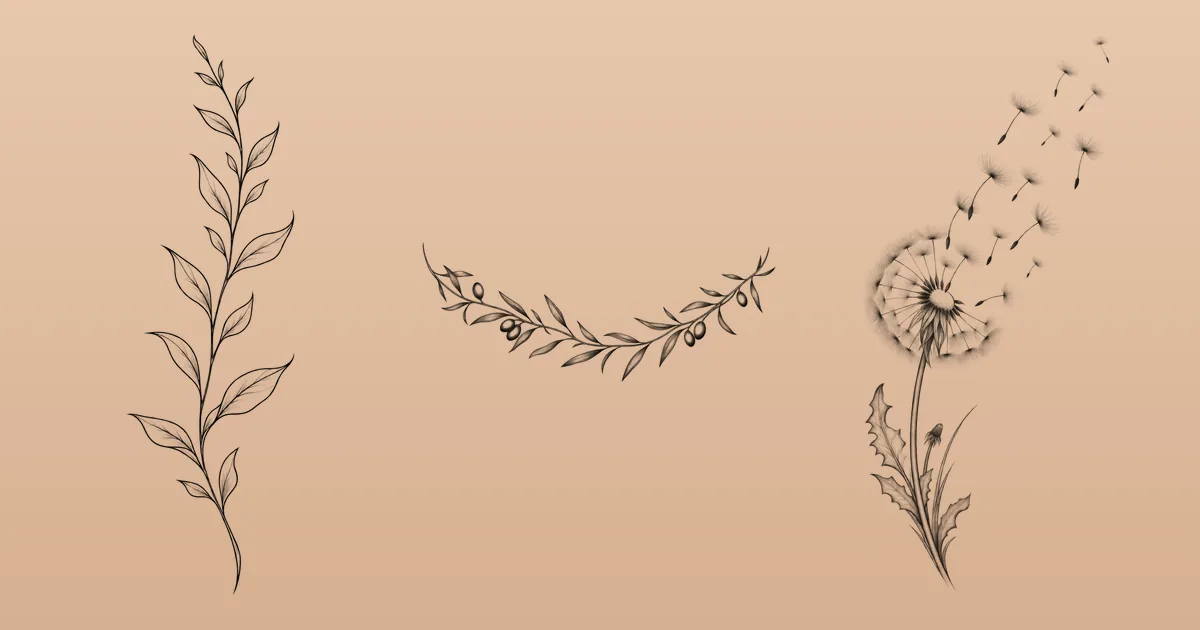
Ask a tattoo artist what makes a botanical tattoo different from a flower tattoo and you'll usually hear one word: stems. The bloom is optional. What carries the design is everything a florist trims away, the leaves, the twigs, the seed heads, the way a vine climbs. This guide is about that green half of the plant world and how to draw it for skin.
What makes a tattoo "botanical"
The look comes from botanical illustration: drawings made to describe a plant accurately enough to identify it. From the 1500s, printmakers worked in woodcut and later in copperplate engraving and etching, and some plates were coloured by hand. That careful, observed linework is what most people picture when they search for this style.
Plants on skin are older still. The Royal Horticultural Society's cultural history of botanical tattoos notes that plants have given tattooing both subjects and materials, from thorns used as needles to plant pigments, and that national emblems such as the Scottish thistle and the Canadian maple leaf have long been chosen as motifs.
So a botanical tattoo can be a fern frond, a sprig of rosemary or a full herbarium sheet with a label. Flowers can join in, but they don't have to lead. For blooms as the main subject, and what each one means, see our flower tattoo guide.
Leaves, branches and herbs worth drawing
Each of these has its own silhouette, and the silhouette is what still reads after twenty years. Pick the plant for its shape as much as its story.
Olive branch
Long, narrow, paired leaves along a gently curving twig, with a few oval olives if you want weight at one end. The olive branch has stood for peace since antiquity: Greek supplicants carried one when asking for protection, Roman coins showed it, and early Christian art set it in the beak of Noah's dove. Wikipedia's article on the olive branch traces those threads, and also notes that Jewish tradition doesn't read the olive leaf of the flood story as peace. It's a reading that grew over time, not a single rule.
Eucalyptus
Round, coin-like leaves strung along a stem. Each leaf is a clean shape with a single midrib, so a eucalyptus sprig stays legible even when small.
Fern
A tapering spine of small leaflets, made for long, narrow spots. Keep the leaflets few and spaced; a realistic count becomes a grey stripe at tattoo scale. A curled young frond works on its own.
Herbs
Lavender, thyme, sage and rosemary make small, upright sprigs that sit well on a wrist, an ankle or behind the ear. Rosemary carries a long-standing link with remembrance: Ophelia gives it "for remembrance" in Hamlet, and the rosemary article notes sprigs worn on Anzac Day and at funerals in Europe and Australia. That makes a rosemary sprig a quiet choice for a memorial piece.
Ivy and vines
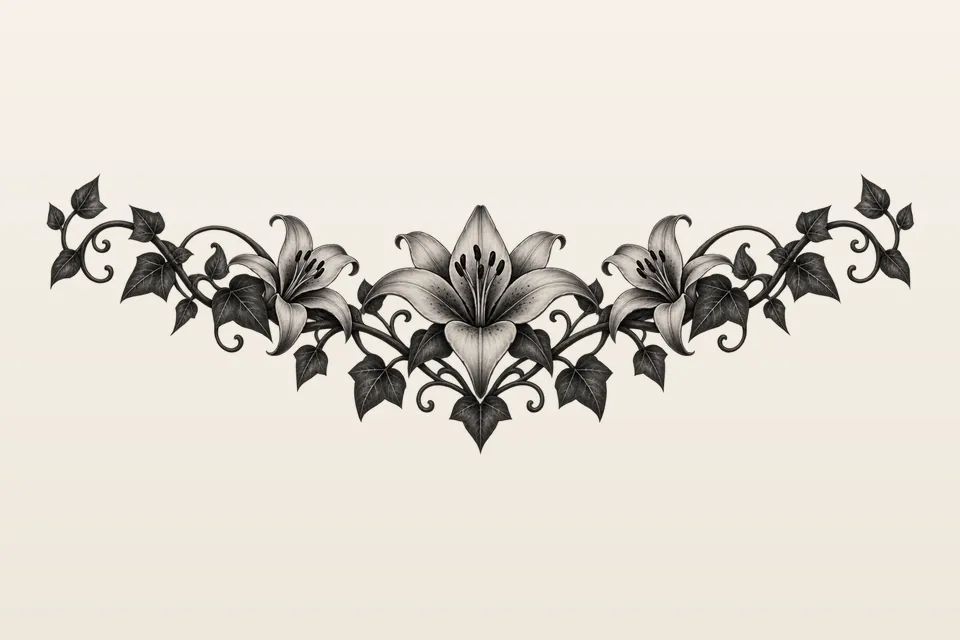
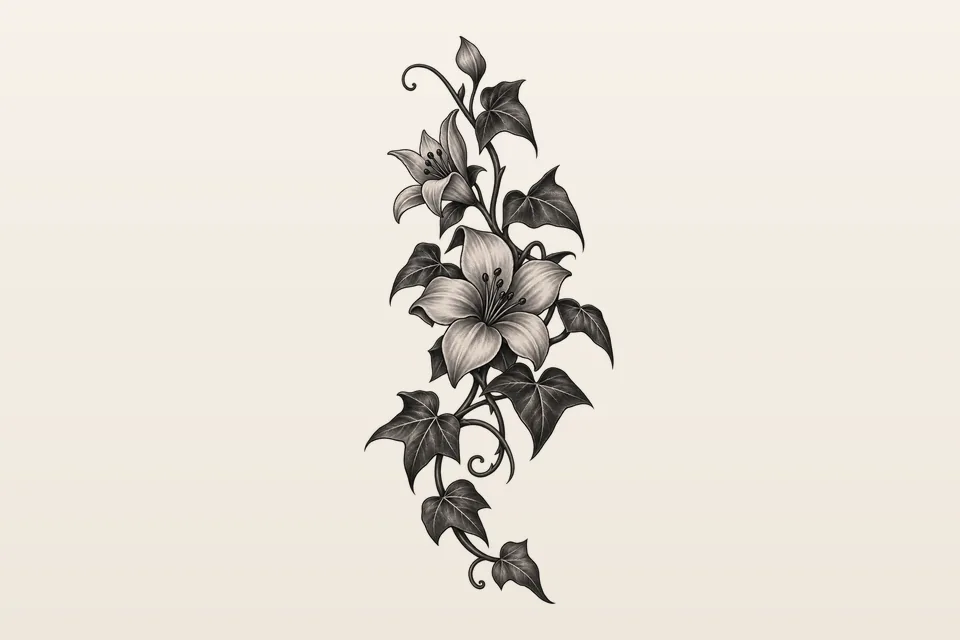
Common ivy climbs with aerial rootlets and has two kinds of leaves: five-lobed ones on the climbing stems and unlobed, heart-shaped ones on the flowering stems, according to the Hedera helix article. The lobed leaf is the one people recognize as "ivy", and a vine can be stretched, coiled or wrapped to fit almost anywhere.
Dandelion
The seed head, which children call a clock, is a sphere of tiny parachutes that come apart in the wind (the name itself comes from the French dent de lion, "lion's tooth", after its jagged leaves, says the article on Taraxacum officinale). In a tattoo, the seeds drifting away carry the movement. Give each one room: a few well-spaced seeds age far better than a cloud of them.
Wildflower sprays
Grasses, seed heads and small field flowers bundled loosely, varied in height, with no single bloom dominating, so it reads as a meadow rather than a bouquet.
The botanical plate look, labels and Latin names
The vintage-plate style borrows from old natural history books: one specimen drawn upright, perhaps with a seed or a cross-section beside it, fine hatching, and a neat label underneath. It suits the inner forearm, outer thigh and shoulder blade, where a rectangle of skin acts as the page.
The label is where people slip. Scientific plant names follow binomial nomenclature, formalized by Carl Linnaeus starting with Species Plantarum in 1753: the genus has a capital letter, the species name is all lowercase, and in print both are italic. Names also change as botanists learn more. Some correctly spelled examples:
| Plant | Scientific name | Note |
|---|---|---|
| Olive | Olea europaea | Two a's together at the end of the species name |
| Common ivy | Hedera helix | Also sold as English ivy |
| Dandelion | Taraxacum officinale | "officinale", not "officinalis" |
| Rosemary | Salvia rosmarinus | Moved to the genus Salvia in 2017; the older Rosmarinus officinalis is now a synonym |
Check any name against a current botanical source, then check the stencil letter by letter. A small serif or typewriter font suits the plate look, but tiny letters blur first, so ask your artist how small the label can go.
Shapes that follow the body
Plants grow; skin moves. A botanical tattoo looks best when its main stem runs the same way as the body part under it.
- Spine: a vine or a fern frond running down the vertebrae, narrow and symmetrical, tapering at the lower end.
- Forearm: a branch or a spray running from wrist to elbow, on the inner side for a plate-style piece, or curling around the outer side. Our forearm tattoo guide covers sizes and angles.
- Ribs and side: long, slightly curved sprays that follow the line of the ribcage, leaning toward the hip.
- Collarbone: an olive or eucalyptus branch lying along the bone, leaves hanging slightly.
- Wrist, ankle, upper arm: ivy or a fine vine wrapped all the way round as a band.
Fine line, blackwork or etching?
The same eucalyptus sprig can look like three different tattoos depending on the technique:
| Style | What it does to plants | Best for |
|---|---|---|
| Fine line | Thin outlines, light or no shading, airy and sketch-like | Small sprigs, herbs, dandelions; see the fine line tattoo guide on how thin lines age |
| Blackwork | Solid black leaves or silhouettes with skin left bare for veins | Bold ferns, monstera, ivy; covering older work |
| Etching | Hatching and cross-hatching like an old engraved plate | Vintage botanical plates with labels; see our etching tattoo guide |
Colour is a choice too: greens and ochres give a hand-coloured plate feel, black and grey keeps attention on the shapes, and black linework with one accent (red rosehips, purple lavender) sits between.
Describing a botanical tattoo so it comes out right
"Leaves" could mean a dozen things. Name the plant, the arrangement, the style, the size and the placement. Some descriptions that work for an artist or for an AI:
- "A single olive branch with eleven leaves and three olives, curving gently, fine line, no shading, about 14 cm along the left collarbone"
- "A vintage plate of a fern frond with a curled young frond beside it, illustrative etching, a small typewriter label reading Polypodium, inner forearm"
- "Ivy wrapping the right ankle as a band, five-lobed leaves, blackwork with veins left as bare skin"
In click2ink you write a description like these in a chat, and an AI artist draws an original design that lands on a 3D figure, sized in real centimetres to your height. Fine line, blackwork and illustrative etching are among its 16 styles. The Adjust panel wraps a vine around the limb, Simpler thins out busy leaves, and the editor's add-text tool sets a Latin label by hand at no credit. The 450+ ready-made library designs, including the sprig, olive branch and dandelion above, are free; how it works shows the flow. Then print the stencil at real size for your tattoo artist.
Botanical tattoos: questions people ask
What is the difference between a botanical tattoo and a flower tattoo?
A flower tattoo is built around the bloom. A botanical tattoo treats the whole plant as the subject: leaves, stems, roots, seeds and branches, often drawn with the accuracy of a scientific illustration. Many botanical pieces have no flower at all, like an olive branch or a fern frond, and those that do usually give the leaves and stems as much attention as the petals.
What does an olive branch tattoo mean?
Most often peace or reconciliation. The olive branch carried that meaning in ancient Greece and Rome and later in Christian art, where a dove holds it, after the story of Noah. People also choose it for Mediterranean roots, a fresh start, or simply its elegant shape.
Are botanical tattoos good for men?
Plant designs suit anyone. They read bolder when they're bigger, darker and more structured: a blackwork fern down the spine, an etched oak branch with acorns on the forearm, a thistle on the calf, or ivy wrapping a sleeve. Line weight and size change the feel far more than the subject does.
Should I add the Latin name to my tattoo?
It completes the vintage plate look and makes the piece unmistakably botanical. Check the name in a current botanical source first, since names get revised: rosemary, for example, is now Salvia rosmarinus. Then check the stencil letter by letter. Keep the text large enough to stay readable, and ask your artist how small lettering can safely go.
How small can a leaf sprig tattoo be?
Smaller than most subjects, as long as the leaves stay simple. A sprig of rounded eucalyptus leaves or a short lavender stem can work at a few centimetres, drawn as clean outlines without inner veins. Detailed leaves, labels and hatching need more room. If a design looks crowded when printed at its real size, it will look more crowded in skin later on.
Can a botanical tattoo become a full sleeve?
Yes. Plants are among the easiest subjects to grow into a sleeve, because vines and branches connect everything. Plan a main stem that spirals around the arm, add two or three feature plants, and fill gaps with leaves. Our sleeve tattoo guide covers how big pieces are planned.
Which plants stand for remembrance?
Rosemary has a long written link, from Ophelia's line in Hamlet to sprigs worn on Anzac Day, and the forget-me-not carries the idea in its name. Many people choose a plant tied to the person instead: a herb from their kitchen, a tree from their garden, wildflowers from a walk you shared.
How do I keep a dandelion tattoo from blurring?
Fewer, larger seeds. Draw the seed head with clear gaps between its parachutes and let a small number drift away, each with a visible stem and tuft. Avoid a dense ball of very fine lines, which tends to soften into a grey patch over the years. Bolder stems and enough overall size help, and your artist can judge the spacing for your skin.