AI tattoo prompts that read like a brief to a tattoo artist
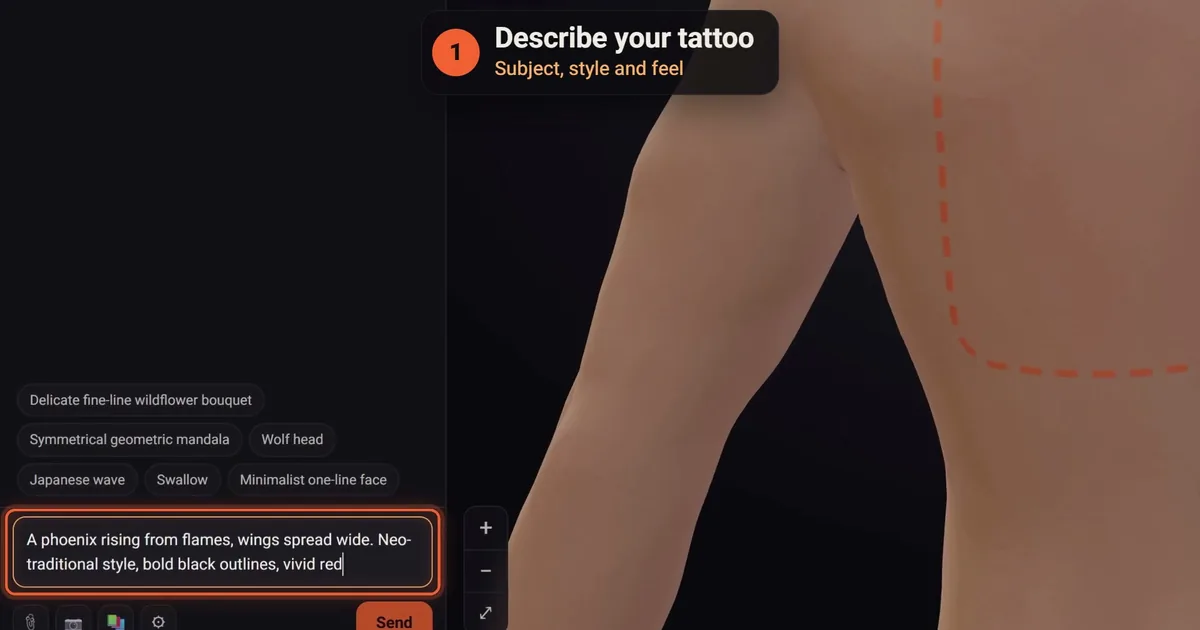
Most weak AI tattoo prompts fail for the same reason: they describe a picture, not a tattoo. "Epic dragon, 8K, cinematic lighting" gets you a movie poster. Name the placement, the style, the line weight and what to leave as bare skin, and you get something an artist can work from. Below: a formula, an example for each of 16 styles, and follow-ups that fix a design without starting over.
The five parts of a tattoo prompt
Writing for an image model is a small craft of its own, usually called prompt engineering: choosing words that steer the subject, style and layout. For a tattoo, five parts do almost all the work:
- Subject and action. Not "a heron" but "a heron lifting off from tall reeds."
- Style. One named style, such as "illustrative etching," carries a whole set of rules about lines and shading.
- Shape and size. "Tall and narrow, about 15 cm, for the outer forearm." The shape matters as much as the subject.
- Ink. Black only, black and grey, or a short color list, plus how it's shaded: crosshatching, smooth gradients, dots or solid black.
- What to leave out. "No background, no frame, no text." Tattoos live on skin, not on a scene.
Put together: "A heron lifting off from tall reeds, illustrative etching with fine crosshatching, black only, bare skin for the highlights, tall and narrow for the outer forearm, about 15 cm, no background." That's one sentence, and an artist could sketch from it. Our AI tattoo generator guide shows where a prompt fits in the whole process.
AI tattoo prompts for 16 styles
Copy one, then swap in your own subject; the five parts carry over to anything.
| Style | Example prompt |
|---|---|
| Fine line | A sprig of lavender with three small buds, single fine needle lines, no shading, about 8 cm, running along the inner wrist |
| Minimalist | A paper boat on two short wave lines, one even line weight, lots of bare skin, 4 cm, on the ankle |
| Black and grey realism | An old pocket watch, half open, chain curling downward, smooth soft shading, 14 cm tall, for the outer forearm |
| Color realism | A ripe pomegranate split open, glossy seeds, deep reds and purples, no background, 10 cm, on the calf |
| American traditional | A dagger through a rose, bold black outlines, solid red, green and yellow, heavy black shading, 12 cm, upper arm |
| Neo-traditional | A fox head framed by autumn leaves and a crescent moon, varied line weights, rich orange and teal, 13 cm, thigh |
| Japanese | A koi swimming up through waves with falling maple leaves, bold outlines, wind bars, full color, half sleeve |
| Blackwork | A raven with spread wings in solid black, feathers cut out in negative space, no grey, 18 cm, across the upper back |
| Dotwork and mandala | A mandala of three petal rings, shaded only with dots, perfectly symmetrical, 9 cm, centered on the back of the neck |
| Geometric | A stag head built from clean triangles and straight lines, black only, strict symmetry, 12 cm, center of the chest |
| Tribal | Flowing black shapes with sharp tapered points, following the curve of the shoulder cap, no shading |
| Polynesian and Māori | A kirituhi-style armband of koru spirals and repeating bands, black only, sized to wrap the upper arm |
| Illustrative etching | A lighthouse on rocks under a stormy sky, engraving-style crosshatching, black only, 15 cm, on the calf |
| Lettering and script | The words "still here" in flowing script with one small swash, black, 9 cm wide, along the collarbone |
| Ornamental | A symmetrical lace ornament of filigree and small beads around a central drop shape, black and grey, 16 cm, lower back |
| Biomechanical | Torn skin opening onto pistons and cables that follow the forearm muscles, black and grey, deep shadows, 20 cm |
Some of these styles belong to living cultures. Japanese tattooing, irezumi, has its own long history and its own rules for koi, dragons, peonies, waves and wind bars. Māori tā moko carries genealogy and identity; kirituhi is the term for Māori-style designs made for anyone, and Polynesian tatau has histories of its own. Use prompts like these for inspiration, and for the real thing, work with an artist from that tradition. Our guide to tattoo styles covers all 16 in more depth.
Words that work against you
Some words feel descriptive but pull the AI away from a tattoo:
- "Photorealistic," "8K," "cinematic lighting." These ask for a photo or a poster. Write "black and grey realism, smooth shading" instead.
- "Glowing," "neon," "white highlights." White paint fights skin. Ask for bare skin as the highlight.
- "A tattoo on a man's arm." You may get a photo of an arm. Describe the shape, "tall and narrow for the forearm," and keep the design flat.
- "Lots of tiny details" on a small piece. Detail has to suit the size; a 5 cm design holds a few bold elements.
- A list of eight symbols. The AI crowds them all in. Pick one main subject and two supporting ones.
- "In the style of" a named living artist. Describe the qualities you admire instead, and if you love that artist's work, book them.
Follow-up prompts: one change at a time
The first design is a draft. The follow-ups do the finishing, and the best ones name one change, say where, and protect the rest:
- "Make the petals deep red and keep everything else exactly as it is."
- "Remove the two small birds on the right."
- "Thicken the outer outline; keep the inner lines fine."
- "Make it taller and narrower so it suits the forearm."
- "Leave more bare skin inside the wings."
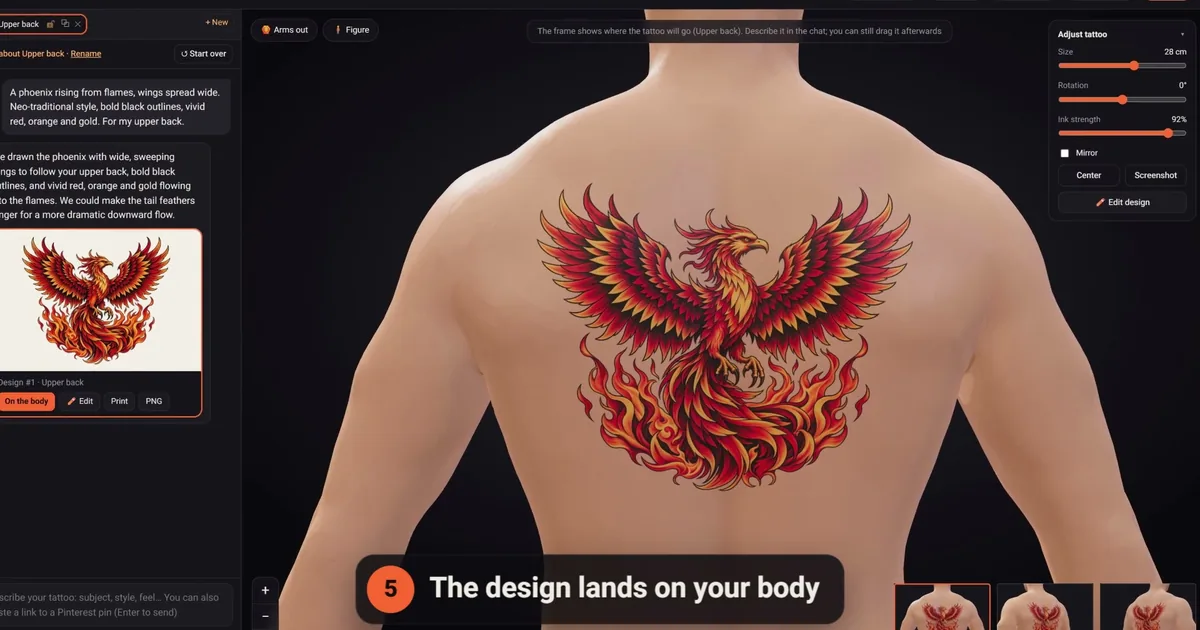
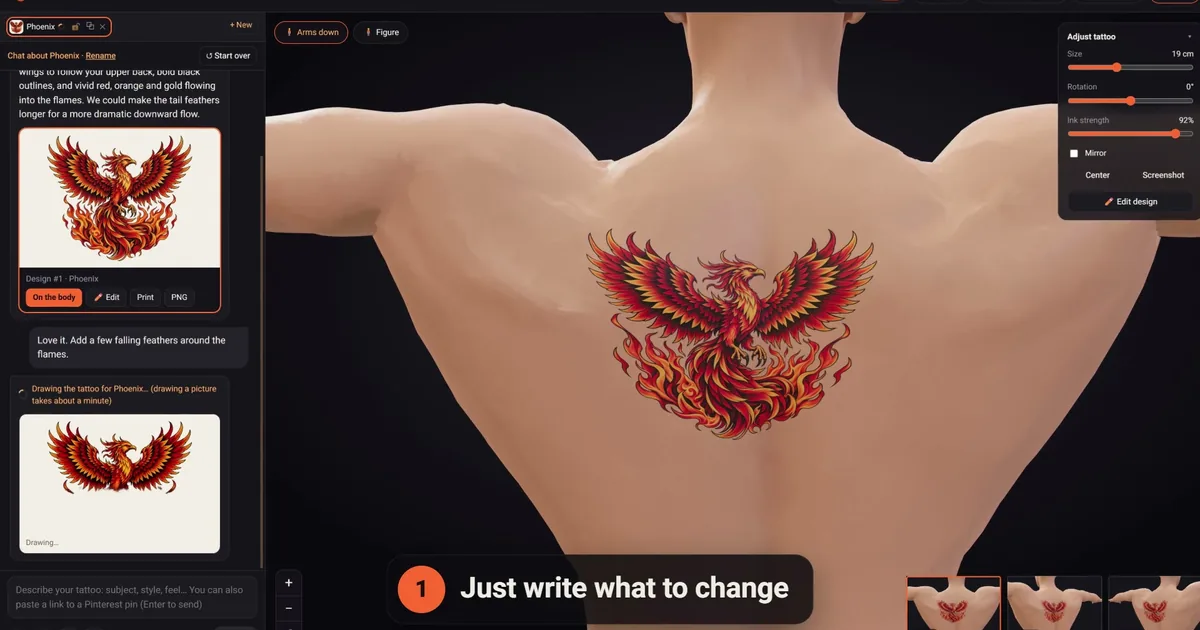
In the click2ink studio, the AI changes only what you named and remembers everything asked earlier in the chat, so you can refer back to any of it (how it works shows the loop in pictures). Under the newest design, one-tap buttons cover common requests: More detail, Simpler, Add colour, Black & grey and Another version, a credit each. Some changes don't need a prompt at all: flipping, cropping, black and grey, an outline and adding a name or a date are hand tools in the editor and cost no credit.
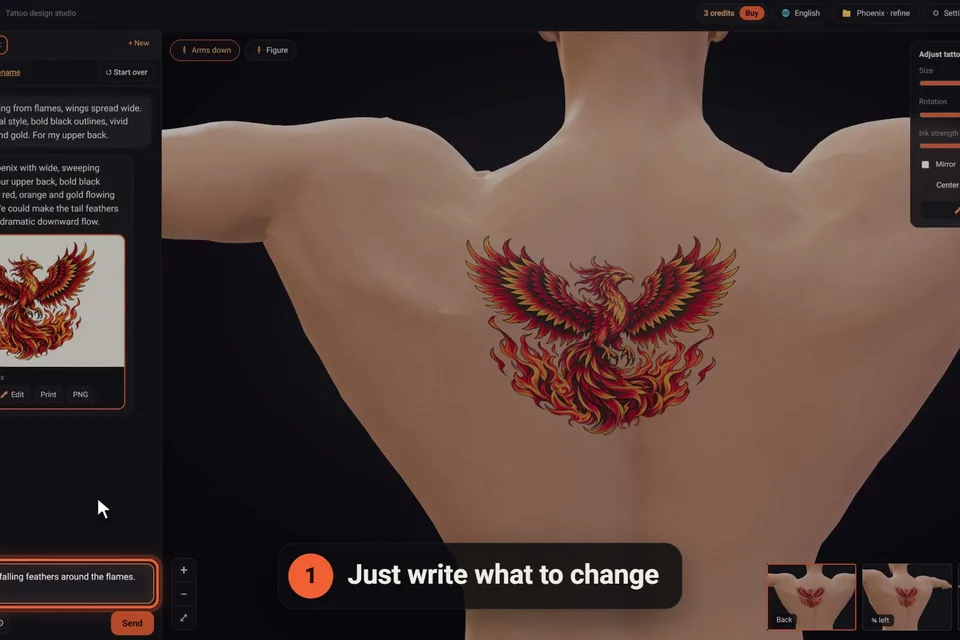
Prompts for sleeves and back pieces
Big pieces need a plan for how the parts connect, or you get stickers scattered on skin. Name two or three main subjects, the background that joins them (waves, clouds, wind bars, smoke or leaves), the direction everything flows, and where it starts and ends. For example: "A full sleeve: a tiger climbing from the wrist toward a peony at the shoulder, linked by wind bars and clouds, Japanese style, black and grey, one continuous design all around the arm."
In click2ink you choose a full, half, forearm or leg sleeve, right or left, in the first question, and the design wraps all the way around the limb. You can then set its length, slide it along the arm, turn it, or let it carry on onto the chest or back, fading out.
Prompting with a picture
A picture can say what a paragraph can't, as long as you tell the AI what to take from it: the idea, the style, or that exact design. "Take only the composition from this photo; make it fine line" is a complete prompt. Our guide to turning a photo into a tattoo covers which pictures work best, and designing your own tattoo puts the whole process together.
Writing AI tattoo prompts: what people ask
How long should AI tattoo prompts be?
One to three sentences is usually enough: subject and action, one style, shape and size, ink, and what to leave out. Longer prompts tend to get parts ignored, because the AI has to choose what matters most. If you have more to say, send the core idea first, then add details in follow-up messages once you see the first design.
Can I write my prompt in my own language?
In click2ink, yes: the AI answers in the language you write in, so you can describe your tattoo the way you'd say it, and the 🌐 menu translates the site itself. Other tools differ, so check theirs. Whatever the language, keep the five parts, and give any text that should appear in the tattoo exactly as it must be spelled.
Do negative prompts work for tattoo designs?
In a chat, plain words do the job: "no background, no white highlights, no text, no frame." Some image tools have a separate field for what to exclude; if yours does, put those words there instead. Either way, keep the list short. A few clear exclusions work better than a long list of everything you don't want.
Can I reuse prompts written for other image generators?
Keep the description and drop the rest. Settings written as codes, weights or camera terms mean nothing to a tattoo artist, human or AI. Strip the prompt back to subject, style and mood, then add what most general prompts lack: the placement, the size, the ink and what to leave as bare skin.
Why does the AI ignore part of my prompt?
Usually because the prompt asks for too much, or for things that clash, such as "minimalist" and "highly detailed" at once. Cut it down to one main subject with two supporting elements, and drop contradictions. Then add the missing part as a follow-up, naming where it goes: "add a small crescent moon above the left wing."
Should I name a tattoo artist's style in my prompt?
We'd advise against naming living artists. Their style is their living, and copying it skips the person who made it. Describe the qualities instead: "heavy black outlines, muted earthy colors, a vintage engraved feel." If one artist's work is exactly what you want, the best prompt is a booking with that artist.
What should I write if I don't know which style I want?
Describe the mood and the place instead: "soft and delicate, small, for the inner arm" or "bold and dark, for the calf." In click2ink you can also pick "Let the artist choose" as the style and see what comes back, then ask for a version in a different style and switch between the two on the figure.
How do I keep the same look across several tattoos?
Stay in one chat, since the AI remembers what was asked earlier, and name the shared qualities each time: line weight, palette and shading. You can also attach an earlier design and ask the AI to take its style for a new subject. That works well for a set of matching pieces, or for adding to an existing tattoo.
Does every prompt cost a credit?
In click2ink, each message you send to the AI artist uses one credit, whether it asks for a new design or a change, and new accounts get 3 free credits. Writing and rewriting your prompt before you press Send costs nothing, so take your time over the first message, where good AI tattoo prompts pay off most.