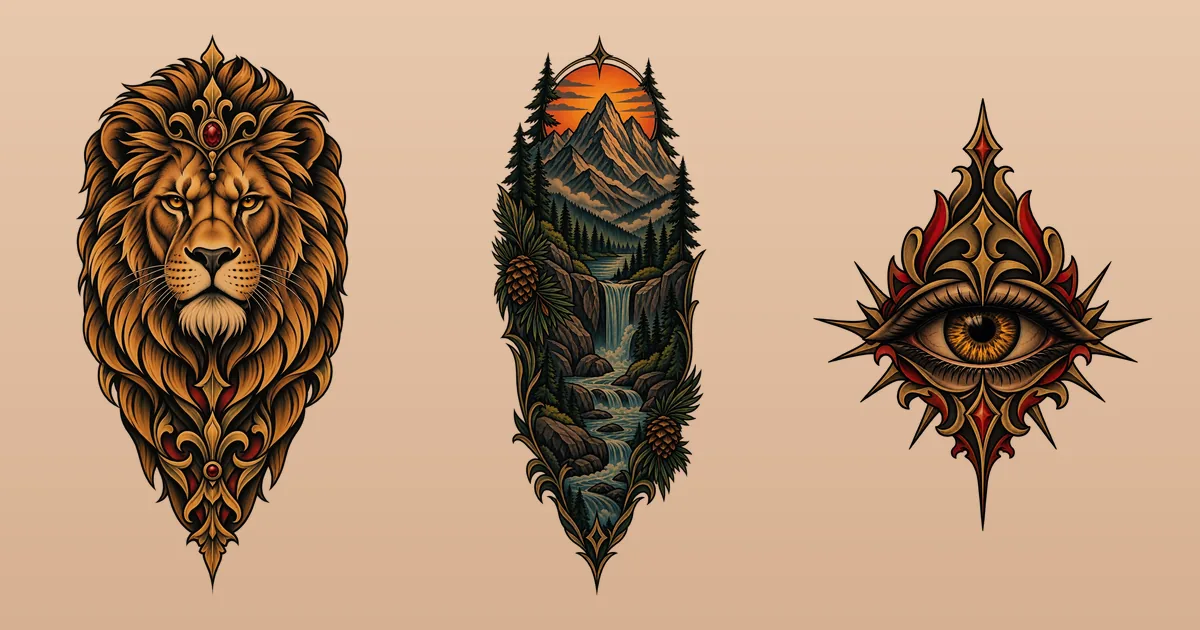
AI tattoo designs and tattoo artists: how to bring one to the shop
Yes, many tattoo artists will work from AI tattoo designs, and some won't. What usually decides it isn't the software but the request. Bring an AI image as a reference and ask how the artist would make it work in skin, and you're a client with a clear idea. Ask for an exact trace of a screen image, and you've asked for something skin may not hold.
What artists are saying about AI tattoo designs
Opinions in the industry run the full range, and it helps to know them before you walk in. In a September 2026 Euronews report, a Hungarian artist said most of her clients now arrive with AI-generated images. She uses AI for reference pictures herself, but doesn't try to match them exactly, so the tattoo looks right on skin. Another artist said she would work from a client's mock-up, then hand-draw something better. An Edinburgh artist called AI one more tool, like Photoshop, while a veteran artist's worry was how AI companies gather the artwork they train on.
Others draw everything from imagination, in pencil, and plan to keep it that way. None of these positions is wrong. Together they tell you the real question isn't whether tattoo artists accept AI, but whether this artist does.
Why your artist will probably redraw it
Even an artist who enjoys working from AI tattoo designs will rarely tattoo one pixel for pixel. The reasons are technical, not personal:
- Light that ink can't copy. Image models paint with soft, photographic light. In skin, depth comes from black, shades of grey and bare skin, so the shading has to be rebuilt, a point the Hungarian artist made too.
- Detail that won't stay. Lines soften and spread a little as a tattoo ages, so twenty fine feathers in a 5 cm wing can merge into one grey patch.
- No line hierarchy. A tattoo needs a strong outer contour and lighter lines inside it. Generated pictures often give every edge the same weight.
- Highlights painted in white. On a screen they glow. On skin, the brightest highlight is usually the skin itself, so the artist plans around it.
- Letters that aren't quite letters. Image models can garble text, so check every word and expect lettering to be redrawn by hand.
- A flat drawing for a round body. The design has to bend around a forearm or settle between the shoulder blades, and only the artist sees your body on the day.
So treat the redraw as the artist's share of the work, not as a verdict on your idea. It's also why a custom tattoo design developed with your artist tends to fit better than any picture you bring.
How to bring AI tattoo designs to the shop
- Ask when you book. One line in your first message, such as "I have an AI-made reference; do you work from those?", saves everyone time.
- Send it early. Artists who draw custom work plan their drawing time in advance, so a reference in their inbox before the consultation helps.
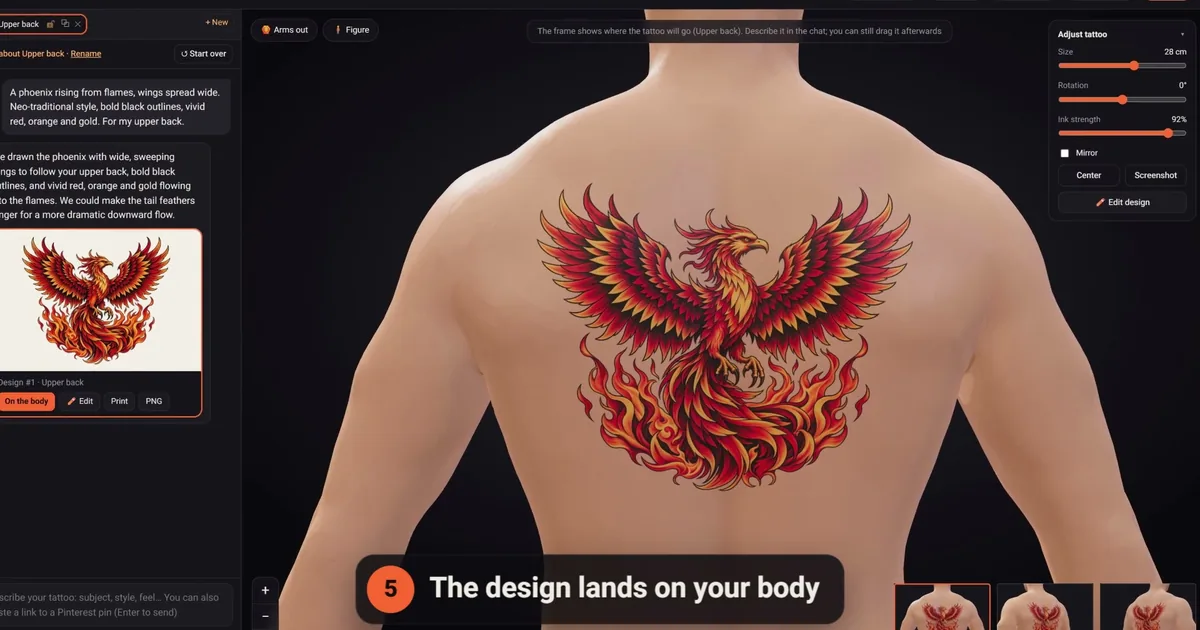
- Pack the essentials. A clean PNG of the design, a stencil printed at real size for the spot you want, and a link that shows the design in place on a 3D figure.
- Mark what matters. Tell the artist which parts are the point, such as the heron or your daughter's initial, and which are open to change.
- Ask about drawing costs. Some artists charge for design time or take a deposit, and redrawing is design time. Better to know up front.
- Judge their drawing on its own. Don't hold it against your screen looking for differences. Look at it on your skin, as a tattoo.
What to say, and what to skip
The way you talk about your reference shapes how the artist hears it. A few swaps go a long way:
| Instead of | Try |
|---|---|
| "Can you copy this exactly?" | "This is the layout and mood I want. How would you make it work in skin?" |
| "Don't change anything." | "The wolf and the moon matter to me. The trees are up to you." |
| "The AI made it in a minute, so it should be quick." | "How much drawing time would something like this need?" |
| "Make it as small as you can." | "What's the smallest size where this will still read in ten years?" |
| "I had the AI copy another artist's style." | "Here are pieces of yours I love. Can we go in that direction?" |
Who owns an AI-made design?
It depends on where you live. In the United States, the Copyright Office concluded in its January 2025 report on AI and copyrightability that AI output can be protected only where a human author has determined enough of its expressive elements. Writing prompts alone isn't enough; human changes and arrangements can be. In practice, a picture that came straight out of a generator may not be protected at all, while the drawing your artist makes from it is human work.
This isn't legal advice, and other countries have their own rules. The fairness question matters as much as the legal one: don't run one artist's portfolio through an AI and ask a different artist to tattoo the result. If you love someone's work, book them.
Make it easy for an artist to work from
A few habits turn AI tattoo designs into references artists are glad to get. Most come down to asking the AI for a tattoo rather than an illustration:
- Choose the spot and the size before the subject, so the detail matches the space. A 7 cm ankle piece and a 30 cm thigh piece are different drawings.
- Ask for less. Under the newest design in click2ink, the Simpler button strips back busy detail, and the Detailed speed setting is the one to use for a final design.
- Keep the highlights in the skin. click2ink draws without white ink unless you ask for it, which is closer to how your artist will shade.
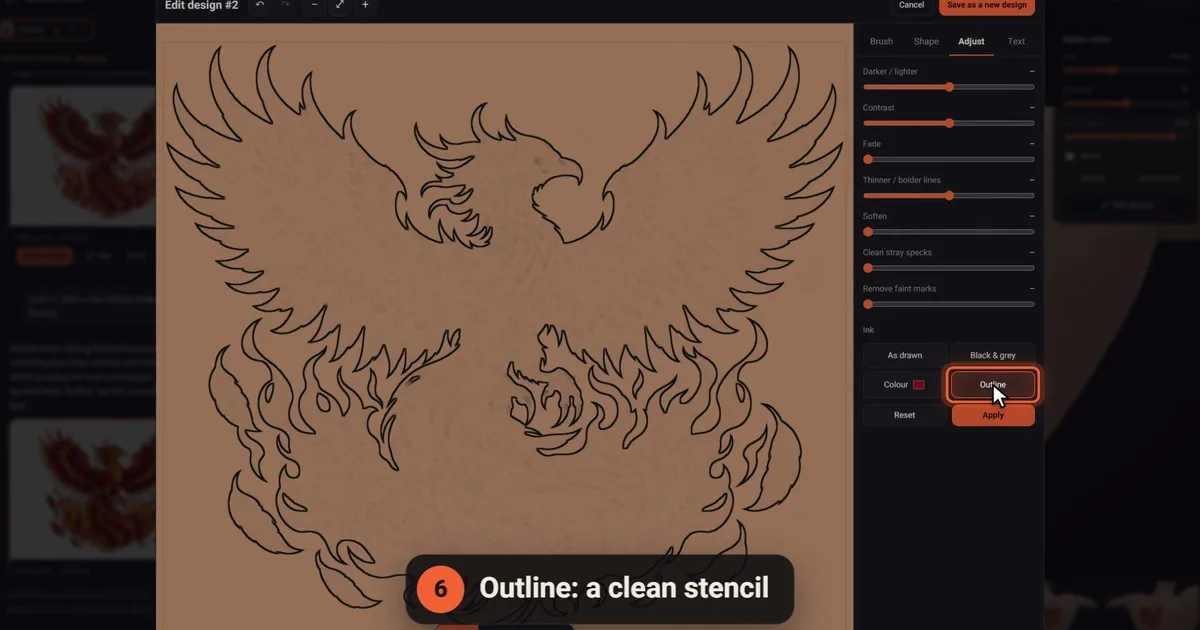
- Show the structure. The design editor's outline tool gives a stencil look, and black & grey shows the values without color; both are hand tools that cost no credit.
- Print it true to size. The print page sets the stencil at its real size on the body, with a 5 cm check ruler. Print with scaling turned off and measure the ruler.
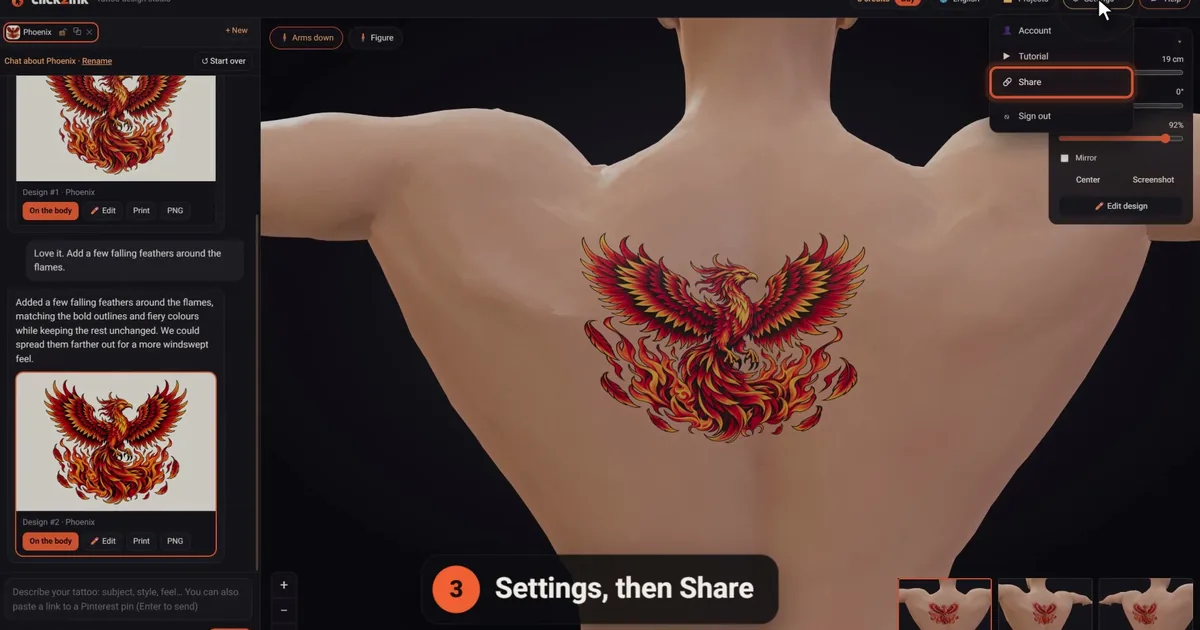
- Share the placement. A share link, made from the Settings menu, opens the 3D figure with its tattoos and none of your chats. You can update it or revoke it later.
The artist is always your choice: click2ink doesn't tattoo anyone, book appointments or list artists. For the drawing side, our guide to the AI tattoo generator explains how designs are made, and how it works shows each step in pictures.
Bringing an AI design to the shop: what people ask
Should I tell my artist the design came from AI?
Yes, say it up front. It sets the right expectation: this is a reference, not a finished stencil. It also lets an artist who prefers not to work from AI tell you so before anyone's time is spent. Being honest at the booking stage is the easiest way to start a good collaboration.
Can a tattoo artist turn down an AI design?
Yes. Artists choose what they put their name on, and some only tattoo their own drawings. A no usually isn't about you; it's about how they work. Look through their portfolio, ask whether they'd redraw your idea in their own style, and if not, find an artist whose work already looks like what you want.
Will I still pay for drawing time?
Possibly. A clear reference can shorten the back-and-forth, but the artist still has to redraw the design for your skin, size and placement, and that's real work. Shops handle it differently: some include drawing in the tattoo price, others charge for design time or take a deposit. Ask when you book so nothing surprises you.
Can an AI design go straight onto a stencil?
Simple, clean linework sometimes can, after a little cleanup. Most designs need the artist to rebuild the lines and shading first. A printout at true size is still worth bringing, because it settles how big the piece should be before the appointment. The artist then makes the final stencil and fits it to your body on the day.
Do tattoo artists use AI themselves?
Some do. Artists interviewed by Euronews in 2026 described using AI to make reference images, and to restore old, blurry photos that clients wanted tattooed, much as they'd use Photoshop. Others won't touch it and draw everything by hand. If it matters to you either way, ask; a good artist will happily explain how they work.
How do I find an artist who's open to AI references?
Start with style, not software. Find artists whose portfolios already look like your design, then mention the AI reference in your first message and ask how they like to work. Artists who specialize in custom pieces are used to working from client references. click2ink doesn't list or book artists, so the choice is entirely yours.
What if the artist changes my design more than I expected?
Ask why. There's usually a reason: a detail that would blur, a shape that fights the muscle, a line too fine for the size. If a change removes something that matters to you, say so and look for another solution together. You can also take time to think, or walk away before the needle starts. It's your skin.
Can my artist post the finished tattoo online?
Artists commonly photograph and share their work, and a tattoo they redrew and inked is part of their portfolio. If you'd rather it stayed private, say so before the session. Being open about the AI reference helps here too, because the artist can describe honestly how the piece came together without any awkward surprises later.
Is it disrespectful to bring an AI design at all?
Not when it's offered as a starting point. Artists have always worked from client references, from magazine clippings to phone photos. What feels disrespectful is treating the artist as a tracing machine, or using an AI to copy another artist's style. Bring the idea, explain why it matters, and let them do their part.