Feather tattoo design guide: from the shaft to the last barb
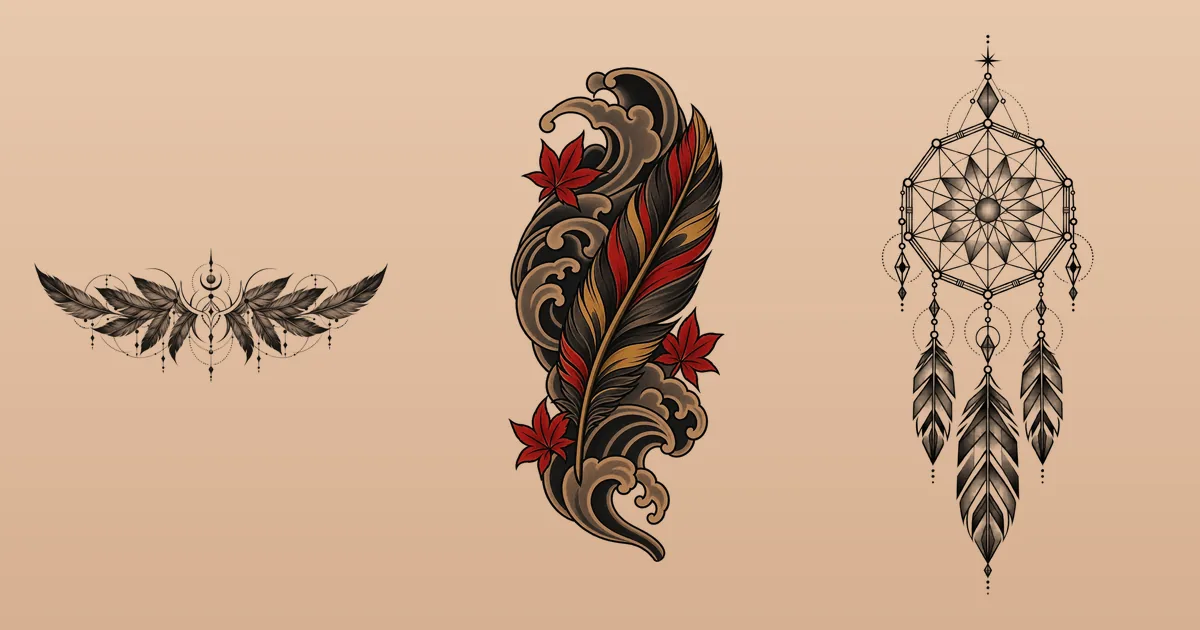
The most common feather tattoo mistake is drawing every barb. On paper, dozens of hair-thin strokes look delicate and real; in skin, a few years later, they can merge into one soft grey smudge. A good feather design picks a handful of strokes and a few deliberate splits, and lets them suggest the rest. Here is how to build one that still reads as a feather in a decade.
How a feather is built, and what that means for the drawing
As Wikipedia's article on feathers explains, a typical vaned feather has a main shaft called the rachis, which widens at the base into the hollow quill, or calamus. Branches called barbs grow from the shaft, and their own tiny branches, the barbules, hook onto each other so the barbs lock into the flat surface we call the vane.
Each of those parts does a different job in a tattoo:
- The shaft is the spine of the design: the boldest line, and its curve sets the mood. Straight looks formal; a gentle S-curve looks like it's drifting.
- The vanes are the silhouette, the outline people recognize from across a room.
- The split barbs are the texture. Where barbs come unhooked, the vane opens into a gap. Two or three splits look real; twenty look shredded.
- The fluffy base is optional. Soft barbs near the quill read well large and vanish when small.
One feather, a pair or a fan
Count comes before style, because it decides the shape the design takes on your body.
| Arrangement | Shape | Where it suits |
|---|---|---|
| A single feather | long and narrow, gently curved | inner forearm, ribs, behind the ear, along the spine |
| Two feathers crossed or side by side | a slim V or X | the collarbone, the back of the neck, a shoulder blade |
| Three or more in a fan | a wide half-circle or a spray | the shoulder cap, the hip, across the upper back |
| Feathers fanning from a center | symmetrical, both sides | the sternum, the back of the neck, below the collarbones |
The wide picture above shows the last idea: fine-line feathers fanning from a small crescent, which gives the symmetry a point to rest on. A full pair of wings is its own subject; our angel wings tattoo guide covers it.
A feather that breaks into birds
A favorite version starts as one feather whose barbs lift away near the tip into a small flock. Make the change gradual: solid vane at the base, loosening barbs in the middle, simple birds shrinking as they leave. Give it 12 to 15 cm so the transition has room. Our bird tattoo guide has more on drawing the birds themselves, in flight or perched.
Which bird's feather?
The bird changes the silhouette, the pattern and what people read into it. Meanings below are common readings, not rules.
Peacock
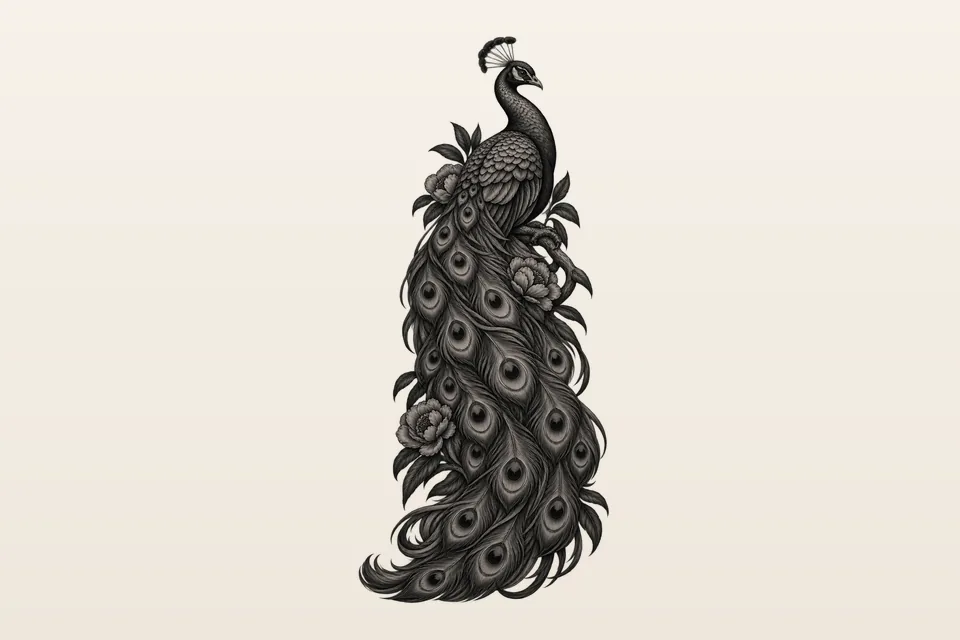
The eye is the whole point. Wikipedia's page on peafowl notes that a peacock's train is made of very long upper tail coverts, not true tail feathers, marked with eyespots. The eye needs about 10 cm or more to keep its rings separate, with teal, blue and bronze in clean bands, or a dark core and pale ring in black and grey.
Eagle and hawk
Broad flight feathers with a dark tip or barred bands, strong in blackwork or American traditional. Read the section on Native traditions below before you design one.
Owl
Soft, rounded edges and fine barring, lovely in fine line. Often tied to wisdom or night.
Dove
A small white feather: on skin, an outline with little inside, since designs carry no white ink unless you ask. Often chosen for peace or remembrance.
The quill pen
A feather cut to a nib, trailing an ink line that turns into a short word. A natural pick for writers.
Arrows, dreamcatchers and the traditions behind them
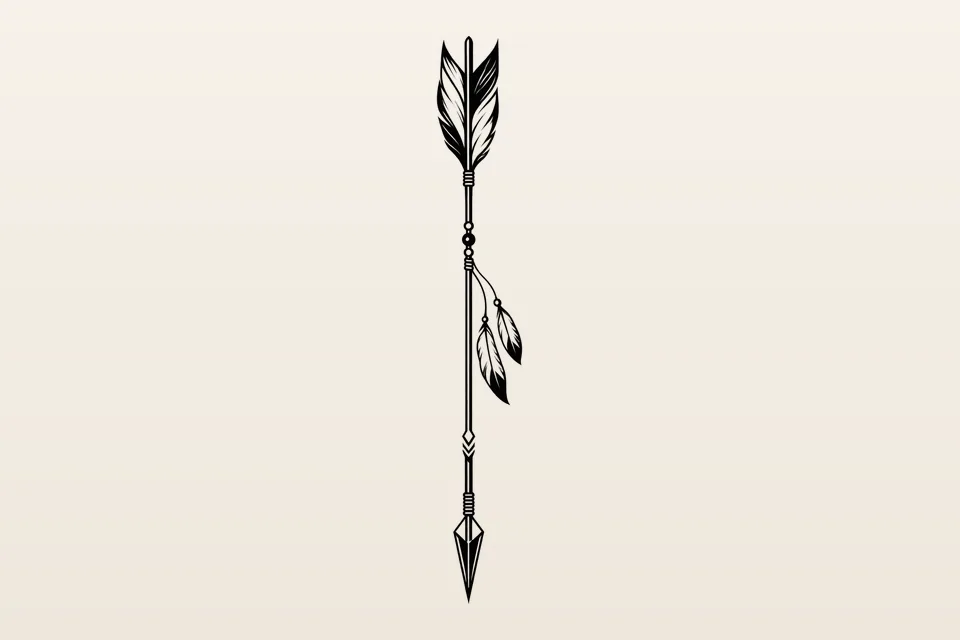
Arrows already carry feathers as fletching, and their straight line keeps loose feathers from looking scattered.
Dreamcatchers are a different matter. Wikipedia's article on dreamcatchers traces them to an Ojibwe legend of Asibikaashi, the Spider Woman who cared for children, and describes how they were later adopted by other Native nations as a symbol of unity before becoming a mass-marketed craft. Eagle feathers carry weight too: the U.S. Fish and Wildlife Service explains that its National Eagle Repository exists because Native Americans have long used eagle feathers for religious and cultural purposes, and it supplies them to enrolled members of federally recognized tribes.
Views differ between nations and people, but both ask for care: learn where the imagery comes from, consider a clearly personal or geometric version (like the dreamcatcher in our wide picture), and if you can, talk to a Native artist. Avoid a costume-like collage of "tribal" symbols.
Line weight and size: making the barbs survive
A feather is mostly texture, and texture is the first thing time softens. Plan the detail around the size, not the other way round:
| Length of the feather | What holds up | Good styles |
|---|---|---|
| 3–6 cm | a shaft, an outline and one or two splits; no inner barbs | fine line, minimal outline, solid blackwork silhouette |
| 7–12 cm | a few grouped barb strokes per side, light shading toward the shaft | fine line with shading, dotwork, neo-traditional |
| 13 cm and up | individual barbs, a fluffy base, eyespots or bands | black-and-grey realism, colour, Japanese, etching |
Keep the shaft the heaviest line, group barbs into a few strokes, and leave clear skin in the splits. Thin lines have the least ink to spare, as our fine line tattoo guide explains. For a tiny wrist or ankle feather, see our small tattoos guide.
Where a feather tattoo sits best
A feather is long and narrow, so it loves long, narrow parts of the body. A slight tilt usually looks more natural than dead straight.
- Forearm: the classic spot, running toward the wrist; see our forearm tattoo guide.
- Ribs and side: a tall feather, or one turning into birds.
- Behind the ear: a single feather, 3 to 5 cm.
- Collarbone: one feather along the bone, or two meeting near the center.
- Spine: a long feather, centered with care, since the spine shows any tilt.
- Calf and thigh: room for a big peacock feather in colour.
Bony, thin-skinned spots such as the ribs, spine and collarbone are generally described as more intense than fleshier areas, and everyone feels it differently. Ask your artist what to expect and follow their aftercare.
Describing your feather tattoo to an AI or an artist
Name the bird, the count, the curve, the style, the size and the spot, then the extra that makes it yours:
- "One owl feather with a gentle S-curve, fine line, a few grouped barbs, two small splits on the right side, about 10 cm, inner forearm."
- "A single feather whose tip breaks into five small birds flying up, black and grey, 16 cm, along the left ribs."
- "A peacock feather in colour, teal and bronze eye, clean outline, 12 cm, outer calf."
- "A quill pen with a thin ink line ending in the word write in small script, behind the right ear."
In click2ink you tap the spot on a small figure, pick one of 16 styles, and add your description and up to three pictures. The AI artist draws an original design on a 3D figure sized in real centimetres to your height, so you see whether that 10 cm feather really fits behind your ear. Ask for one change at a time ("fewer barbs") or tap Simpler, then print a true-size stencil for your artist. The how it works page shows each step, and new accounts start with 3 free credits.
Feather tattoo questions
What does a feather tattoo mean?
Common readings include freedom, lightness, travel, hope, and a connection to someone who has passed. Specific birds add their own associations, such as strength for an eagle or peace for a dove. None of these is fixed, and in some cultures feathers carry sacred meanings that deserve respect. The meaning that matters is the one you choose and can explain.
What does a feather tattoo mean on a woman?
The same as on anyone: it depends on the wearer. Many women choose a fine-line feather for lightness or freedom, or a peacock feather for its beauty and confidence, but those are popular readings rather than rules. The bird, the placement and anything you add, such as a name, a date or a small bird, say more than the feather alone.
What feather tattoo ideas suit men?
Bolder versions are often asked for: a broad hawk feather in blackwork, a feather with an arrow, a Japanese feather in waves, or a long black-and-grey feather down the forearm or calf. Size and line weight matter more than the subject; a bigger feather with heavier lines looks strong on any arm.
Which way should a feather point on the forearm?
Most people point the tip toward the wrist so the feather reads upright when the arm hangs, or toward the elbow so it reads for you when you look down. Neither is wrong. A slight angle away from the arm's center line usually looks more natural than a perfectly straight one. Try both directions on a figure before you decide.
How small can a feather tattoo be?
Around 3 cm works if the design is very simple: a shaft, an outline and one or two splits. Below that, even the outline crowds. If you want visible barbs, plan for 7 cm or more, and for peacock eyes or realistic texture, 10 cm and up. Your artist will tell you the smallest size that suits your design.
Can I get a feather tattoo stencil to print?
Yes. Your artist will make the final stencil, but bringing one helps the conversation. In click2ink, the Print option gives a stencil at the real size the design has on the body, with a 5 cm check ruler so you can confirm it printed at 100%, and the editor's outline tool gives a clean line version.
Is it respectful to get an eagle feather or dreamcatcher tattoo?
Many people outside Native cultures wear them, and views differ. Both come from living traditions: dreamcatchers from the Ojibwe and other Native nations, and eagle feathers hold religious importance for many Native peoples. Learn the background, avoid treating them as costume, consider a version that is clearly your own, and ask a Native artist if you can.
Do feather tattoos work in colour?
Yes, especially peacock, macaw or jay feathers, where colour is the point. Keep colours in clear bands held by a dark outline rather than soft blends across fine barbs. Black-and-grey suits most feathers just as well; in click2ink, the "Add colour" and "Black & grey" buttons let you compare both versions of the same design.